/pic8143724.jpg)
















Reef Project Deep Dive
What the Community Thinks About Reef Project
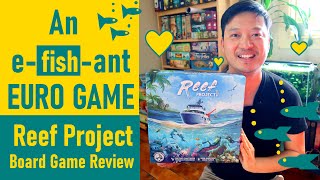
Reef Project has emerged as a surprising favorite among board game reviewers, earning top placements on end-of-year lists despite flying under the radar against bigger releases. The Board Game Garden named it a game of the month, The Broken Meeple was drawn in by its presentation, and The Dice Tower championed its engine-building even after finding others slow to warm to it. Its blend of environmental storytelling and mechanical depth has won over players who appreciate games that marry theme and gameplay cleanly.
Core Mechanics That Define Reef Project
Route Building and Resource Management
At its heart, Reef Project centers on strategic route building with a collaborative twist. Players deploy buoys across a shared map to establish movement paths between islands and reef zones. The brilliance of this system lies in its economy: building a buoy on a path makes future travel along that route cheaper, creating a puzzle where players weigh immediate costs against long-term efficiency. This shared infrastructure means that while players build in their own interests, their investments ripple outward, creating a web of indirect interaction that reviewers found genuinely engaging.
Area Majority and the Restoration Mechanic
The second pillar of gameplay revolves around area majority in polluted ocean regions. As players complete routes to surrounding reef areas, they compete for majority influence over degraded zones. Whoever controls a polluted area when it is restored claims the restoration reward and its points, creating natural tension as players race to claim the most valuable sites before rivals dominate them. The Board Game Garden noted discovering a real fondness for area majority through Reef Project, a sign of how naturally the system draws players in.
The Reef Project Experience
The Dual-Phase Structure
Reef Project unfolds in two distinct phases that create a satisfying rhythm. In the travel phase, players position themselves on the map and activate their growing engine of abilities. The refresh phase that follows functions less as a simple income step and more as an advancement opportunity, where players progress on personal tracks and convert their activity into points. This structure prevents the pass-and-accumulate fatigue common to many Euro games, keeping players engaged as their decisions cash out into concrete rewards.
Engines Within Engines
The game rewards systematic play through a tableau-building layer. Each player develops a personal board of assistant cards that trigger abilities when activated. Reviewers noted the satisfaction of watching these mini-engines develop over the game, with newly added cards creating unexpected synergies and opening fresh strategic paths. Multiple scoring tracks layered atop the route-and-majority core mean several viable paths to victory exist: the ocean restoration track, the research progression, and the assistant board all contribute meaningfully to final scores.
What Makes Reef Project Stand Out
Visual and Thematic Excellence
The most consistent praise across reviewers centered on Reef Project's presentation and environmental theme. The Broken Meeple described the cover and theme as genuinely enticing, with artwork that pulls players in immediately. More importantly, the coral reef restoration theme informs the mechanical experience rather than sitting decoratively atop it. The vibrant visual design creates an underwater atmosphere that matches the subject matter while keeping the board readable. The theme transforms abstract Euro mechanics into a narrative about conservation and healing, lending weight to every decision.
The Sweet Spot Between Accessibility and Depth
Reef Project occupies a comfortable middle ground between gateway game and strategic challenge. Reviewers estimated a manageable teach time, with relatively straightforward core rules that nonetheless support rich emergent complexity. The game does not require deep Euro experience to enjoy, yet experienced players find ample room for clever play. The Dice Tower highlighted how the mechanisms work seamlessly together rather than feeling bolted on, which is rare enough to merit real praise.
Potential Drawbacks
The Teaching Curve and Table Presence
While reviewers appreciated the balance between weight and accessibility, the moderate complexity does create a slight barrier to casual play. Multiple scoring tracks and the interaction between route-building and majority-control require attentive teaching. The runtime, while reasonable, runs long enough that some casual players may find themselves fatiguing partway through a session.
Area Majority as a Dividing Mechanic
Not all players embrace area majority, and Reef Project leans on it as a core scoring system. The Dice Tower noted showing the game to many people who did not immediately love it, which suggests its appeal is not universal. Players who actively dislike contested area control may find themselves fighting the design rather than enjoying it, particularly in the mid-game when the map grows crowded and majority swings become consequential.
If You Enjoy Reef Project
Players who gravitate toward Reef Project often appreciate games that pair constructive themes with mechanical sophistication. Those who loved Windmill Valley for its pastoral aesthetics and solid midweight gameplay will find Reef Project a natural next step, offering more interlocking systems while keeping elegant design. Players who relish the engine-building of Wingspan or the shared-infrastructure tension of Great Western Trail will recognize kindred mechanics. For those drawn to nature-themed games that reward thematic integration rather than flavor text alone, Reef Project delivers.
What Reviewers Are Saying
"The aesthetics and your cover and your theme are enough to draw me in for the first play, because I'm wondering if this is going to be more along the same weight and style line as Windmill Valley. The mechanisms look fairly straightforward, so I am more than just curious about this one."
— The Broken Meeple
"You are putting out these different buoys on this huge map in order to make your way of getting to these different islands cheaper. There's a bunch of different tracks, there's a research track that you're going up. It is just such a great Euro game with so much going on."
— The Board Game Garden
"I really enjoyed it, and I feel like I showed it to a lot of people and nobody really loved it, which makes me sad. But I like the engine building, I like what's going on. It's really cool the way that as you build your engine, you create this movement engine as well as a little engine on your boat board."
— The Dice Tower