/pic1405986.jpg)

/pic1691099.jpg)
/pic332870.jpg)
/pic1405986.jpg)
/pic8054188.png)










Relic Deep Dive
What the Community Thinks About Relic
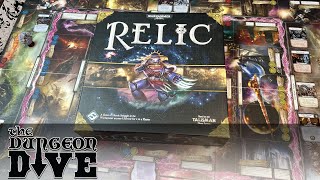
Relic holds a distinctive place in board gaming as a faithful modernization of a classic. Fantasy Flight Games took the beloved Talisman formula and transplanted it into the grim darkness of the Warhammer 40,000 universe, but did far more than swap fantasy art for science fiction. The Dungeon Dive argues it meaningfully expands on its predecessor, while 3 Minute Board Games frame it as accessible, luck-driven fun. The game strikes a balance between approachability and depth, equally comfortable as a casual evening centerpiece or a slightly meatier adventure than base Talisman offers.
Core Mechanics That Define Relic
Roll-and-Move Adventure Around the Antian Sector
At its heart, Relic is a roll-and-move game where players take on powerful characters such as Space Marine Captains, Inquisitors, Commissars, and Rogue Traders, traveling a three-ring board representing the Antian Sector. As characters land on spaces, they resolve encounters drawn from color-coded decks tied to different character attributes. The system uses exploding dice, where rolling a six grants an additional roll, creating moments of escalation. Combat is straightforward: heroes and enemies each roll with applicable bonuses, and the higher total wins. This simplicity keeps the action moving while remaining immediately accessible.
Power Cards and Meaningful Choices
What truly distinguishes Relic from Talisman is the power card system. These cards carry values from one through six that can be spent in place of dice rolls, with each card offering a unique ability beyond its number. A power card might guarantee a critical result, provide healing, or grant a temporary boost during a movement phase. This mechanic introduces real agency: instead of being purely at the mercy of dice, players make strategic decisions about which power to activate and when. The system transforms random moments into opportunities for clever play, giving matches a texture of choice that base Talisman lacks.
The Relic Experience
A Cozy Game for Low-Pressure Fun
One reviewer describes keeping Relic as a cozy game, the kind pulled out when friends are tired from work or gathered for conversation rather than heavy strategy. Its inherent unpredictability is liberating: some sessions feature terrible dice and unlucky draws, others see a character storm to victory on great rolls. Players can settle in for a tale of cosmic adventure without fearing that one early mistake decides everything. The colorful, densely illustrated board invites examination and discussion, turning downtime into appreciation of the game's artwork.
Mission-Driven Progression Toward Cosmic Confrontation
Players begin by drawing a mission that sets a specific objective, such as defeating an Ork or eliminating a Tyranid threat. Completing missions grants access to a relic, the key to advancing toward the center of the board and the scenario's final boss. Unlike Talisman, where reaching the center is the only goal, Relic's relics are not ceremonial tokens but powerful items with mechanical effects, one permanently boosting a character's life, another resetting health and purging corruption. This makes the journey feel like genuine character growth rather than mere positional advancement.
What Makes Relic Stand Out
Corruption and Mutation as Thematic Peril
The corruption system gives Relic a flavor entirely its own. As heroes explore the warp-tainted Antian Sector, they accumulate corruption cards that trigger based on a threshold. Corruption manifests as mutations both beneficial and detrimental: a character might gain extra arms, fall to darkness, or develop grotesque traits. Some are strictly penalties, others offer trade-offs. The threat reaches a crescendo when full corruption eliminates the character from play. This mechanic grounds the Warhammer 40,000 setting thematically, making the environment itself an adversary that warps heroes as they adventure.
A Board That Begs to Be Examined
Reviewers cannot overstate the quality of Relic's board. It is expansive, colorful, and densely packed with evocative artwork from across the Warhammer 40,000 universe. The three-ring structure, with a dangerous outer ring, a contested middle realm, and a climactic center, creates natural pacing and escalation. The character figures arrive as oversized busts larger than standard miniatures, rewarding those who enjoy painting. The presentation elevates the play experience simply through how good it looks on the table.
Potential Drawbacks
Randomness That Can Overwhelm Planning
Relic embraces its identity as a random event generator. There is no optimal build path that guarantees victory, and a character can draw the worst cards, roll poorly round after round, and find themselves outmatched by lucky opponents. For some, this is the appeal; for others, it is frustrating. The game does not reward cunning in the traditional sense, so a sharp tactical mind holds little advantage over a lucky one. Players who crave measurable progression or competitive achievement may find the experience hollow.
Player Elimination and Lengthy Games
Full corruption, or an unrecoverable deficit, can eliminate a player before the game ends, and being knocked out midway is inherently frustrating, especially in longer sessions that stretch well beyond an hour. With multiple players and missions to complete before reaching the center, playtime can balloon. Groups need to commit to the experience, since this is not a quick filler despite its simple rules.
If You Enjoy Relic
If Relic clicks with you, seek out Talisman, the original that inspired it, which offers the same roll-and-move adventure in a fantasy setting without the corruption and power-card layers. Arkham Horror shares Relic's cosmic-horror sensibility while focusing on investigation rather than a journey. Fans of straightforward, luck-driven adventure games with gorgeous boards and an emphasis on experience over optimization should also explore other Fantasy Flight thematic titles from that era. The unifying thread is games that prioritize atmosphere and narrative moments over mechanical rigor.
What Reviewers Are Saying
"Relic and Talisman, they're not deep games. They are literally random event generators. You can have some games where you just have the worst rolls, the worst card flips, and everything goes terribly for you, and other games where things go perfectly and you romp home and win. None of that has anything to do with skill, but it is a good bit of mindless fun."
— 3 Minute Board Games
"What this game does better than the Talisman base game is give the players more choices to make in how they are interacting with the game, and in that way this is kind of advanced Talisman. However, it doesn't add a ton of rules that get in the way of that simplistic adventure and fun of Talisman, and that is why I really do enjoy Relic."
— The Dungeon Dive
"If you're familiar with a game called Talisman, this is just Talisman but set in the Warhammer 40,000 setting. The board is just so damn big."
— 3 Minute Board Games