/pic4422847.jpg)








































Res Arcana Deep Dive
What the Community Thinks About Res Arcana
Res Arcana has solidified itself as a modern classic in engine-building circles, earning consistent praise for what reviewers describe as elegant minimalism paired with surprising strategic depth. The game appears on numerous top-100 lists and is frequently recommended alongside other celebrated card games like Race for the Galaxy and Magic: The Gathering. While most players celebrate its core design, discussion in the community reveals nuance around platform preference and longevity, with some noting that physical plays deliver more satisfaction than digital implementations.
Core Mechanics That Define Res Arcana
Engine Building with Extreme Constraint
At its heart, Res Arcana is an engine-building game like few others: your entire deck contains exactly eight cards. This architectural choice forces every card selection to matter profoundly. Players draft these eight cards before the game begins (using a formal hand-passing draft for experienced groups), then spend the entire race to 10 victory points figuring out how to combine and chain their abilities. Unlike sprawling deck builders where redundancy offers safety, Res Arcana demands precision. Each card can be played for its tableau ability, or discarded as a resource generator. This dual-purpose design creates a constant tension: do I activate this card’s power, or trash it to fuel something more powerful? The magic emerges from discovering synergies within severe constraints, making each eight-card deck feel like its own puzzle with multiple solution paths.
Resource Management Through Essence Conversion
Five types of essences (represented by beautifully distinct physical resources) flow through every turn. Players gain essences through collection abilities on their cards, convert them via powers, spend them to acquire places of power and monuments, and bank them as fuel. The economy tightens strategically: gold essence is particularly valuable for purchasing monuments, while specific essence types unlock specific card powers. This creates a satisfying loop where players spend early turns building income streams, then channel those resources into victory-point generators. The resource tray keeps everything organized and tactile, inviting players to physically manipulate tokens as they plan conversions. Gold becomes especially precious as a bottleneck, forcing tough choices between building economy and converting to points. Each mage card offers a unique resource ability, and each magic item that cycles through the table provides tactical options to address whatever gaps remain in a player’s engine.
The Res Arcana Experience
Satisfying Engine Mastery
Nothing in Res Arcana feels more rewarding than the moment your engine clicks into place. Two or three turns of setup yield a tableau where resources flow predictably: each turn generates the essences you need to activate powerful abilities, which in turn generate more essences, which feed conversion chains that produce victory points. Reviewers consistently highlight this sensation as the core satisfaction, watching a hand-crafted system produce exactly what you need, when you need it. The tempo builds from tight, conservative play into explosive turns where a single action chains through multiple abilities. A player who mills their deck efficiently, aligns their essences, and discovers the right sequence can suddenly burst from behind. This escalation feels earned, not random, making even losing plays feel intellectually satisfying because the logic of failure is always traceable to strategic choices, not chance.
Quick Playtime with Surprising Depth
Res Arcana concludes in roughly 45 minutes across most player counts, yet this brevity masks genuine complexity. The game avoids the common trap of either shallow speed (where decisions don’t matter) or analytical paralysis (where optimal play becomes exhausting). Instead, it sits in a sweet spot where meaningful strategy exists but players can move decisively. Two-player games run particularly snappy, with minimal downtime between turns. The speed paradoxically makes mastery more rewarding: players can run many games in sequence, testing different card combinations and mage choices, watching how small deck variations cascade into wildly different game shapes. This makes Res Arcana exceptionally replayable. The double-sided places of power add variance so that no two games present the same set of point-conversion targets, and each mage character offers a distinct strategic flavor. After dozens of plays, players report still discovering synergies and fresh approaches.
What Makes Res Arcana Stand Out
Minimalism as Strategic Richness
In an industry often equating more with better, Res Arcana proves the opposite through relentless design discipline. The game contains no player boards, no complex tracking, no dozens of power combinations. Instead, 60-odd cards get shuffled into an eight-card starting deck, and those eight cards become a player’s entire strategic landscape. This constraint forces clarity: every card must be valuable, every ability must interact meaningfully with others. The iconography is streamlined; the rules teach in 15 minutes. Yet reviewers consistently report that the more they play, the more strategic flexibility they uncover. A card combination that seemed weak in game one becomes powerful in game three when paired with a different mage. The same place of power feels completely different depending on which essences flow most plentifully from a player’s tableau. The game does more with fewer components than almost any engine builder in print, creating a sense of elegance and intelligence in the design itself.
Thematic Integration of Fantasy Elements
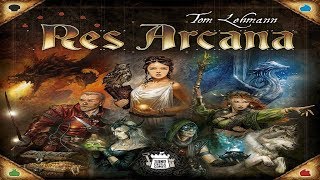
Res Arcana wraps its mechanical elegance in a fantasy-magic theme that feels unusually cohesive for a European-style game. Dragons and artifacts don’t sit decoratively; they integrate mechanically. A dragon card costs resources to deploy but provides both offensive abilities against opponents and synergies with dragon-specific places of power. The alchemist mage manipulates resource conversion while the dragon mage scales through creature deployment. Each character feels genuinely different to play, not just mechanically but thematically. The artwork conveys a darker, less generic magical world than many fantasy games, with character designs that reward closer examination. Reviewers specifically praise how thematically resonant card abilities are, the dragon egg destroying itself to discount future dragons, the artifact forge that transmutes resources. The theme never feels tacked-on; instead it grounds the abstract engine building in a believable fantasy world of mages competing for arcane supremacy.
Potential Drawbacks
Luck Sensitivity in Initial Deck Generation
Without a formal draft, Res Arcana suffers from significant luck variance. Drawing eight random cards from a pool of 60 means some starting hands cohere beautifully while others contain conflicting elements. A card that synergizes with dragons becomes a dead draw if no dragon-producing cards appear. The rulebook acknowledges this, recommending formal drafting for serious play, but casual groups beginning with random draws may experience frustrating games where one player receives an obviously superior set while another struggles to make their cards work together. The official solution works perfectly, the hand-passing draft eliminates luck while maintaining simplicity, but groups that skip this step sometimes feel the randomness stings. Each player then ends up with eight cards, but arriving at that eight is neither random nor truly in player control if done the novice way.
Iconography Barrier and Symbolic Learning
Despite the game’s elegant simplicity, deciphering power icons requires study. Arrows indicate costs and effects, colored icons represent essences and resource types, and special symbols denote reactions versus main powers. None of this is intuitive without reference. New players inevitably pause mid-turn to check a reference card or ask clarifications. The iconography is streamlined compared to games like Race for the Galaxy, but it still imposes a learning curve steeper than games with text-based powers. After one play, most players internalize the symbols; by the third play, they read fluently. However, teaching Res Arcana to a casual audience requires either explaining icons upfront (which feels dry) or tolerating repeated lookups (which disrupts flow). Groups comfortable with symbol-heavy games move past this quickly, but those new to card games may find the initial teaching a small friction point.
If You Enjoy Res Arcana
Players who love Res Arcana’s tight engine building should explore Race for the Galaxy (designed by the same creator, Tom Lehmann), which shares DNA around card synergies and iconography. Gaia Project offers asymmetrical factions and engine-building satisfaction at greater complexity. Terra Mystica delivers similar resource-conversion chains with area control elements. Magic: The Gathering provides the deck-building depth Res Arcana hints at, though with vastly more overhead. For those seeking quicker engine builders, Cascadia and Splendor offer similar satisfaction in tighter packages. And for players wanting Res Arcana’s minimalist philosophy applied elsewhere, Wingspan and Sagani prove that small card counts and big strategic space coexist naturally.
What Reviewers Are Saying
"I love the way this game does so much with so little. Although it looks like there's a lot of pieces on the table, essentially you only have eight cards in your hand, so it's not like you are making these big complex decks like in Magic: The Gathering. It does a lot with a very few components, and that's really impressive in my eyes."
— Chairman of the Board
"This is basically a euro version of Magic: The Gathering, and which I absolutely adore. I love just exploring the new synergies and new things you can do, how cards are going to work together, which order you're going to activate them in to get the most out of your turn."
— Chairman of the Board
"It's such a fascinating game of your whole deck is only eight cards, and you're only going to get eight. The ideally you've drafted those ahead of time, so you have this nice strategy of how you get those eight cards, but it's this little puzzle of just with these eight cards, how do I build an engine in this race to ten points?"
— Rolls in the Family