/pic49307.jpg)
Game Info
Year
1999
Collection
Your Tier
Loading…
Mechanic profile
Not enough video data yet
Vibe profile
Not enough video data yet
Description
This Reiner Knizia game, produced by Hasbro's European division, casts players in the roles of dukes who are trying to establish duchies along the banks of the Rhine River. Players hold a hand of cards that correspond to numbered plots on each bank, and they place knights in open plots for which they hold the corresponding cards. After establishing duchies, players attempt to expand them to include more plots of land, as well as buildings - such as castles, cathedrals, and cities. These buildings both add to the value of a duchy and provide their owners with advantages during game play. Combined with a uniquely Knizia-style scoring system, this game has some very interesting dynamics.
Ask a Rules Question
All mentions
Browse transcript mentions, sentiments, pros/cons, mechanics, topics, quotes, and references.
Total mentions: 4
This page: 4
Sentiment:
pos 4 ·
mix 0 ·
neu 0 ·
neg 0
Showing 1–4 of 4
Video 0wm_thyj1Fs
Board Games With B7 Top List at 0:04 sentiment: positive
video_pk 99474 · mention_pk 277067
Click to watch at 0:04 · YouTube ↗
Overall sentiment (raw)
positive
Pros
- Maximizes player interaction and confrontation (with 5 players).
- Builds tension.
- Thrilling to see duchies form and merge.
- Hostile takeovers are exciting.
- Impressive plays.
- Fantastic game.
Cons
- Can end surprisingly quickly.
Thematic elements
- Vying for control of the Rhineland
- Medieval Rhineland
Comparison games
- Acquire
- Big Boss
Mechanics (from transcript analysis)
- Area Control — Mentioned as a core mechanic.
- Enclosure mechanics — Mentioned as a core mechanic.
- Hand Management — Mentioned as a core mechanic.
Video topics + discussion points
No key topics recorded for this video.
Quotes (from this video)
- What if you could take on the role of a medieval duke vying for control of the Rhineland?
- Let's explore Rhinlander, a game of cunning and conquest.
- Rhinlander is a fantastic abstract strategy game that I truly enjoy playing.
- Volle Hotte is a delightful gem in the world of board games that quickly captured my attention and kept me engaged from start to finish.
- What if you could build a railroad empire and outsmart your friends, all in under an hour?
- Let's dive into the thrill of Colorado Midland.
- I can't believe this game isn't more popular. It truly is a hidden gem.
- A legendary adventure comes to the table.
- What if one of the greatest stories ever told could be experienced around a board game table?
- Overall, Journey to the West truly exceeded my expectations.
- A cafe full of quiet decisions.
- Cafe International is one of those games that looks relaxed until you realize every move matters more than it seems.
- Have you ever wanted to collect fabulous goods while outsmarting your friends?
- Welcome to Gloria Picktoria, where every move counts.
- Can you outsmart your opponent and uncover the hidden spy before it's too late?
- Join me as we dive into the suspenseful game of Counterspy, where every move counts and deception is the name of the game.
- Counterspy was one of my favorite two-player only games from 2023.
- Get ready for a showdown with your family as we race across the bridge in Chow Chow.
- Who will come out on top?
- Chao Chao is a super fun family game that's always a blast to play.
References (from this video)
No references stored for this video.
Video EDHMNJqMGE4
TheGameBoyGeek - Hi Quality Hi Energy Board Game Reviews Top List at 7:40 sentiment: positive
video_pk 95553 · mention_pk 262720

Click to watch at 7:40 · YouTube ↗
Overall sentiment (raw)
positive
Pros
- Republished by 25th Century Games, a publisher known for quality reprints
- Features new Eono Tool art, which looks amazing
- Abstract area control with card hand management, appealing to fans of Knizia's style
- Often cited as Knizia's most underrated or favorite game
Cons
none
Thematic elements
- Establishing and expanding duchies by placing knights and building structures
- Along the banks of the Rhine River
Comparison games
none
Mechanics (from transcript analysis)
- Area Control — Players establish and expand duchies by placing knights on open plots and adding buildings like castles, cathedrals, and cities.
- card hand management — Players hold cards corresponding to numbered plots on the riverbank to place knights.
Video topics + discussion points
No key topics recorded for this video.
Quotes (from this video)
- "A lot of these come in airlifted and they're very limited releases. So, it might be hard to get some of these, but they are theoretically for sale, so you should be able to get some of these."
- "The card no one drafts... is the dinosaur that moves up an additional space. So, it's one of those things where it's like, 'Oh, I want this one, but if we leave this one, this will move up.'"
- "I usually don't like legacy games, but this one is on there because of that. You can reset it, you can replay it, you can play them separately. So, in theory, I guess it's not really technically I don't know what the definition of legacy game is."
- "Forbidden Island came out, I believe, in 2010, and it's the game that sort of got me back into the board gaming hobby."
- "I was nicknamed the Game Boy, which is why my channel is called Game Boy Geek, actually."
References (from this video)
No references stored for this video.
Video 4bhmQQrHFAA
Hungry Gamer Preview at 0:12 sentiment: positive
video_pk 83725 · mention_pk 211533
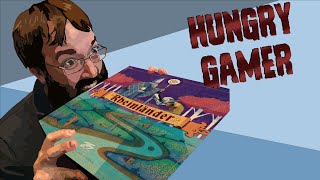
Click to watch at 0:12 · YouTube ↗
Overall sentiment (raw)
positive
Pros
- Good production and cover art.
- Chunky bits and overall aesthetic.
- Lightning fast gameplay.
- Deceptively strategic with hard choices.
- Satisfying scoring when losing control of a duchy.
- Clever interactions with scoring tokens (cities, castles, bishop).
- The boat module adds a clever extra option.
- Alternate churches add interesting abilities.
- Was an awesome surprise and liked more than expected.
- Satisfying for area control and euro fans.
- Delightful and different from many games.
Cons
- The board still looks old, honoring the 1999 aesthetic.
- Can feel at the whims of luck due to card draws.
- Occasional moments where players become unusually analysis-paralysis prone.
Thematic elements
- Area control
Comparison games
none
Mechanics (from transcript analysis)
- Area Control — Players place influence tokens on a board to gain control of areas called duchies. Whoever has the most influence controls the duchy.
- Card Drafting (implied) — Players draw cards which determine where they can place influence based on numbers on the cards corresponding to areas on the board.
- Hand Management — Players manage a hand of cards and decide when and where to play them.
- Modular Board (implied) — The placement of cities, churches, and castles can be randomly set up each game.
- Set Collection (implied for church favor) — Players collect church tokens to gain favor with the bishop.
- Variable Player Powers (modules) — Modules like the ship, titles, and alternate churches add unique abilities and scoring opportunities.
Video topics + discussion points
No key topics recorded for this video.
Quotes (from this video)
- This game was an awesome surprise when Chad from 25th Century reached out and asked me I wanted to cover it.
- This is one that if you are area control curious and you are a Euro fan, then this one is just going to knock your socks off. It's delightful.
References (from this video)
No references stored for this video.
Video tdE50o7G-DQ
News at 3:14 sentiment: positive
video_pk 67585 · mention_pk 163729
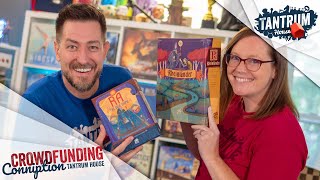
Click to watch at 3:14 · YouTube ↗
Overall sentiment (raw)
positive
Pros
- Double-sided board balances gameplay for different player counts.
- New art makes for a beautiful package.
- Gameplay experience is more involved than anticipated.
- Lots of strategy in card management (sandbagging).
- Walls add a layer of area denial and blocking.
- Scoring is dynamic with opportunities for points from lost control.
- Random token setup increases replayability.
- Expansions like boats, goal cards, landmarks, and power cards add depth.
Cons
- Original game had issues with certain player counts.
- Gameplay involves more than initially apparent from rules.
Thematic elements
Comparison games
- original game
Mechanics (from transcript analysis)
- Action Point Allowance — Playing cards is the primary action, with strategic choices on when to play or hold cards.
- Area Control — Players gain majority in duchies to place a duke, and the player controlling the majority of churches gains the bishop.
- area influence — Players place influence tokens on numbered spaces and can bolster their area by adding tokens beside already placed ones.
- Card Drafting — Players play cards from their hand and will shuffle the deck when they draw up to the joker.
- Modular Board — The game features a two-sided board and random placement of tokens, enhancing replayability.
- Set Collection — Players aim to control the majority of churches to gain the power of the bishop.
- Variable player powers — The bishop token allows players to displace other tokens on the board if they play the matching card, and new power cards offer unique abilities.
Video topics + discussion points
No key topics recorded for this video.
Quotes (from this video)
- Tantrum House crowdfunding conipion.
- Raw the Dice game and Rhinelander.
- Now we're going to give you a quick overview of both of these games.
- Just like in the original game, once RAW reaches the end of the track, the epoch ends and the board is scored.
- Disaster strikes, meaning you get to determine the punishment for all the other players.
- Rhinelander is an area influence game for two to five players.
- It was one of Canitia's most elegant designs, except for the fact that they didn't like it at certain player counts.
- The way the deck works in the game is that you'll play cards until you draw up to the joker and then you'll reshuffle the deck immediately.
- And so there's a lot of strategy just in holding on to cards so that other people can't get them.
- There were lots of little strategies like that that I didn't see coming when I sat down to play the game.
- That is the main way to score points in the game.
- Really interesting stuff.
- 25th Century does a really great job of putting together some really nice packaged games.
References (from this video)
No references stored for this video.
Transcript Navigation
Showing 1–4 of 4