






























Rising Sun Deep Dive
What the Community Thinks About Rising Sun
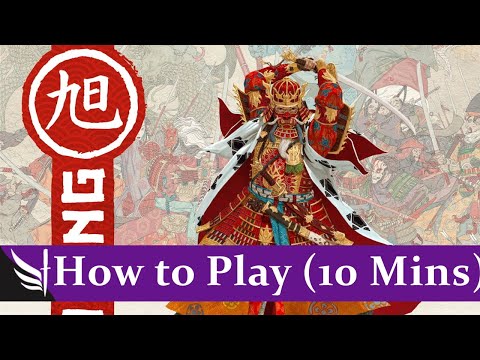
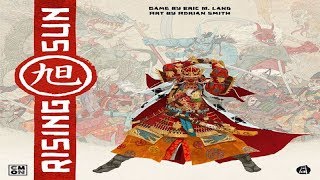
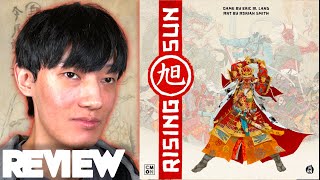
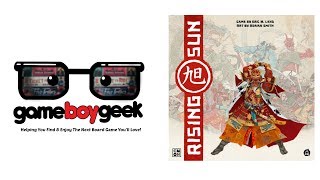
Reviewers agree that Rising Sun announces itself before a single mandate is chosen. Board Game Coffee said opening the box makes the miniature detail and the hand illustrated board "absolutely gorgeous," and The Discriminating Gamer called the production one that "knocks it out of the park" while ranking the game among the epic titles it has played. Shelfside and No Pun Included, reviewing after living with the game longer, land in a more mixed place: both praise the sculpts and the negotiation while pushing back on the price and the way certain clans warp the table.
The clearest split is over whether the alliance system is the game's best feature or its most punishing one. Board Game Coffee and Board Gaming Ramblings describe backstabbing and swinging fortunes as the highlight of a session. No Pun Included agrees the design is generous but argues one clan ability in particular removes too much of the decision space for opponents, and calls that criticism personal even while standing by it. Shelfside sums up the tension bluntly, landing on a middle score after admitting the game is "technically cool" while also, in the same breath, "massively hateable."
Core Mechanics That Define Rising Sun
Political Mandates and Turn Order
Each round opens with a political phase in which players take turns selecting a mandate: recruit, marshal, train, harvest, or betray, as Board Game Critique lays out. The player who draws the mandate tiles chooses one and returns the rest face down, then everyone at the table performs that action in a fixed order starting with the player to the selector's left; the selector goes last, except on the train mandate, where they go first. Only the player who chose the mandate and their ally get its bonus effect. Board Game Coffee had the same worry looking at the rulebook cold, admitting the jargon around bushi, kami, and political mandates was intimidating at first, only to find that a political mandate boils down to "each player gets to pick an action for that turn."
War Phase and Secret Bidding
Battles are resolved through simultaneous, secret bids rather than dice. Board Game Coffee found the war mechanic easy to teach once the group understood that each player bids on the military actions they want during a fight, and the outcome of those bids decides the winner. Board Game Critique adds that combat is structured around predetermined provinces rather than spontaneous skirmishes, with most groups seeing four to eight major battles a season, and that the political phase moves quickly while the war phase is where the game's complexity peaks. Shelfside singles out the bidding as the strongest thing the game does, arguing there is more to think through in a Rising Sun battle than in the comparable systems of other bidding games.
The Rising Sun Experience
Diplomacy at the Table
Every reviewer who discusses the alliance system frames it as the emotional core of a session. Board Game Coffee calls watching a former ally get squeezed out "the highlight of Rising Sun," full of backstabbing and under the table dealing. Board Gaming Ramblings describes how allying with the player who chose a mandate lets both partners share its bonus action, and singles out the bidding in combat as a favorite mechanism, noting that losing a battle still hands the loser coins from the winner. Board Game Critique frames Rising Sun as the pick for a group that wants negotiation and table talk over a fast, clean ruleset.
Teaching and Session Length
The learning curve comes up often. Board Game Critique reports that teaching typically runs sixty to ninety minutes and that many groups benefit from a practice round, with five player sessions usually running two to two and a half hours and three player games finishing faster. Board Game Coffee had a similar first impression, saying the rulebook's unfamiliar vocabulary "did scare me a little" before the political mandate concept clicked. JestaThaRogue found the deck setup a mild frustration next to Blood Rage but rated Rising Sun's slightly higher complexity worth it once hidden information turned out to be limited to a handful of mandate cards kept in front of each player.
What Makes Rising Sun Stand Out
Production and Presentation
The component quality draws consistent praise. The Discriminating Gamer calls the minis and map great and says the production alone "knocks it out of the park," while No Pun Included, reviewing a fully loaded Kickstarter pledge, describes the monsters as big, the card sets as plentiful, and the plastic as lush, and notes the campaign raised over four million dollars from backers. Board Game Coffee had the same reaction unboxing the retail edition, saying nothing in years of gaming compared to the detail on the miniatures.
Asymmetric Clans
Each clan bends the rules in its own way, and reviewers treat that as the game's deepest well of replay value. Board Game Critique credits the exceptional replayability directly to each clan's unique abilities and the multiple play styles available within a single clan. No Pun Included illustrates the range with specifics: the Dragonfly clan can move a figure anywhere on the board and, with the right card, twice on its own turn, while the Koi clan can purchase upgrades for a single coin, sometimes for nothing at all, and singles out the turtle clan as "a joy to play" because its power does not come at the expense of the other clans' plans.
Potential Drawbacks
Clan Balance
The same asymmetry that reviewers praise also draws the sharpest criticism. No Pun Included argues the Dragonfly clan's movement ability is "game breaking," taking away the positioning and bluffing decisions that define the genre for whoever plays against it, and frames this as its most esoteric and personal criticism of the design. JestaThaRogue found the card deck setup a small point of friction compared to Blood Rage, and Shelfside describes politics needing to self balance the game's bidding structure, walking away with a score the reviewer expects to revise only after playing with the expansions.
Rulebook and Length
Onboarding is the other recurring complaint. Board Game Coffee found the rulebook "a tad intimidating" thanks to terms like bushi, Shinto, and kami before the mechanics clicked. Board Game Critique quantifies the cost of that vocabulary, putting typical teaching time at sixty to ninety minutes with a recommended practice round, and warns that a group that dislikes negotiation or is prone to analysis paralysis will find the war phase "tedious and frustrating," with five player sessions running two to two and a half hours.
If You Enjoy Rising Sun
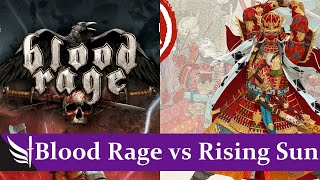
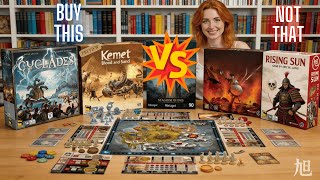
Several reviewers place Rising Sun alongside other Eric Lang area control games from CMON. JestaThaRogue ran a direct comparison against Blood Rage, scoring the two nearly even on theme and components while giving Rising Sun the edge for its alliance rule and season cards. Board Gaming Ramblings reached the same shelf, saying Rising Sun "has much of the same DNA" as Blood Rage even while preferring Blood Rage overall. Shelfside compares the bidding in Rising Sun's war phase favorably against Dune and Scythe, arguing both of those games ask for a single bid where Rising Sun's combat asks players to think through several at once. Board Game Critique, weighing five area control titles side by side, places Rising Sun next to Kemet and Inis as the pick for groups chasing the deepest negotiation and the highest strategic ceiling, at the cost of the longest sessions of the group.
What Reviewers Are Saying
"Nothing beats alliances. That is the aspect of the game I absolutely love. Alliances are the best way to screw over your best friends, and I love it."
— Board Game Coffee
"The action selection is fun and each action will give you something, even if the perfect action is not available to you. The Alliance rule is really great, is what made me back the game a Kickstarter and it works really well. The season cards are great and make for massive variations in your game."
— JestaThaRogue
"I'd pick Rising Sun. Negotiation dynamics create unique experiences every session. Asymmetric clans and multiple play styles mean you're discovering new strategies even after 50 plus plays. Yes, it's slower and harder to teach, but for experienced groups willing to invest time, Rising Sun delivers the deepest strategic experience in our opinion."
— Board Game Critique