
Rolling Freight is a route building and cargo shipping game in which dice represent each player’s resource pool. Players spend these dice to purchase and complete rail contracts, deliver cargo, and improve their companies’ competitive abilities. Who can build the best rail network and deliver the most profitable goods? Get rolling and find out!
Players begin the game with a pool of six dice with multi-colored sides. On each turn, a player can spend his or her dice to purchase contracts, construct rail links, build switching stations, purchase improvements and deliver one cargo of passengers or freight. Unused dice can be converted into stockpile markers for future use. By purchasing improvements, players can gain more dice with special abilities, become more efficient at laying rail or stockpiling dice, or increase the points they receive when other players deliver cargo over their rails. Bonus points are awarded for delivering passengers quickly or delivering freight over long distances.
The large, two-sided, colorful board has two maps. The western U.S. map, from the California gold rush era, is designed for 2 – 4 players. With many double-track routes, this map allows newer players to effectively plan their networks and maximize deliveries. The southeastern U.S. map, depicting the late Nineteenth Century, has only single-track routes that are significantly interwoven. This provides more advanced strategic options and is intended for 3 – 5 experienced players.
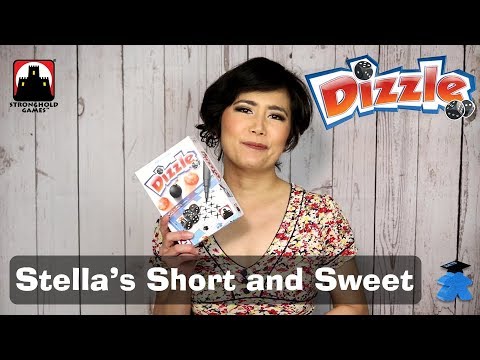
Dizzle Board Game – Stella's Short and Sweet
Images

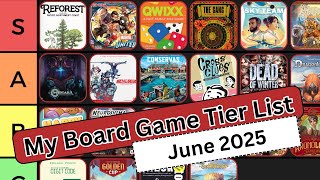
- Simple
- Classic
Mechanics (from transcript analysis)
Video topics + discussion points
Quotes (from this video)
- STI, I will give this an A. I played this twice. I really like the game. I don't know how much I will like it in the long run, but I really enjoyed and I could imagine actually owning it.
- It's like a um it's kind of a tile puzzling and resource management game. Um in a pretty short play time, very simple, very red, like very streamlined, which I like. Um but it like at the end it wasn't too special.
- One of my most favorite word games. I would give this an A. We're trying to like um prevent goats from taking like the letters from a from a printing office. Very very cool.
- Star Wars Imperial saw to play for the first time. Um and we're actually playing it again today. And I really like what I really like this. Um there was a lot of setup. The setup isn't very streamlined.
- Tiny Towns on my list for a while. Finally, I got a copy and I really like this. I will give this an A for now as well.
- Walking Birano. I will have to like do this here because this one also gets an S. Like always a great game to play. Really love this little puzzly game.
- Wingspan amazing amazing my most favorite game ever. You know that. So of course Srank
- It's a very good uh word game. I would give this a B. I enjoy that one.
- Duel which is fine. It definitely is not as good as Azour. It's It's a fine enough game. I would probably play it again if you asked me, but I don't understand why it exists.
- At the Helm, a deck building game by Buttonsh Games with only 18 cards, which is pretty good. Um, I'll give this an A as well.
- Animal Kingdoms. That one surprised me. It's like a uh you like place cards down in specific regions and you're trying to get like the majority there.
- And then Aon's End, of course, always gets an S for me. It's my most favorite solo game, and that will probably not change for a while.
- And then I've also finally gotten Seventh Content. I got a like a huge collection. I've got almost everything that you can get at retail, uh, including like the cool white box and stuff. Um, and I would give this I've only played this once, but I would give it an A for now.
- Loads of A ranks this time. Not bad. Not bad. Um, and a lot of B's as well and quite a lot of S's. No D's this time and only a few C's.
References (from this video)
Mechanics (from transcript analysis)
- Dice Placement — Players take one die in turn and place it on their own sheet, crossing the corresponding placement box.
- dice placement on personal sheet — Players take one die in turn and place it on their own sheet, crossing the corresponding placement box.
- Dice Rolling — At the start of each round, the active player rolls all dice.
- highest points win — The player with the most points wins.
- Limited Points — The player with the most points wins.
- multiple sheets with levels — The game comes with four different sheets from level 1 to 4.
- orthogonal placement after initial round — Dice can only be placed after the initial round in an orthogonal relation to dice already placed this round.
- placement rules - matching pictures or values — You can only place the die on the corresponding picture or onto the same picture across dice.
- risk of losing a die when rerolling — If you can't get the right amount of PIP, you may reroll the unused dice pool with risk of losing one of your dice.
- round count depends on players — Rounds length varies depending on the number of players.
- scoring via rows and columns — Sitting rows and columns give you points.
Video topics + discussion points
Quotes (from this video)
- the game also comes with four different sheets from level 1 to 4
- it sounds simple but there are some rules placement that is a little bit tricky
- you can only place the die after the initial round orthogonal
- if you can't get the right amount of PIP on the die you can roll the rest of unused eyes pool with risk of loosing one of your dice
- one good strategy for the game is to look at your opponent sheet to see what dice peeps they can't take
- preventing them from taking more dice
References (from this video)
- Familiar mechanic with fresh twist
- Discussion suggests it may not fit tiny box constraint
- Strategy and world-building through dice
- Roll-and-write genre evolution
- Mechanic-driven with minimal text
Mechanics (from transcript analysis)
- Fog of war concept — Hidden information revealed over time
- roll-and-write — Players roll dice and write results on a sheet
Video topics + discussion points
Quotes (from this video)
- it's a cooperative game
- you have the choice to betray somebody
- pull everything out of the box and it's good to go
- there is already a story deck but you would add things into it based upon your actions
- we are making a prototype next time
- fantastic not the master but fantastic