














Rolling Heights Deep Dive
What the Community Thinks About Rolling Heights
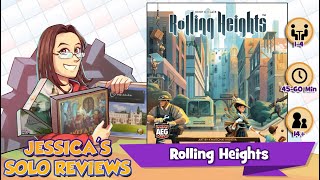
Rolling Heights stands apart in the board game landscape for a single, unexpected choice: rolling meeples as workers. At first blush it sounds absurd. Dice-rolling gamers already struggle with variance, so how could tossing wooden workers into a chamber possibly work? Yet reviewers consistently report that the mechanic does work, and works well. kovray, Let's Table It, and The Cardboard Herald all came away impressed, praising it not just as a novelty but as a genuinely engaging tableau-building experience that combines satisfying production with meaningful strategic depth.
Core Mechanics That Define Rolling Heights
Meeples in Motion: The Dice-Rolling Worker System
Rolling Heights pairs an unlikely mechanic, meeple rolling, with worker placement. Players roll their worker meeples into a chamber and resolve their positions: standing up (working hard), on their side (working steady), or flat on their back (exhausted). Each position unlocks different abilities and resource rewards. The genius is in the risk: you can push your luck by re-rolling exhausted workers to chase more productive outcomes, but if all your meeples land exhausted, you are penalized and forced to set aside your best workers. The rolling layer works because it is bounded and meaningful, with limited worker slots forcing turn-by-turn roster choices about whom to keep in the pool and whom to bench.
City Building Through Resource Accumulation
At its heart, Rolling Heights is a tableau-building engine game wrapped in a push-your-luck shell. Your rolled workers generate resources such as stone, steel, wood, and concrete, which you accumulate on building cards to complete them. Completed buildings score points and sometimes grant new meeples or permanent powers, so your workforce grows more specialized as you complete buildings that grant new worker types such as carpenters, architects, and city planners. The board itself, randomly configured from modular neighborhood tiles, creates territory that matters: placing buildings costs more when they sit far from your existing structures, incentivizing contiguous districts. Resources double as currency for acquiring new building plans, providing real mitigation against bad rolls.
The Rolling Heights Experience
A Smooth, Mid-Weight Engine
Rolling Heights avoids the trap many gimmick-driven games fall into: overcomplication. The design has the feel of a mid-to-light game that sings, with crunchiness in the turn-by-turn roster and resource optimization that never overwhelms the flow. The game teaches cleanly, plays smoothly once understood, and the variable board setup ensures spatial tension without extra rulebook overhead. The endgame trigger, which fires when a single resource color runs out of the supply, keeps pacing tight. One reviewer noted surprise at a sudden ending, glancing away and returning to find the game had wrapped, a sign of elegant design that leaves players wanting another play rather than overstaying its welcome.
The Aesthetic Payoff: Your Cityscape Grows
A reviewer called Rolling Heights super unique, and the uniqueness lives in the moment you realize what you have built. Over the course of several rounds, resources accumulate on your tableau, buildings rise with materials stacked atop one another, and you gradually assemble a skyline. It is a visual crescendo: the board shifts from sparse to dense, your personal city grows alongside your roster, and by the end you are looking at a genuine artifact you constructed rather than just a pile of points. That physical satisfaction of stacking cubes, completing buildings, and watching your engine rev is a real part of the hook.
What Makes Rolling Heights Stand Out
Innovation Without Overreach
Rolling Heights does not reinvent worker placement or tableau building. Instead, it evokes the push-your-luck thrill of Pass the Pigs and the city-building loop of Suburbia, combining them into something that feels fresh through synergy rather than novelty. The roll happens once per turn, so the game never becomes a dexterity gauntlet. The outcomes matter because roster size and composition constrain what you can do next turn, creating a feedback loop between luck, choice, and long-term planning. Reviewers highlighted this as the sweet spot: the rolling is not chrome, it is integrated into the tableau-building engine, letting the gimmick fuel the strategy rather than overshadow it.
Accessibility Paired with Depth
Rolling Heights earns a place in a collection because it invites players in without punishing them for variance. Reviewers who curate competitive shelves noted that it holds its own against heavier games, with enough spatial planning through placement costs, adjacency, and board layout, plus resource optimization, to sustain engagement. Yet it stays light enough to propose to casual players without a lengthy teach. Production is solid, components feel premium without excess, and setup is manageable. For a game built around rolling meeples in a chamber, achieving that smoothness is no small feat.
Potential Drawbacks
Luck Remains a Factor
Roll-based resolution means variance is baked in. A player who consistently rolls exhausted workers will struggle compared to one who rolls working-hard results naturally. The game mitigates this through wild tokens earned from busts, alternative spending paths, and the ability to push your luck strategically, but if luck does not break your way on a critical turn, you feel it. This is not a dealbreaker for most reviewers, since the multi-purpose resources help, but players who dislike any randomness should know that meeple-rolling is fundamental to the experience.
The Endgame Can Catch You Off Guard
Because the endgame is triggered by resource depletion, it is possible to be building toward a plan and suddenly find the game over because someone completed a building with the last cube of a color. One reviewer noted mild surprise and frustration at looking away and finding their planned turn never came. This is less a flaw than a design choice that prioritizes pacing over predictability, but it means you cannot always shepherd a multi-turn arc to completion. If you love planning your exact final moves, this may feel abrupt.
If You Enjoy Rolling Heights
If Rolling Heights resonates with you, consider Suburbia, the tableau-building city-planning forebear without the rolling, or Splendor, a resource economy with a similar engine-building feel. Pass the Pigs itself scratches the pure push-your-luck nostalgia that Rolling Heights channels through its meeples. For the blend of worker placement and tableau building, Calico offers pattern building with spatial placement, while Ticket to Ride shares the modular-board, long-term-planning appeal. The common thread is games that reward forward planning while keeping each turn quick and satisfying.
What Reviewers Are Saying
"It does work. I thought every time those meeples would be laying flat and you would never get them to stand up or be on their side. And it does. It just works. And it's such a fun little gimmick."
— Let's Table It
"You're rolling meeples in a little chamber and the different meeples have different things that they give you. It's a real pleasant city-builder engine-building game that you wouldn't anticipate really having that smooth of a transition in something that has rolling meeples in a chamber on it."
— The Cardboard Herald
"It's so unique. That is something I do value in our collection, having a game that does something that nothing else does. And I like that you are constantly building. Even when endgame happens, sometimes you want that extra turn, but you definitely don't feel like it's overstayed."
— Let's Table It