







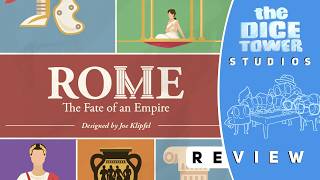

Rome: Fate of an Empire Deep Dive
What the Community Thinks About Rome: Fate of an Empire
Reviewers agree that Rome: Fate of an Empire is a dense, solo-only experience that rewards patience. Released in 2024, it is an engine-building, deckbuilding and tableau Euro, and the praise and criticism tend to come from the same places. Players who enjoy working through a tight web of cards and resources tend to find the game absorbing, while those who want something lighter often bounce off it. Zee Garcia gives it a strong recommendation with clear warnings, and the live stream from Watch Review presents it as a shorter, more approachable cousin of a much larger game. Not every reviewer is convinced. One video from Watch Review is openly negative, saying the reviewer does not enjoy the game and that it is simply not for them, while acknowledging the award it has earned.
Core Mechanics That Define Rome: Fate of an Empire
Deck Building
Cards sit at the center of the game. Players acquire developments and attribute cards, and each card adds to a personal deck that shapes what happens on later turns. Board Games for One walks through the prototype in detail, explaining how level 1 and level 2 developments enter the market and how attribute cards carry a top ability and a boosted ability that can be triggered at the right moment. That layering is what makes the deckbuilding feel meaningful, because a single purchase can change how every future turn plays out.
Resource Management
Resources are tight, and most reviewers describe managing them as the real puzzle. Zee Garcia describes the card and resource management as tricky and challenging but very satisfying, and the loan system adds another layer of pressure. Loans can help a player expand quickly, but they also come with limits that can close off options when a turn goes wrong. Mike, One Stop Co-op Shop points out that many of the Mage Knight mechanics are present here, but they are turned in different ways so that the economy feels like its own system rather than a copy.
The Rome: Fate of an Empire Experience
A Demanding Solo Puzzle
The game asks a lot of its solo player. Zee Garcia calls it complicated, demanding and heavy, and expects that to be a big hurdle for many buyers. The session length is a significant commitment as well, with Zee estimating a play time of roughly 1.5 to 2 hours. Players who like to think several moves ahead will find the decision space engaging, but casual solo players may want a gentler introduction.
Lighter Than the Original It Is Inspired By
Several reviewers compare the game with Mage Knight, and most see it as a condensed version of that experience. The live stream from Watch Review says it is nowhere near as involved as Mage Knight and is much easier to get to grips with. In a short session, the reviewer won as Augustus with 38 points against a target of 21, which suggests the game can be played in a sitting once the rules are familiar. The experience feels more focused than its inspiration, with fewer moving parts and a clearer path toward victory.
What Makes Rome: Fate of an Empire Stand Out
Variability Through Setup and Leaders
Replayability is one of the strongest arguments in the game's favor. Zee Garcia highlights the random setup, the edicts that shape each round, and the six leaders as sources of variety that keep sessions from feeling identical. Board Games for One also praises the game for leaving space for different approaches, and the presence of multiple leaders and setups means that no two sessions are likely to unfold the same way.
Depth in a Small Package
Packing a lot of decision-making into a compact box is a point that several reviewers return to. Mike, One Stop Co-op Shop describes the game as smaller and cheaper than Mage Knight, and the graphic design gets praise from the Board Games for One review. The combination of a compact footprint and a rich set of interacting systems is what makes the game appealing to players who want a substantial solo session without a large table commitment.
Potential Drawbacks
Rules Density and a Missing Player Aid
The rules are the most frequently cited obstacle. Zee Garcia criticizes the density of the rulebook and points out that there is no official player aid to help during play, which makes the learning curve steeper than it needs to be. Board Games for One suggests a phase reminder card and sideways cards to smooth out solo play, which reinforces the sense that the game would benefit from more onboarding support.
A Punishing Economy
The game is unforgiving when things go poorly. Strife costs players victory points, and combat or loans can quickly tip the balance. Watch Review notes that enemy shields and attacks can cause Strife, and that civil war and loan limits add further pressure. Zee Garcia says the game is very punishing, though Garcia adds that it is good and rewards players who put in the effort. Anyone who dislikes tough, unforgiving systems should weigh that before buying.
If You Enjoy Rome: Fate of an Empire
Players who like the way Rome: Fate of an Empire combines resource pressure with tableau and deck development should look first at Mage Knight, which the reviewers name as the closest relative. It offers a similar sense of building an engine under constant pressure, at a larger scale. Players who want a related solo experience with a campaign-style framing can explore Gloomhaven: Buttons & Bugs, which the live stream mentions as a point of comparison. For a game centered on growing an economy over time, Feudal Kingdom is another title worth a look.
What Reviewers Are Saying
"This is a complicated game. This is a demanding game. This is a heavy, challenging game in every aspect of that word, of that concept."
— Zee Garcia
"So, this is kind of Mage Knight. It's shrunk down Mage Knight, Roman Mage Knight with some engine building in it."
— Watch Review
"It's one that's fascinating to me. I find it to be, it worms its way into the back of my head, and I keep thinking about it."
— Zee Garcia