/pic5854330.jpg)





Royal Visit Deep Dive
What the Community Thinks About Royal Visit
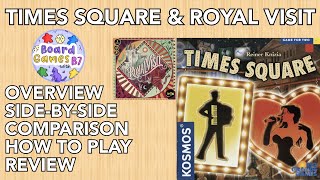
Royal Visit has earned sincere affection from the gaming community as a deceptively strategic two-player experience that rewards both tactical card play and easy conversation. Chairman of the Board calls it a gorgeous reprint of an older design, Board Games With B7 praises its dynamic back-and-forth, and Rolling Dice & Taking Names frames it as an inviting game for kids and adults alike. Reviewers consistently return to it for casual game nights, noting how it creates natural moments of interaction without demanding mental exhaustion, all wrapped in striking production.
Core Mechanics That Define Royal Visit
Hand Management and Card Play
At its heart, Royal Visit is a game of managing a hand of cards that correspond to the characters on the board. Each turn, players play matching cards to move shared pieces across the cloth playmat. The flexibility of card play creates interesting decisions: you can play several cards of one type at once, allowing a single turn to chain movements or to hold options back for the critical moment when precise control matters. This hand management rewards careful planning, since the cards you hold determine which pieces you can influence and by how much. Designed by Reiner Knizia, the system favors timing over raw power.
Tug-of-War Movement and Special Characters
The game's tug-of-war structure creates a constant struggle for position as players push the king and his retinue toward opposite ends of the track. Special characters add tactical wrinkles to the basic movement, letting clever players reposition pieces in ways that swing the board state in a single turn. Reviewers describe the result as a contest of positioning where luring the right characters to your side, at the right moment, separates a win from a loss. The push and pull keeps both players invested in every card played.
The Royal Visit Experience
A Game Built for Conversation
What distinguishes Royal Visit from heavier strategy games is its social fabric. Reviewers note playing multiple times without the game consuming their full attention, instead leaving comfortable space to sip coffee and talk while making meaningful decisions. The brisk play time means rounds finish quickly, often shorter than expected, yet the game never feels rushed. The tug-of-war momentum creates natural swings of tension and release, letting players settle into a rhythm rather than grinding toward victory.
Accessible Yet Engaging Gameplay
The theme of drawing a royal court toward your side is immediately intuitive, and the core action of playing cards to move characters along a central track requires no special knowledge to grasp. Yet beneath that simplicity lies genuine depth. Reviewers describe the game as thinky without being heavy, asking players to anticipate an opponent's card plays and plan their own responses. This balance makes Royal Visit welcoming to newcomers and children while still offering enough substance to hold adult interest across repeated plays.
What Makes Royal Visit Stand Out
Exceptional Component Design and Production
The physical quality of Royal Visit immediately captures attention. A cloth playmat replaces the cardboard board of earlier versions, creating a tactile, visually striking surface. The wooden character pieces are chunky enough to feel substantial in hand, and the bright player colors create a vibrant tableau. Reviewers highlight the insert, the production choices, and the overall aesthetic cohesion as key reasons this reissue of the 2006 design feels premium despite its modest footprint.
Built-In Game Length and Closure
Royal Visit features an elegant self-regulating system that keeps the game from overstaying its welcome. Victory can arrive by drawing the king fully to your side, by accumulating enough characters to claim the crown, or by working through the card deck. These layered paths and the built-in clock prevent runaway leaders and protect against endgame tedium, so each push toward the goal feels meaningful rather than inevitable.
Potential Drawbacks
Visual Clarity in Card Design
While the overall production shines, Board Games With B7 noted that the card fronts carry colors that sit a little too close to one another and do not stand out dramatically. In the heat of quick decision-making, this can create minor friction in identifying card types at a glance, particularly for players with color sensitivity. The concern is not a dealbreaker, just a small quality-of-life issue that sits oddly against the otherwise meticulous production.
Limited Player Count and Strategic Range
Royal Visit is strictly a two-player game with no variant for more players, which limits its flexibility for larger game nights. Beyond that, while the tug-of-war structure creates engaging back-and-forth, the modest card deck and fixed board mean repeated plays tend to follow similar strategic contours. Players seeking high variability through changing setups or scaling player counts will want to look elsewhere.
If You Enjoy Royal Visit
Fans of Royal Visit should explore other two-player designs by Reiner Knizia, whose catalog is rich with intimate head-to-head contests. Schotten Totten and Battle Line share the same elegant, card-driven positional tension in a compact package. Those who love the conversational, accessible feel may also enjoy Jaipur and 7 Wonders Duel, both of which balance simple rules with real tactical play in a two-player format. The common thread is short, sharp duels where reading your opponent matters more than rules overhead.
What Reviewers Are Saying
"There's tons of back and forth between the players. The struggle of luring the right characters into your side of the board is real, although there could be some very smart moves performed given the right cards at one's disposal."
— Board Games With B7
"Simple rules, simple play, but it is a little bit thinky, and it's great for kids all the way up through adults. We played this game multiple times just sitting there, sipping some coffee, enjoying our company, talking back and forth as we played the game."
— Rolling Dice & Taking Names
"Pretty much a pure tug of war style game, and this one is actually a really gorgeous looking game with some amazing production choices."
— Chairman of the Board