
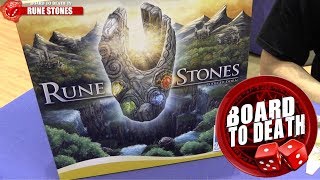
Rune Stones is a deck-building, hand management game by acclaimed designer Rüdiger Dorn. In Rune Stones, every card has a unique number on it. Two cards are always played together, and the higher numbered card is removed from the player's deck. You have to be careful which cards you buy and how you play them to not lose your best cards. Players will use their cards to gather gems, forge them into Artifacts, then combine those into Rune Stones, which grants a special ability for the rest of the game. The more artifacts used in making a Rune Stone, the more points it scores, so players must decide whether it is best to gain abilities early or save to score more points.
On your turn, you may choose from one of three options:
1. Summon Creatures: Take new creature cards from the display by playing the appropriate amount of spell power from cards in your hand.
2. Play Cards: Play two cards from your hand, which will give you resources, new cards, or points. However, every card has a unique number, and the higher numbered card of the two is removed from the game (the other is placed in the player's discard pile).
3. Forge Artifacts: Players spend gems at the 6 different Dwarf forges to make an artifacts. Once they have at least two artifacts of different colors, these may be made into a Rune Stone, which grants a special ability and a significant number of points.
The first player to 65 points triggers the end of the game, and then the player with the most points at the end of the round is the winner.
—description from the publisher
The time has come to find the most powerful druid, that they may claim the throne!
Players will take on the role of druids who must prove their skills handling the powerful rune stones. Summon creatures by magic and benefit from their abilities, all in a search to gain precious gems. These gems must go to the talented dwarfs, who know how to use them to make a rune stone.
As their collection of artifacts grows, the druid's rune stones become more powerful. Each stone gives the druid a permanent ability (as well as power points). The abilities will aid in acquiring gems and artifacts, and the power points increase the player's chance to claim the coveted throne.
The druid with the most power points at the end of the game ascends the throne and is the winner of the game.
—description from the back of the box

Images


- Unique component use (dominoes instead of cardboard)
- Asymmetric factions
- Potentially massive scope
- Likely to be expensive
- Requires Kickstarter to publish
- War game
- Fantasy
Mechanics (from transcript analysis)
- Asymmetric Player Powers — Each faction has unique units and abilities.
- Dominoes as components — Uses domino-like pieces that represent units and can be used for movement and combat.
- Hand Management — Players manage a hand of domino pieces that represent their available units.
- Modular Board — The map is made of cloth and comes in a zipper bag.
Video topics + discussion points
Quotes (from this video)
- I always kind of think it shouldn't be the rules that are complicated it should be the situation that's complicated
- The key thing was dealing with opportunity fire
- The card system is for me a way of modeling that in that you have to know when to hold back and make sure you've got options at hand
- The figures are just gorgeous really good detail
- it's a game where there is no cardboard in the game at all
- people assume I'm you know some wealthy game designer in a mansion and Brisbane but no it's um yeah definitely needed to royalties
- the world we live in is the result of technological developments nothing to do with politicians nothing to do with generals it's just we a lot of relatively unknown scientists designing stuff you know creating stuff that allows us to shape the wall you know that has a creator the world we live in
- we probably just ruined the chance of him ever coming on the show again but at least now we know what lawn mower he has
References (from this video)

- deck-building with unique numbered cards
Mechanics (from transcript analysis)
Video topics + discussion points
Quotes (from this video)
References (from this video)

- Clever deck building mechanism.
- Fondness for the designer's previous work.
- Risk of losing valuable cards if played at the wrong time.
Mechanics (from transcript analysis)
- Deck Building — A deck building game in which every card has a unique number on it.
- Hand Management — Players use their cards to gather gems, forge them into artifacts, then combine those into runestones.
- Resource Management — Gathering gems and forging them into artifacts.
Video topics + discussion points
Quotes (from this video)
- 10 games on the radar is a production of party Lemmings media Holdings Incorporated
- you don't need to know everything just one more thing than your friends do
- it was really satisfying to watch your fake clue totally send someone off in the wrong direction
- this game seems to be pairing beautiful art with Cutthroat gameplay which sounds exactly like something I'd enjoy
- we discovered just how unforgivingly deliciously brutal a word game can be
- the fact that it's two player only makes me think that I might just have to give them a try one more time
- party Lemmings has assured me that everything's gonna be absolutely fine
References (from this video)
- Unique blend of deck-building, artifacts, and rune powers
- Multiple rune stone powers create varied strategies
- Engaging late-game decision-making and tension
- Can be lengthy; deck management can become slow
- May require careful pacing to avoid dragging in multi-player games
- deck-building with gems, artifacts, and rune stones
- The Magnificent
- Marco Polo - Maracaibo
- Oh My Goods
Mechanics (from transcript analysis)
- Artifact acquisition and rune stones — Acquire artifacts, then cash in artifacts to obtain rune stones with ongoing powers; higher wait yields more points.
- Deck Building — Start with a base deck and gradually lose lower-numbered cards as higher-powered cards are acquired.
- Deck-building and card shedding — Start with a base deck and gradually lose lower-numbered cards as higher-powered cards are acquired.
- End Game Bonuses — Game ends when a player reaches 65 victory points; artifacts and powers contribute to scoring.
- end-game trigger and scoring — Game ends when a player reaches 65 victory points; artifacts and powers contribute to scoring.
- Power rows and ongoing powers — Artifacts grant ongoing abilities; examples include wild buying power, larger hand size, or convert actions into more draws.
- Three action options per turn — Buy new cards from a row by discarding cards of the same color/gems, or activate two cards, or take artifacts to cash in for a rune stone.
Video topics + discussion points
Quotes (from this video)
- it's the slowest azul' game by far
- I liked New Dale quite a bit
- I think there were some cool streamlining things that happened overall by having the amount of stuff that you have to make stuff be less streaky
- this is a deck-building style game
- I might have a chance to try it again at some point in the future
- I don't think I'm super excited to keep playing
References (from this video)

- tight engine-building with unique power cards
- thematic druidic throne pursuit provides clear goals
- scoring can be intricate and unforgiving if mismanaged
- stone collection and druidic power balancing
- medieval druidic contest to claim a throne
- deck-building with hand management and stone-based scoring
- Las Vegas
- Kariba
- Istanbul
Mechanics (from transcript analysis)
- Deck Building — building a deck of cards to drive actions
- deck-building — building a deck of cards to drive actions
- Hand Management — careful play of cards to maximize returns
- Set Collection — collecting different runestones and artifacts for points
Video topics + discussion points
Quotes (from this video)
- "The future of Paris is in your dice filled hands"
- "is based on the Stratego universe"
- "the game supports brief skirmishes, sprawling campaigns and custom scenarios"
- "you are a pioneer who has taken a break from his research into dinosaur genetic manipulation in order to travel out west and strike it rich"
- "the druid with the most power points at the end of the game... claims the throne"
- "the tropical lands that surround the valley of the Ancients are all up for grabs"
- "the raid ability allows players to capture valuable treasure cards from their opponents"
- "they want what's theirs and they're ready to pounce on you at any time from anywhere"
- "oh Fox now let's say just for a moment that you and I are various woodland creatures"
- "Ocean Crisis depicts a real-life environmental disaster"
References (from this video)
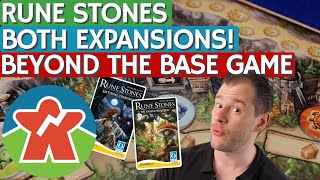
- simple, quick to learn and play
- strong expansion support increasing variety
- artwork and components are appealing (overlay inserts)
- one runestone can be overpowered in multi-player games (needs house rule)
- familiar board module's impact modest
- some modules add complexity; can be optional
- engine-building with resource collection
- Fantasy deck-building around gathering runestones and artifacts
- Array
- positive
- Cryptid
Mechanics (from transcript analysis)
- deck-building — Players buy cards and play two per turn; the higher value card is trashed from the deck.
- resource & artifact economy — Gems, artifacts, and runestones drive purchasing and scoring.
- trash-on-play and draw-on-demand — High-value cards are trashed to thin the deck; some effects draw or manipulate cards.
Video topics + discussion points
Quotes (from this video)
- these are what i want expansions to do introduce new elements if you like but make them simple
- it's so simple
- this is a must buy
- i gave Runestones a nine
- runestones elevated to a 10 out of 10
- i throw it into every game
References (from this video)
- excellent deck building mechanic
- cool twist with card trashing
- accessible to left and right-handed players
- creates rewarding engine
- Dominion
- Star Realms
Mechanics (from transcript analysis)
Video topics + discussion points
Quotes (from this video)
- Remember it's only a game
- I am very much one of these people that if you go after my family or friends there will be hell to pay
- Five out of ten is average, it's a game that I would still play if you put it on the table
- I do really like closed drafting in games
- I love the way that you plan for this sort of stuff
- Power Grid is the worst contender for this, auctions in this just refuse to freaking end
- I want to see it more - the typewriter mechanic
- Area control is just kind of meh
- It's just so many of these games are just like oh we need to make a quick buck
References (from this video)
- Clear three-action turn structure: buy cards, play actions, or buy artifacts
- Artifact and rune-stone system adds depth and variability to engine-building
- Wilds and color management create engaging decision space
- End-game trigger creates a tense, race-like finish
- Rune stones offer varied powers and meaningful late-game growth
- Deck thinning can be punishing if high-value cards are discarded early
- Complex color/artifact interactions may be intimidating for newcomers
- Rune-stone slot limits can force early commitment and constrain choices
- collecting gems to purchase artifacts, which grant rune stones that provide points and powers
- fantasy world built around gems, artifacts, and rune stones
- deck-building driven with hand management and engine-building implications; progression via artifacts and runes
Mechanics (from transcript analysis)
- artifact economy — artifacts grant bonuses and can be bought up to two per turn; some artifacts provide immediate effects or end-game benefits.
- deck-building / hand management — on a turn you have four cards and choose one of three actions; purchased cards go to discard and cycle back into play.
- dice bonus — certain actions allow using a dice bonus to gain additional points.
- end-game trigger and race — the game ends when one player hits 65 points, triggering a final round for others.
- Resource Management — gems come in colors; you spend them to buy cards or artifacts; wilds and color rules influence purchasing power.
- resource management / color-coded gems — gems come in colors; you spend them to buy cards or artifacts; wilds and color rules influence purchasing power.
- rune stones — rune stones grant powers that affect your deck and scoring; some increase hand size, others affect purchasing or card play.
Video topics + discussion points
Quotes (from this video)
- you are collecting these gems to be able to purchase artifacts which you will then used to buy rune stones which gives you points and special powers
- you can play all cards of one color you have some wild symbols here
- unlimited buy so you know you can buy a three and a one with the four purchase price
- after that you can convert your gems into wild gems and you can get the top card for free
- it's a bit of a race as well and it's end when one player reaches 65 points
References (from this video)
- clever engine-building
- tight race to a target score
- early-stage deck-building may feel clunky
- engine-building through combination of cards
- gem collection and deck-building
- engine-building abstraction
Mechanics (from transcript analysis)
- deck-building — build a deck to generate better engine effects
- resource-gem collection — collect gems and use them to fuel engine improvements
Video topics + discussion points
Quotes (from this video)
- this is the best area control game out there
- a perfect 10
- I adore El Grande
- really nice game I taught this to a complete non-gamer
- I love Feld games this one is just an absolutely brilliant one
- it's one of the best two-player games ever made
- overproduced to say the least
- one of my favorite dice games and it's actually just broken into my top 100 for the first time
- the sudden death mechanism where if you are the first player to collect three buildings then you'll instantly win
- really cool decisions
References (from this video)
- Very teachable for new players; approachable for a light deck-builder
- Outstanding production: board, components, and artwork are visually striking
- Innovative two-card discard/draw mechanic edges away from traditional deck-builders
- Clear, accessible iconography; left/right-handed card design aids inclusivity
- Depth emerges from runestone choices and artifact/set collection without heavy complexity
- Theme and immersion are relatively light for a fantasy setting, more mechanical than narrative
- Base game replay variety is limited by the eight runestones; expansions add breadth
- With four players, pacing can slow if players hesitate or if teaching new players
- druidic magic, artifact collection, and gem-based power progression within a streamlined deck-building framework.
- fantasy realm where druids gather gems, summon creatures, and trade artifacts to empower runestones.
- light thematic veneer; emphasis on mechanics and strategic choice over immersive storytelling.
- Dominion
- Star Realms
- Dale of Merchants
- The Lost Ruin of Arnak
- Clank!
Mechanics (from transcript analysis)
- resource flow with runestones — Runestones grant permanent abilities and VP as they are acquired, shaping your path to victory through strategic selection among eight available powers.
- set-collection with artifacts — Artifacts form a set collection; collecting larger sets yields more points, but the mechanics incentivize balancing immediate gains with long-term goals.
- two-card deck-building resolution — On a turn you play exactly two cards; you may resolve them in any order, but the card with the higher top-value is trashed from your deck after resolution, causing your deck to thin over time and forcing ongoing card-purchase decisions.
Video topics + discussion points
Quotes (from this video)
- It's a light deck builder with a twist you haven't seen before, and the twist is implemented in a way that keeps every game feeling fresh.
- You could teach this to someone who has never played a deck-builder in their life and they'd pick it up quickly.
- The production quality is absolutely top-shelf—one of the best-looking deck-builders around today.
References (from this video)
- Great light deck builder
- Unique self-cleaning deck mechanism
- Beautiful design with double-sided cards
- Accessibility for left-handed and right-handed players
- Variety from 18 different special power options
- Hidden gem that deserves more attention
- Some rune stones may be slightly imbalanced
- Can go long with 4 players
- Collecting gems and acquiring magical rune stones
- Fantasy gem trading world
- Light deck building fantasy
Mechanics (from transcript analysis)
- Card Multi-Use — Cards are double-sided and can be used for mana or abilities
- Deck Building — Light deck building with unique self-cleaning mechanism
- Deck Self-Cleaning — Higher numbered card is trashed, lower retained in discard
- Gem Trading — Trading colored gems for artifacts and rune stones
- Special Powers — Rune stones grant special powers for rest of game, max 4
Video topics + discussion points
Quotes (from this video)
- I'm sorry I'm sorry please forgive me I blatantly overworked myself through September
- this is such a cool unique Innovative idea but it plays really well
- such a good Gateway game that deserved the award
- one of my probably my favorite dice that existed any game ever
- Scythe is just such a cool big Euro engine builder game
- all the decisions feel like juicing the agonizing but in a fun way
- you will constantly regret the order that you did those four actions in because there's no technical right answer
- most thematic laserder game
- card art in this is Sublime Instagram is wet dream
- I think it is a 10 out of 10 game for me
- Hidden Gem one that I never saw coming at all
- Shut Up And Take My Money