













Sabika Deep Dive
What the Community Thinks About Sabika
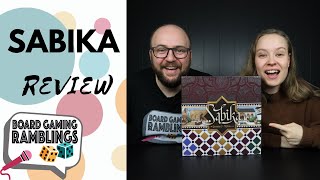
Sabika is a 2022 game from the designer of Bitoku, published by Ludo Nova, and reviewers treat it as a demanding Euro with a strong sense of place. Board Gaming Ramblings describes Sabika as a tight, interaction-heavy game in which players build the Alhambra by moving workers around its rondels. The channel gave it an eight out of ten. The Dice Tower ranks it second on its list of favorite games, behind only Trajan, and praises the same core system: three interlocking rondels that compress five rounds of decisions into a single board.
Where reviewers agree is on the tightness of the economy and the importance of timing. Where they differ is on player count. Board Gaming Ramblings played with two, three, and four players and concluded that three is the sweet spot, because two players can plan too easily and four players stretch the game to around three hours. The Dice Tower's assessment is that five rounds are not nearly enough time, which points to the same pressure from a different angle. Watch It Played opened its monthly chart with Sabika as a title generating significant buzz after its debut at Essen, which suggests the game arrived in the market with considerable anticipation.
Core Mechanics That Define Sabika
Rondel
The rondel is the defining system of Sabika. The board holds three interrelated rondels, and each one represents a different activity: constructing the Alhambra, carving poems into its halls, and exporting goods along trade routes. Board Gaming Ramblings explains that each worker stays on one ring, with two workers on the outer ring and one each on the middle and inner rings, and that movement is strictly clockwise. Players can move two spaces for free, and each additional space costs a coin. Landing on a space that is occupied by another player's worker also carries a coin cost, so timing becomes a central decision. Board Gaming Ramblings found the interaction on the rondels especially rewarding, noting that waiting for opponents to move out of the way and then snatching an action is a key part of the strategy. The channel also observed that the three rings connect through a few secondary actions, so landing on the same space on a neighboring ring can trigger a related bonus, though it found the connection between rings less extensive than the game's marketing implies.
Resource Management
Resource management in Sabika is defined by scarcity, particularly of coins. Board Gaming Ramblings summarized the economy as one where "resources are tight but the money is what is super tight." Every movement along a rondel and every purchase draws down a supply that rarely feels generous. The channel described a balance between taking actions that generate coins or resources and taking actions that score points. Storehouses on each player board hold only a limited number of goods, and upgrading them adds capacity along with abilities. Big buildings require specific materials such as gypsum, with more valuable materials like marble and glazed ceramics worth more points. Reviewers said that this forces players to decide whether to build quickly or to accumulate resources for larger returns.
The Sabika Experience
Table Presence
Sabika has a commanding physical presence. Board Gaming Ramblings called it a table hog and noted that the board is large enough that a two-player game still required a substantial table. The channel said the game packs a great deal of information onto the board itself, so players can see costs, final scoring symbols, and end-of-round scoring without consulting a separate reference. The result feels deliberate and generous once the table is set up, but the reviewers also noted that the amount of information can feel overwhelming the first time through. The feeling is that of a game designed to fill the space in front of you and occupy your attention for the length of the session.
Colorful and Vibrant
The visual design is one of the most consistently praised aspects of the game. Board Gaming Ramblings singled out the artwork on the buildings, especially the small buildings with their gardens and towers, and described the overall look as very good. Even with a complaint about the readability of the poem card typography, the channel framed the art as a highlight that rewards time spent with the components. The palette and the illustrated architecture give the game the warm, Andalusian setting that the theme promises.
What Makes Sabika Stand Out
The Poem Cards
Reviewers consistently highlight the poem cards as a standout feature. Board Gaming Ramblings described two main kinds of poems: some grant ongoing abilities, while others trigger an instant ability when played. An action with the poem writer can trigger that instant ability again, which the channel called amazing. The powers are strong enough to change how a player approaches the game, but Board Gaming Ramblings was clear that they are not game breaking. Those poems that offer a bonus tied to specific building actions were described as shaping a player's whole plan for the round.
Storehouse Upgrades
The storehouse system is the other feature that reviewers single out. Board Gaming Ramblings said it was one of the mechanisms they most enjoyed, because each upgrade trades a limited space for an ability and forces a decision about how much capacity the rest of the game will need. Players who ignore the storehouses early can find themselves unable to take a valuable action because they have room for only one resource. The channel described this as another way the game stays tight, and it was one of the parts of the design that felt most satisfying to master.
Potential Drawbacks
Length With Four Players
The most frequent concern is the length of the game with four players. Board Gaming Ramblings found that two hours was a comfortable session, but three hours was too long, and the channel hoped the four-player game could be tightened. The reviewers acknowledged that the interaction on the rondels is one of the best parts of the design, but they felt it does not fully compensate for the extra time. The channel suggested that groups with a lot of analysis paralysis should expect the game to drag, and that Sabika works best with players who plan ahead.
Rulebook and Readability
Board Gaming Ramblings raised concerns about the rulebook and the card text. The channel found the 24-page rulebook straightforward in most areas but organized in a way that made it hard to find answers during play, since rules are introduced as a list of elements before explaining how they combine. The poem card typography was described as more thematic than readable, and a storehouse action was singled out as easy to forget. The channel acknowledged that these problems fade once the symbols are familiar, but they make the first few sessions harder than the core ideas require.
If You Enjoy Sabika
Players who enjoy the tight economy and the timing of Sabika should look at Alhambra, the game whose theme Sabika builds on and whose tile-placement and building focus overlap with the way Sabika rewards construction. Bitoku is the natural next step for anyone who wants more from the same designer, since Board Gaming Ramblings explicitly linked the two titles. Catan and Ticket to Ride are the comparisons most often used when describing the game to newcomers, and they offer a lighter entry point into trade and route-based scoring. Ginkgopolis and Vizor Noir round out the comparison set for players who want a more involved planning experience with interlocking choices. Sabika is best suited to groups that already enjoy medium-heavy Euros and want to share a table where every move affects everyone else.
What Reviewers Are Saying
"It's like the rondelle itself, it's very interesting because of the timing. Yes, like this is what makes it interesting that it is three parts because you can then, okay, I hope someone's going to move in this, then I can do my middle move now, even though that might be not as good in the order, but it's going to be less expensive, and I hope that somebody moves around so I can go in there and snatch it."
— Board Gaming Ramblings
"When you first sit to play this game, you're going to have a hard time figuring out how you can achieve anything. And as you can tell, this is what I like."
— The Dice Tower
"Sabika implements three interrelated rondelles, each of which focuses on a different scenario: the construction of the monument, the carving of poems in its halls, and the export of goods along the trade routes."
— Watch It Played