




Safranito Deep Dive
What the Community Thinks About Safranito
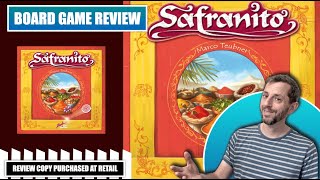
Safranito, the Zoch dexterity and bluffing game designed by Marco Teubner in 2010, is a title that reviewers tend to rediscover rather than recommend as a mainstream hit. The coverage that exists is consistent on the core verdict: it is a charming oddity with superb components and an unusual blend of flicking and trading, but it is not a polished masterpiece. Adam Porter of Adam in Wales makes that point directly, praising the artistry and tactile quality while admitting the mechanics feel a little strange.
Tom Vassel of The Dice Tower revisited the game in a retrospective "Look Back" episode and rated it 7 out of 10, appreciating how a dexterity game is wrapped around a collection puzzle. Getting Games played a four-player session and described it as a quick, wonky game that was fun to try but could easily overstay its welcome. Reviewers agree on the theme, the presentation, and the laughter at the table. Their disagreement centers on whether the chaos of the flicked chips is a feature or a flaw.
Core Mechanics That Define Safranito
Flicking
Flicking is the mechanic that defines Safranito. Players skim poker chips from off the board onto the play surface, and each chip has to land inside a spice space to claim it. Adam Porter notes that the chips match the thickness and size of standard poker chips, and that the hole in the middle of each chip is what lets players judge whether it sits inside or outside a space. Chips cannot be placed by hand, so accuracy matters as much as strategy. Knocking a rival's chip off a space is a legitimate tactic, and Getting Games described how a carefully planned throw can be wiped out when another player's chip lands on top of it. The values on the chips stay hidden until every chip is down. Only then does each one reveal the price of the spice beneath it, which sets the order in which players buy and sell.
Set Collection
The second core system is set collection, built around spice cards and blend objectives. Spice cards are laid out around the edge of the board, and three spice blend objectives are available to everyone. Each player may also hold a secret blend that only they know. Adam Porter explains that the first player to complete three of these objectives wins the game. Money is not a goal in itself, because selling spices only provides the funds needed to buy the spice cards that complete a blend. Getting Games admitted to spending most of their money on the first card early in the game and then struggling to recover. Some board spaces grant a starting player marker or a secret blend, so where a chip lands carries set collection value as well as spatial value.
The Safranito Experience
Humor and Mischief
Safranito feels like a party game, and reviewers describe a table full of laughter. Adam Porter says the game creates a lot of laughs, and that other people wandering over to ask what is being played is part of its appeal. Players can get quite mean with it, focusing on blocking one another and complaining about being aimed at, which adds to the comedy. The silliness is sharpened by how quickly plans collapse. A well-judged throw can be erased by a neighbor's chip, and the moment becomes a shared joke. Getting Games described a session of around forty minutes that keeps its wonky weirdness from wearing out its welcome.
Tactile Satisfaction
The other defining feeling is tactile. Adam Porter describes the board as thick and lavishly illustrated, with two halves that lock together into one large spice market surface. The chips feel as substantial as a good poker set, and the act of flicking one and watching where it comes to rest gives each throw a physical payoff that the rules alone do not provide. Tom Vassel names the Indian spice theme as the part of the game they love most.
What Makes Safranito Stand Out
Components and Artwork
Reviewers consistently return to the production. Adam Porter discovered the game through the hot deals forum on BoardGameGeek and was struck by how much quality it offered for the price, from the chips that match a standard poker set to the spice illustrations. Chilis, turmeric, saffron, and the other ingredients give the board the look of an Indian spice booth, and Tom Vassel singled out that theme as a favorite. Adam Porter calls the illustration a real selling point, and the tactile quality of the pieces reinforces that impression every time the game is set up.
A Hybrid Unlike Other Games
The second standout is the mix of genres. Tom Vassel frames Safranito as a dexterity game that also asks players to collect ingredients, while Adam Porter describes it as a strange combination of silly, economic, and strategic play. Adam Porter says the game is unlike anything else in their collection, and that it feels refreshing when so many other titles feel alike. That novelty is why reviewers keep recommending it as an oddity worth seeking out, even though it is hard to find.
Potential Drawbacks
Chaotic and Mean Interaction
The most common concern is that the interaction can feel arbitrary. Getting Games lost by a large margin in a four-player game and attributed much of the result to misjudging the economy. They also noted that a missed throw can wipe out a turn's plans, and that a chip knocked by another player can erase a well-planned purchase. Adam Porter describes the mechanics as feeling a bit odd, and some players in the same Getting Games session were lukewarm about the experience. The chaos clearly suits some groups better than others.
A Steep Economic Learning Curve and a Four-Player Ceiling
The second concern is that the economy takes time to understand. Because the chip values are hidden until the round ends, planning around opponents is a skill that develops with repeated play. Adam Porter also feels the game is limited to four players, arguing that it seems like it could handle six if more chips were on the board, which would make it more frantic. Adam Porter attributes that cap to the cost of the components, so the restriction is one of production rather than design. Both points suggest the game rewards replays and may feel constrained by its component budget.
If You Enjoy Safranito
Players who enjoy Safranito's flicking will find similar satisfaction in Mondrian, which Adam Porter describes as a game where players roll, drop, or flick dice to land on high-scoring cards and collect sets of matching colors. That pairing of dexterity with set collection makes it the most natural companion to Safranito. Players who want a sharper accuracy challenge can try Crocodile, where discs are flicked across a highly polished surface toward a central hole, rewarding precise control. For a lighter option that keeps the laughter, Ice Cool offers simple flicking with penguins that slide through doorways, a good fit for groups that want an easy entry point. Adam Porter recommends Mondrian and Safranito together as offbeat choices for players who want something different from typical dexterity fare.
What Reviewers Are Saying
"Safranito is a game where you were tossing chips onto a board, but there was a game built around that. So, it was dexterity, but also trying to collect ingredients and stuff. I love the Indian spice theme to it."
— Tom Vassel, The Dice Tower
"It's this weird mix of silly and economic and strategic, delightfully mean, trying to knock other people's pieces off the board. But a weird and wonderful game."
— Adam Porter, Adam in Wales
"It was a quick game like 40 minutes, so if it was too much longer than that it would probably start to overstay it's welcome with its wonky weirdness, but I enjoyed playing it, I hope to get it out again."
— Getting Games