




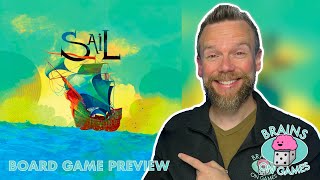


























Sail box art

Sail

Game ID: GID0274687
Collection Status
Description

Strap up your piratical boots, and navigate your ship through turbulent waters in Sail, a co-operative trick-taking game for two players. Reach the end of this dangerous deep end, and avoid taking damage from the Kraken to win the game together...or your crew will be sleeping with the fish!

Before each round begins, players exchange cards, then play a series of tricks. Different game actions will be triggered depending on who wins each trick in combination with the unique character skills. However, the crashing sea water and the roaring Kraken make for a deafening situation, and players are unable to communicate about tactics and card information from the moment cards are dealt to the end of the action phase.

Players win the game as a team if they sail their ship into the final token before the Kraken reaches the Death tile or the Kraken deck is exhausted.

—description from the publisher

Year Published
2023
Transcript Analysis
Browse transcript mentions, sentiments, pros/cons, mechanics, topics, quotes, and references.
Total mentions: 11
This page: 11
Sentiment: pos 9 · mix 1 · neu 1 · neg 0
Mentions per page
Top
Showing 1–11 of 11
Video 8j4hRR1WUJY rules_teach at 0:01 sentiment: neutral
video_pk 61672 · mention_pk 154319
Sail video thumbnail
Click to watch at 0:01 · YouTube ↗
Overall sentiment (raw)
neutral
Pros
  • Clear setup and play explanation
  • Explicit description of how scoring works, including row/column matching and differing word card difficulties
  • Discussion of pacing (nine rounds) and hand management options
  • Mention of a solo mode for single-player play
Cons
none
Thematic elements
  • visual-word association within a grid; tableau-building driven by image and word cards.
  • Tabletop, players build a 3x3 image-card tableau in front of them across nine rounds.
  • procedural
Comparison games
none
Mechanics (from transcript analysis)
  • grid-based tableau construction — Players create and modify a 3x3 grid of image cards to form their tableau.
  • hand management — At the end of a round, players may draw new cards or discard to refresh their hand, with endgame penalties for discards.
  • hand management / card draw — At the end of a round, players may draw new cards or discard to refresh their hand, with endgame penalties for discards.
  • image card drafting / selection order — After players reveal their chosen image cards, the numeric marker on each card determines play order for selecting from the grid.
  • resource scoring with gems — Gems are used to track scoring on the grid; points are tallied and endgame deductions apply for discards.
  • round-based play — The game unfolds over nine rounds, with simultaneous play and scoring each round.
  • solo mode — A solo variant exists for playing alone.
  • tableau building — Players create and modify a 3x3 grid of image cards to form their tableau.
  • Word building — Word cards placed around the grid score points when they associate with corresponding images in rows or columns.
  • word-image association scoring — Word cards placed around the grid score points when they associate with corresponding images in rows or columns.
Video topics + discussion points
No key topics recorded for this video.
Quotes (from this video)
  • This is Mosaic, a tableau building game
  • the goal of the game is to have a nine card tableau in front of us.
  • When everyone has played their picture cards, adjusted their grids, and scored their words, they then have two options.
  • The game also features a solo mode which I will let you explore for yourselves.
References (from this video)
No references stored for this video.
Video 5OL_buGr-o4 game_review at 0:11 sentiment: positive
video_pk 61677 · mention_pk 154322
Sail video thumbnail
Click to watch at 0:11 · YouTube ↗
Overall sentiment (raw)
positive
Pros
  • beautifully simple
  • puzzly and engaging
  • stunning artwork
  • open to interpretation leading to discussion
Cons
  • No explicit rating provided in transcript; potential depends on players enjoying puzzle-y word-grid mechanic
Thematic elements
Comparison games
none
Mechanics (from transcript analysis)
  • Compound Scoring — Score in a row/column depends on how many cards match the word on the corresponding word card, indicated by gems.
  • gem_resource_management — Gems are placed on cards to indicate the number of matches (1-3).
  • hand management — Players start with a hand of three cards and choose one to place in their grid.
  • hand_management — Players start with a hand of three cards and choose one to place in their grid.
  • Resource management — Gems are placed on cards to indicate the number of matches (1-3).
  • row_column_scoring — Score in a row/column depends on how many cards match the word on the corresponding word card, indicated by gems.
  • tableau building — Players place cards into a 3x3 grid to create a personal tableau.
  • tableau_building — Players place cards into a 3x3 grid to create a personal tableau.
  • Word building — After placing a card, players select a word card from a common supply to place in a row or column.
  • word_card_selection — After placing a card, players select a word card from a common supply to place in a row or column.
Video topics + discussion points
No key topics recorded for this video.
Quotes (from this video)
  • What I really love is when a game seemingly comes out of nowhere, blindsides you, and is just incredible to play.
  • Mosaic is beautifully simple and also really, really puzzly.
  • I just love the artwork.
  • It's open to interpretation as well, so there's a lot of discussion and conversation that can go around.
  • I highly recommend you give Mosaic a try when you get a chance.
References (from this video)
No references stored for this video.
Video bybvGfaQpgY Unknown Channel game_review at 0:07 sentiment: positive
video_pk 42639 · mention_pk 129541
Unknown Channel - Sail video thumbnail
Click to watch at 0:07 · YouTube ↗
Overall sentiment (raw)
positive
Pros
  • beautiful art
  • solid core concept of grid building and pattern matching
  • engaging, social interaction through card meaning debates
Cons
  • ambiguous card meanings can lead to arguments
  • lack of an explicit reference for card-to-ability mapping may slow play
Thematic elements
  • Grid-based tile matching with pattern recognition in a tabletop party game
Comparison games
none
Mechanics (from transcript analysis)
  • Discard to draw — Discarding two cards allows drawing three new cards; discarded cards are set aside and penalize scoring
  • End-game scoring — When all grids are complete, scoring tallies across players, including penalties from discards
  • grid placement — Players place cards into a 3x3 grid, adding cards adjacent to existing rows and columns
  • hand management — Each player holds a hand of three cards; rounds involve selecting and revealing cards, then adding to grids
  • hand management / draw — Each player holds a hand of three cards; rounds involve selecting and revealing cards, then adding to grids
  • Pattern scoring — Points are earned for matching features across a row/column (e.g., color, helmet, star, moon)
Video topics + discussion points
No key topics recorded for this video.
Quotes (from this video)
  • I like Mosaic.
  • I'm giving this game a seven out of 10.
  • There is a reason it's not an eight.
  • It's a fun, amusing, different style party game. Mosaic.
  • The concept of the game works really well.
  • I find this to be enjoyable.
References (from this video)
No references stored for this video.
Video TbItqe-pkt8 Danny Sia general_discussion at 9:24 sentiment: positive
video_pk 42288 · mention_pk 128291
Danny Sia - Sail video thumbnail
Click to watch at 9:24 · YouTube ↗
Overall sentiment (raw)
positive
Pros
  • Simple core rules with surprising depth
  • Beautiful, rib-cage-like board and a distinctive visual aesthetic
  • The central buck mechanic adds meaningful tactical choices
Cons
  • Dice introduces randomness that can affect control and timing
  • Track-based movement may feel abstract to some players
Thematic elements
  • Deer herd management and territory control with a central buck that can flip sides
  • Sami culture in northern Scandinavia; Arctic deer herding
  • Cultural anthropology-influenced abstract with a vivid wildlife/arctic scene
Comparison games
  • Backgammon
Mechanics (from transcript analysis)
  • Capture via landing on same bone fragment — Landing on an opponent's bone fragment removes their deer from the board.
  • Central buck as dynamic resource — Capturing the central buck flips it to your side, increasing your herd and opening new sweeping options.
  • Dice-driven movement along a track — Rolls of dice determine how deer pieces unlock and advance along a figure-8 track on a rib-like board.
  • track-based positioning — Deer move along three main rows with a central corridor where most conflict and captures occur.
Video topics + discussion points
No key topics recorded for this video.
Quotes (from this video)
  • Doesn't matter which way you turn them around because they all are super fun.
  • Paya is actually a Greek game that philosophers and the citizens of Greece used to play to test their mental agility, their ability to ent trap and encircle their opponent by making strategic and tactical moves.
  • I find Saku quite a fascinating game just because how simple it is, but I just can imagine myself, you know, leading the herd of deer across the snow in the Arctic, bracing that cold weather and just really um thinking about how I'm going to maneuver my herd into position so that I can have maximum impact against my opponent.
  • Bear Hunt has this interesting tactical element to it. You're guided by the lines on the circuit.
References (from this video)
No references stored for this video.
Video 8KMijJnFAQo Board Stupid interview at 0:59 sentiment: positive
video_pk 40517 · mention_pk 122788
Board Stupid - Sail video thumbnail
Click to watch at 0:59 · YouTube ↗
Overall sentiment (raw)
positive
Pros
  • Unique prediction mechanic that ties player attention to opponents' strategies
  • Tarot-based action selection provides a tactile, thematic core
  • Strong thematic integration with fortune telling and studio-building
  • High production value in deluxe edition (premium components, depth illusion from layered printing)
  • Multiple viable strategies thanks to flexible objectives
Cons
  • Potential learning curve for new players due to intertwined mechanics
  • Requires careful tracking of opponents' strategies and resources
  • Deluxe components increase price and may complicate setup
Thematic elements
  • Prediction, fortune telling, reputation-building, and studio management
  • A fantasy setting where fortune tellers operate a studio, vying for customers and prestige
  • Competitive, player-interaction driven with hidden intentions and forecasting
Comparison games
none
Mechanics (from transcript analysis)
  • Artifact and marketplace expansion — Acquiring artifacts and expanding the studio through a marketplace mechanic adds depth and strategic choices.
  • Hidden deployment — Players attempt to anticipate other players' choices, blending hidden intention with strategic planning.
  • Prediction/forecasting of opponents' moves — Players attempt to anticipate other players' choices, blending hidden intention with strategic planning.
  • Resource and set-collection management — Players attract customers who provide resources (money, crystals) and use them to acquire artifacts and build their studio.
  • Tarot card-based action selection — A deck of tarot cards is used to select actionable options each turn, acting as the core action-selection mechanism.
  • Track advancement — A shared track tracks fame and power, influencing customer choices and overall progress toward victory.
  • Track-based fame and power scoring — A shared track tracks fame and power, influencing customer choices and overall progress toward victory.
  • Variable objectives with two-of-four win condition — Four possible objectives exist, and fulfilling any two can secure victory, enabling diverse strategies.
Video topics + discussion points
No key topics recorded for this video.
Quotes (from this video)
  • this is a competitive Bard game for two to four players in which players will pay as fortune tellers
  • they have a cool deck of tarot cards which is actually an action selection mechanism
  • to secure customers ... get their payment
  • spend those money to purchase artifact trinket to set up a good Studio
  • by fulfilling just two of them you can win
  • you can craft your own strategy into the game and each other player will likely have a different strategy with respect to yours
  • seed of the game itself ... we really wanted a game that asked for you to pay attention to the other players and their own strategy
  • the fortune teller led to the tarot cards because we had to provide many actions
  • it's representative of the deluxe edition
  • premium acrylic components with three layers of printing which give an illusion of depth
  • there are shadows and those are the core differences between the premium and the base box
  • the marketplace is an extension over here
References (from this video)
No references stored for this video.
Video -_-JSFSRACI Board Stupid top_5_list at 1:39 sentiment: positive
video_pk 34988 · mention_pk 104327
Board Stupid - Sail video thumbnail
Click to watch at 1:39 · YouTube ↗
Overall sentiment (raw)
positive
Pros
  • Deep interaction and clever cardplay
  • Innovative use of prediction and multi-layered bonuses
  • Vibrant thematic setting
Cons
  • Potential complexity for new players
  • Some player interactions depend on others' choices
Thematic elements
  • Fate, prediction, client management
  • Fortune-teller themed social interaction game
  • competitive deduction with hidden information about others' actions
Comparison games
none
Mechanics (from transcript analysis)
  • deity-end scoring via favors from four gods — End-game scoring determined by God factions
  • hand management — Players hold three face-down action cards per turn; plan and reveal
  • predictions of other players — You predict opponents' plays to gain bonuses
  • Predictive Bid — You predict opponents' plays to gain bonuses
  • set collection — Gaining favors from clients and gods to upgrade abilities
  • set-collection / resource gain — Gaining favors from clients and gods to upgrade abilities
Video topics + discussion points
No key topics recorded for this video.
Quotes (from this video)
  • oh my God how good it is
  • it's absolutely fantastic
  • Mega clever
  • no rarity barrier
  • it's absolutely delightful
References (from this video)
No references stored for this video.
Video dkpHSY36_8A Undetermined (see channel_id) playthrough at 0:00 sentiment: positive
video_pk 12381 · mention_pk 36165
Undetermined (see channel_id) - Sail video thumbnail
Click to watch at 0:00 · YouTube ↗
Overall sentiment (raw)
positive
Pros
  • Novel two-player cooperative trick-taking mechanic
  • Pirate theme
  • Interesting dual objective system
  • Creative tension between cooperation and competition
Cons
none
Thematic elements
  • pirates
  • naval
  • town building
  • cooperative competition
  • heroes
  • fantasy
Comparison games
none
Mechanics (from transcript analysis)
Mechanics unknown.
Video topics + discussion points
No key topics recorded for this video.
Quotes (from this video)
No quotes stored for this video.
References (from this video)
No references stored for this video.
Video FFoqW4f2Z-8 Rolling Dice and Taking Names general_discussion at 1:10:06 sentiment: positive
video_pk 10790 · mention_pk 105810
Rolling Dice and Taking Names - Sail video thumbnail
Click to watch at 1:10:06 · YouTube ↗
Overall sentiment (raw)
positive
Pros
  • beautiful production and tactile components
  • clear path to scoring through paintings and mosaics
Cons
  • setup and table presence can be extensive
  • potential for analysis paralysis for new players
Thematic elements
  • artistic production and geopolitical development
  • Global civilizations and world-building through mosaics
  • tile-based world-building with artistic scoring
Comparison games
  • Canvas
  • Mystic Veil
Mechanics (from transcript analysis)
  • area/engine-building — combine actions and tiles to improve your mosaic engine
  • engine building — combine actions and tiles to improve your mosaic engine
  • tile placement — place tiles to build mosaics and gain effects
Video topics + discussion points
No key topics recorded for this video.
Quotes (from this video)
  • it's a very simple game in that on your turn you're going to take one of several actions but there's a lot going on
  • Dice in a bowl is the current reigning champion
  • this is one of those games if you're interested in playing don't feel like that after one game you feel like you got a handle on it
  • the learn to play guide in here walks you through the game
  • it's a heavy Euro that uses the app for four players only
  • we're here to have fun don't worry about it, we're gamers
References (from this video)
No references stored for this video.
Video Ey7AWFXqFPo Let's Talk Board Games general_discussion at 11:29 sentiment: mixed
video_pk 3934 · mention_pk 11519
Let's Talk Board Games - Sail video thumbnail
Click to watch at 11:29 · YouTube ↗
Overall sentiment (raw)
mixed
Pros
  • Unique twist on trick-taking, cooperative
  • Strong communication and timing opportunities
  • Visually appealing artwork
Cons
  • Two-player limit
  • Can be punishing if goals are not reached
  • Asymmetric powers may be underutilized in some plays
Thematic elements
  • Cooperative trick-taking with map navigation and spatial constraints
  • Cooperative sailing journey with a map and hazards
  • Team-based objective to sail to a destination
Comparison games
none
Mechanics (from transcript analysis)
  • Asymmetric powers — Each player has a power that can alter play timing
  • card passing — At round start, pass one card to teammate to communicate intent
  • symbol matching — Cards have symbols that combine to enable boat movement
  • Trick-taking — Follow suit and win tricks to progress the boat
Video topics + discussion points
No key topics recorded for this video.
Quotes (from this video)
  • cdsk is a trivia based game so it's a little hoot for the family
  • I actually really really like this system
  • it's quick and it plays in like 10 minutes
  • this is a trick taking game but the point is to sail this boat
  • I don't know if I'm ever going to use this asymmetric power but then you get to the final three
  • this game was a pleasant surprise for me
References (from this video)
No references stored for this video.
Video 4YHdlv_XJ2o Chairman of the Board general_discussion at 16:52 sentiment: positive
video_pk 3726 · mention_pk 80860
Chairman of the Board - Sail video thumbnail
Click to watch at 16:52 · YouTube ↗
Overall sentiment (raw)
positive
Pros
  • very accessible for a complex civilization game
  • strong table presence and strategic depth
Cons
  • setup can be lengthy for newer players
Thematic elements
  • card-driven production and multi-path scoring
  • civilization-building mosaic
  • grand strategy with accessible rules
Comparison games
none
Mechanics (from transcript analysis)
  • card drafting — build a diverse production engine by selecting cards
  • card drafting and engine-building — build a diverse production engine by selecting cards
  • military and civil objectives — compete on multiple public objectives and end-game scoring
Video topics + discussion points
No key topics recorded for this video.
Quotes (from this video)
  • I absolutely adore this one
  • I think it is an absolute blast
  • this game is fantastic
  • an evergreen to me
  • it's stripped back and still a blast
References (from this video)
No references stored for this video.
Video gz-txucBOQg Broad top_5_list at 9:19 sentiment: positive
video_pk 2596 · mention_pk 7686
Broad - Sail video thumbnail
Click to watch at 9:19 · YouTube ↗
Overall sentiment (raw)
positive
Pros
  • beautiful production
  • challenging and engaging
Cons
  • very challenging; not casual
Thematic elements
  • cooperative two-player trick-taking
  • pirate voyage with a stormy sea
  • lush, thematic
Comparison games
none
Mechanics (from transcript analysis)
  • Trick-taking — players cooperate to navigate a ship using trick-taking mechanics to steer movement.
  • two-player cooperative trick-taking — players cooperate to navigate a ship using trick-taking mechanics to steer movement.
Video topics + discussion points
No key topics recorded for this video.
Quotes (from this video)
  • Inflation is true. Everything costs more.
  • There is a lot still you can buy for £20.
  • Code Names is a tremendous game that you can get for $19.95.
References (from this video)
No references stored for this video.
Transcript Navigation
Top
Showing 1–11 of 11
View on BoardGameGeek