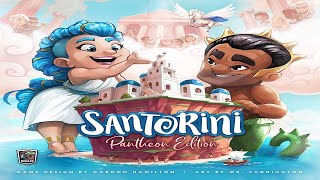
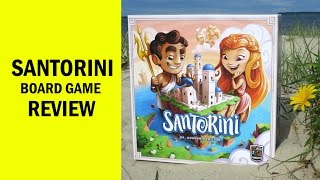
Santorini is a re-imagining of the purely abstract 2004 edition. Since its original inception over 30 years ago, Santorini has been continually developed, enhanced and refined by designer Gordon Hamilton.
Santorini is an accessible strategy game, simple enough for an elementary school classroom while aiming to provide gameplay depth and content for hardcore gamers to explore, The rules are simple. Each turn consists of 2 steps:
1. Move - move one of your builders into a neighboring space. You may move your Builder Pawn on the same level, step-up one level, or step down any number of levels.
2. Build - Then construct a building level adjacent to the builder you moved. When building on top of the third level, place a dome instead, removing that space from play.
Winning the game - If either of your builders reaches the third level, you win.
Variable player powers - Santorini features variable player powers layered over an otherwise abstract game, with 40 thematic god and hero powers that fundamentally change the way the game is played.
Santorini in about 3 minutes
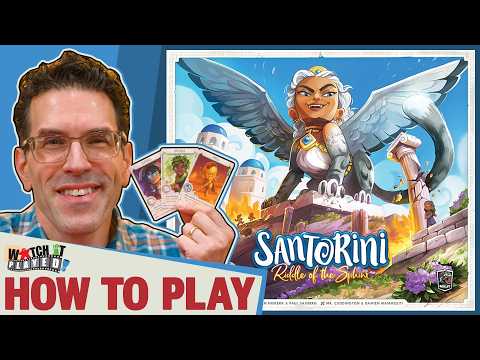
Santorini: Riddle Of The Sphinx - How To Play
Sanatorium | Playthrough
- abstract competition with god powers
- Greek island of Santorini; towers and domes
Mechanics (from transcript analysis)

Video topics + discussion points
Quotes (from this video)
- Stellar is not a super well-known, well-talked-about game. I found it randomly in a local board game store.
- it's basically a two-player only game, asymmetric
- Lost Cities is a hand management game
- Patchwork is a tight, solid Uwe Rosenberg design
- Santorini is my favorite abstract game
- Castles of Burgundy... there's nothing like it for me in two-player
- Race for the Galaxy is my number two two-player game of all time
References (from this video)
- some God power combinations are not fun and can be tedious to figure out
Mechanics (from transcript analysis)
Video topics + discussion points
Quotes (from this video)
- we're going to be doing our updated top 50 games of all time pretty soon
- be critical about the things you love because nothing is perfect
- healthy debates and discussions
- we can all be looking at things we love more critically
- this is a really important exercise
- don't tell me anything you like about it or why it's your number one; tell me what you don't like about it
References (from this video)
Mechanics (from transcript analysis)
Video topics + discussion points
Quotes (from this video)
- it's the meanest game in my top 10, no question
- there's just always something exciting to do on your turn
- it's an absolute hit
- it's the best social deduction experience I've ever had
- the shortest playing time
References (from this video)
Mechanics (from transcript analysis)
Video topics + discussion points
Quotes (from this video)
References (from this video)
- Great physical components and tactile feel that enhance the playing experience
- God Powers add variety and significantly enhance the perceived depth and shine
- Strong suitability for couples; supports multiple rounds with varying configurations
- tower construction, control, and positional play with variable power modifiers
- Mythical island of Santorini; abstract, two-player strategy involving ascent via tower building
- abstract with thematic gloss provided by god powers
Mechanics (from transcript analysis)
- building — On a turn, players build a block on a space, increasing its height and potentially blocking or enabling future moves.
- god powers — A suite of special abilities that alter base rules, providing varied strategic options and replayability.
- Layer building — On a turn, players build a block on a space, increasing its height and potentially blocking or enabling future moves.
- win condition — A player wins by moving a worker to the third level of a tower, achieving vertical dominance.
- worker movement — Players maneuver one of their workers to an adjacent space on a grid, enabling strategic positioning and threat creation.
Video topics + discussion points
Quotes (from this video)
- it's an abstract chess like game where you're having to try to get one of your characters to the top of one of the towers
- the God Powers which really make the game shine
- the physical components in this are great
- fits into the Let's Get Physical category
- there's two games I'm going to recommend here the first one is Santorini
- I talk a lot about this game on the channel so does Carlo um so does Bren we all love this game
References (from this video)
- Eye-catching components and visual appeal
- Strong two-player experience with potential for depth via god powers
- Great as a teaching tool for non-core gamers about strategy without heavy rules
- Can be quite competitive; balance can depend on player skill
- Not ideal for players seeking light, purely casual play every session
Mechanics (from transcript analysis)
Video topics + discussion points
Quotes (from this video)
- "Santorini is it can play up to four I think that I always consider this a strictly two-player game"
References (from this video)
- Immediate, satisfying two-player face-off
- Accessible and fun; easy to reintroduce
- Fell off top 10 lists with time; needs re-engagement to feel fresh
- Toy Battle
Mechanics (from transcript analysis)
- Abstract placement and movement — Strategic dueling with forced placement and movement; quick, head-to-head turns
Video topics + discussion points
Quotes (from this video)
- two players, not enough time
- steal someone's donkey
- bang for your buck
- eight maps in the base box
- you can draw from the deck. Each card has its own way of like yes, you can use it as an item, but it's also one of the endgame conditions
References (from this video)
- Distinct art style and atmospheric presentation that invites curiosity about the historical medical setting.
- Interesting deck-builder-like approach to diagnosing and treating patients in a narrative-driven framework.
- Conversation around sensitive topics (mental health representation and gender/ethics) is foregrounded in the narrative and atmosphere.
- Steep learning curve with the diagnostic workflow and symptom-to-region mapping can be opaque at first.
- Some players may find mechanics repetitive or unintuitive, especially around resource management and daily progression.
- Ambiguities in UI guidance may lead to misdiagnosis or inefficiencies that impact prestige.
- psychiatry and early-20th-century medical ethics; exploration of anxieties around mental health representation; narrative-driven investigation mixed with clinical gameplay elements.
- Roaring 1920s, a mysterious mental asylum/castle woods facility with a shadowy past; clinic ward dynamics unfold through patient files, diaries, and in-game investigations.
- First-person playthrough with diary-like narration, in-game diagnostics workflow, and episodic patient cases that unfold through logs, dreams, and item-based storytelling.
- Strange Antiquities
Mechanics (from transcript analysis)
- Card-based diagnosis — Drag symptom cards into brain-region slots to categorize and diagnose patient conditions.
- Deck building — Acquire and apply treatment cards to patients to improve health and progress the day’s work.
- deck-building / card management — Acquire and apply treatment cards to patients to improve health and progress the day’s work.
- evidence collection — Collect snippets, notes, and diary entries under the bed to build evidence for cases.
- Narrative choice — Interplay between in-game diary/letters and in-session patient interactions that shape story and mood.
- Narrative exploration — Interplay between in-game diary/letters and in-session patient interactions that shape story and mood.
- Resource management — Balance treatments, patient health, and daily prestige; poor performance can risk termination.
- Resource management and prestige — Balance treatments, patient health, and daily prestige; poor performance can risk termination.
- Syndrome grouping — Group related symptoms into syndrome cards to streamline diagnosis and treatment decisions.
- Upgrades shop — Purchase upgrades (e.g., music therapy, dietary protocols) to broaden treatment options.
Video topics + discussion points
Quotes (from this video)
- Mental health issues um are often exaggerated.
- The setting is, as you can see, a mental asylum.
- It's new on Steam, so check it out if you want to.
- It's a deck builder in a way.
- The art style looks very unique, I think.
References (from this video)
- Immediate two-player head-to-head competition with deep strategic depth
- Striking 3D aesthetic and table presence that reinforces the theme
- 30 varied gods provide strong replayability and fresh challenges
- Simple core actions (move, build) but with high strategic ceiling
- Compact playtime (~15 minutes) makes it ideal for quick sessions and repeat play
- Rulebook quality described as a black-and-white photocopy in some editions, which can hinder rule lookups
- Official box text claims two to four players, but the game fundamentally plays as a two-player experience; the 3–4 player modes feel secondary
- Expansion content is present but not fully explored in the discussion
- Asymmetric god-powered competition to shape a city and outmaneuver the opponent, framed as a mythic contest among Greek deities.
- A stylized, elevated 3D city on the Greek island of Santorini, where players compete to build upward and reach the third level.
- Design-driven abstract strategy with thematic veneer; emphasizes tactical play and positional manipulation within a tight playtime.
- Checkers
- Tic-tac-toe
- Chess
Mechanics (from transcript analysis)
- asymmetric god powers — Each player selects a god power that modifies core rules, introducing unique abilities (e.g., Hermes moves extra spaces, Aphrodite affects proximity of opponents, Hephaestus can build multiple times) and dramatically changing strategy.
- asymmetric player powers — Each player selects a god power that modifies core rules, introducing unique abilities (e.g., Hermes moves extra spaces, Aphrodite affects proximity of opponents, Hephaestus can build multiple times) and dramatically changing strategy.
- building — After moving, you build a single block on an adjacent space, creating a vertical stack that can reach a third level; the key is to manage growth while denying your opponent the opportunity to climb.
- hidden victory points — A player wins by having a worker move onto the third level of a tower; domes can block ascent and alter endgame dynamics, adding a spatial chess-like tension.
- Layer building — After moving, you build a single block on an adjacent space, creating a vertical stack that can reach a third level; the key is to manage growth while denying your opponent the opportunity to climb.
- Movement — On your turn you move one of your two workers to an adjacent space (including diagonals) with elevation constraints; you cannot move more than one level up at a time and cannot move onto a completed dome.
- two-player emphasis — While marketed with multiple-player variants, the game is presented and most effectively played as a head-to-head two-player abstract strategy experience, with 3–4 player variants treated as alternate forms in some rulesets.
- Victory condition — A player wins by having a worker move onto the third level of a tower; domes can block ascent and alter endgame dynamics, adding a spatial chess-like tension.
Video topics + discussion points
Quotes (from this video)
- Santorini is a 3d game set unsurprisingly on the greek island of Santorini
- it's a simple but deep 15-ish minute abstract strategy game
- this is a head-to-head brain to brain contest
- this is a modern classic
- you are building an actual 3d city
- the box says two to four players this is a two player game
References (from this video)
- beautiful components and board with a Greek-island aesthetic
- tight gameplay with elegant mechanics
- strong abstract strategy with clear decisions
- abstract nature may not appeal to all players
- asymmetric powers, gods, and climbing buildings
- mythic island with stylized buildings
- Array
- positive
Mechanics (from transcript analysis)
Video topics + discussion points
Quotes (from this video)
- it's a light drafting racing game but it definitely has some summer vibes
- it's six different little mini timers
- it's bright and it's colorful and you are trying to defend the islands from oncoming monsters
- Banner Festival is a really interesting trick taking game
- it's all based on slasher movies
- the Heat is in the title
- Fireball Island ... the Curse of Volcar
- you flick marbles
References (from this video)
- Has the legs to make it to the final four (in discussion)
Mechanics (from transcript analysis)
Video topics + discussion points
Quotes (from this video)
- It's literally a popularity contest.
- Code Names Duet is also just a lot of fun.
- Santorini has the legs to make it to the final four.
- Zenith narrowly edged it out 51% to 49% of the vote on this one.
- Watergate is my favorite two-player game.
- I'm 6 and 0 on Cena so far.
References (from this video)
Mechanics (from transcript analysis)
Video topics + discussion points
Quotes (from this video)
- you can be the most unlike unlikable person, but if you can just get one person to agree to play with you.
- you get to play both roles within a session.
- this is one of the most playable games I think on our list here in terms of just you could play this a 100 times and still be seeing situations you haven't seen before.
- not an easy game to learn.
References (from this video)
- Elegant two-player competition with clear, approachable rules
- Strong direct interaction through movement and building choices
- Abstract without deeper strategy or theme reinforcement
- Learning curve for new players to grasp movement/build constraints
- building towers with gods, balance of power and spatial control
- Santorini island with mythic Greek influences
- Array
- Santorini
Mechanics (from transcript analysis)
- build — after moving, place a block on an adjacent space, stacking levels
- Move — on your turn, move a worker to an adjacent space (diagonal allowed) if unoccupied
- win condition — reach a required height to win or place a dome to block a space
- worker placement — on your turn, move a worker to an adjacent space (diagonal allowed) if unoccupied
Video topics + discussion points
Quotes (from this video)
- In Santorini Riddle of the Sphinx, you and the other players will be working together to accomplish the goals of the riddle you're currently attempting.
- Remember, you can only pick one of the three actions to perform.
- The game is played over a series of turns, beginning with the start player and going clockwise around and around the table.
- One of the main challenges with completing a riddle is that you'll find yourself restricted by what pieces you can build with.
References (from this video)
- Dramatically increases variability of each game through many god power permutations
- Adds a robust two-player mode with new strategic options
- Hero cards provide a balanced way to introduce less experienced players
- New tokens and boards expand thematic and tactical possibilities
- Good compatibility with base game cards so you can mix and match
- Some Golden Fleece cards are not usable with all combinations, which can cause confusion
- Added rules and components increase complexity and setup
- Not all players will feel the expansion is necessary if they already enjoy base game depth
- divine power, competition, and tactical control via God powers
- Mythic island setting where Greek gods influence the landscape and architecture on Santorini
- abstract strategy with thematic god-based powers
- Santorini (base game)
Mechanics (from transcript analysis)
- asymmetric god powers — Each god grants a unique, often one-time or per-game ability that alters how you move, build, or win.
- asymmetric player powers — Each god grants a unique, often one-time or per-game ability that alters how you move, build, or win.
- Compatibility with base game and card pools — Many Golden Fleece cards can be used with base-game gods if compatible, increasing variability without mandating the fleece variant.
- Fleece Map and Adjacent Building — Some fleece powers allow building in eight directions or wraparound play to create tricky positioning.
- Golden Fleece Variant (two-player focused) — A fleece token placed early grants a per-game power activation when adjacent to the fleece; enables a distinct two-player dynamic.
- Hero Cards (one-time powers) — Ten hero cards provide one-time abilities to balance or spice gameplay in two-player matches.
- Movement and Building on a Grid — Players move and build on a grid with gods providing special interactions; classic Santorini core mechanic.
Video topics + discussion points
Quotes (from this video)
- The biggest asset to this game is the plethora of combinations of different God powers
- It's not something I felt like it needed it but at the same time it really is great
- This is a fantastic way to play with kids or play with inexperienced players
- The fleece variant right—it's a completely different game
References (from this video)
- one of the speaker's favorite games; considered a top-tier pick
- three-player variant adds a refreshing variance while maintaining core skill-based play
- older than some other picks; some feel it is best with two players
- even with 3–4 players, luck elements can tip outcomes in some sessions
- mythic architecture and dueling strategies
- mythic city-building on a grid
- abstract strategy with thematic flavor
- Heraldica
Mechanics (from transcript analysis)
- 3-player variant — supports a three-player mode that introduces luck elements and different dynamics.
- grid-based abstract strategy — players maneuver pieces to construct and block on a shared grid.
- Variable player interaction — player capabilities are shaped by god powers and positional plays, with a pure skill emphasis.
Video topics + discussion points
Quotes (from this video)
- this game is more about defense than offense
- it's a very tranquil peaceful game
- the joy of this game is finding cool moves
- I have so much fun with this game
- the colors and harmonies this game has
References (from this video)
- Stunning visual presentation with 3D pieces
- Engaging 3D space strategy
- Accessible yet capable of deep play for hobbyists
- 2-player focus; can be less dynamic with more players
- Some god powers may feel overpowered in certain groupings
- city-building and sky-high towers
- Mythic Greek island with gods and builders
- head-to-head abstract with thematic flair
- Chess-like abstract games
- Other god-power arena abstracts
Mechanics (from transcript analysis)
- 3D area control / building — Each turn you move a unit and build on an adjacent space; goal is to reach the third level with a unit.
- god powers — Each player gets a random god power that alters abilities or victory conditions.
- Unique player powers — Each player gets a random god power that alters abilities or victory conditions.
Video topics + discussion points
Quotes (from this video)
- it's the golden age of board games. It is becoming more and more popular.
- visually it just looks incredible out on a table.
- the game just has a ton of fun kind of figuring out what people have.
- dead simple to teach this game.
- an absolute hit and it's been an absolute blast.
- this is the game I could see playing again and again.
References (from this video)
- Elegant core puzzle
- Great two-player experience
- Limited or minimal theme
- Twilight Struggle
Mechanics (from transcript analysis)
- abstract_strategy — Two-player abstract strategy game focusing on building and blocking.
Video topics + discussion points
Quotes (from this video)
- theres no good or bad games objectively
- every game has its own unique profile
- the five attributes: theme mechanics components strategy and complexity
- the perfect board game formula
- identify the strengths of a game even if those strengths are outside of their own perfect board game formula
References (from this video)
- beautiful production and components
- highly tactical yet accessible
- powers can create lopsided openings if not well matched
- towering gods and clever blocking
- ancient Greek island
- abstract with thematic flavor
- Chess
- Other abstract duels
Mechanics (from transcript analysis)
- abstract strategy / two-player head-to-head — play as builders trying to climb to the top while opponents block and react
- god powers — randomized or chosen god abilities provide game-breaking twists
Video topics + discussion points
Quotes (from this video)
- this is where it's at
- Scout has this really interesting aspect of you can only play cards that are next to each other in your hand to try to beat things
- it's a great escalation
- such an amazing feeling of like oh my gosh we're gonna go another round
- you either lose because you miscommunicate with your own team twice or you win because you intercept the other team's code
References (from this video)
- Dynamic 3D spatial reasoning on a 2D board
- God powers add enormous variability and replayability
- Clear core goal with dramatic, cinematic moments when powers trigger
- God powers can feel unbalanced to some players
- Rules and expansions may require setup time for newcomers
- Verticality, control, and tactical blocking
- A mythic island with building towers
- Competitive, pseudo-heroic duels with magical twists via god powers
Mechanics (from transcript analysis)
- Building caps — A cap can be placed to block opponents from reaching the third level on a given tower.
- god powers — A wide set of powers that can drastically alter win conditions and game state.
- Track advancement — Players climb towers to reach the third level; reaching it wins unless blocked by caps on top.
- Vertical progression — Players climb towers to reach the third level; reaching it wins unless blocked by caps on top.
- worker placement — On your turn, move a builder on a 5x5 grid, then place a building level adjacent to that worker.
- Worker placement and building — On your turn, move a builder on a 5x5 grid, then place a building level adjacent to that worker.
Video topics + discussion points
Quotes (from this video)
- condenses the feeling of chess into kind of a miniature chess board
- movement templates can really change the feel of the game
- there's a ton of God powers that you can play with and these aren't just little things
- portable, very durable, this is a great like camping game
- the pieces themselves make up the play area
- there are some really good opportunities for clever plays or ways to trap your opponent
- the goal is five in a row
- when you move that ring, it flips all of the discs that it jumped over
References (from this video)
- High replay value due to cards and combos
- Beautiful components
- abstract strategic building
- Ancient Greek island of Santorini
- elegant, elegant abstraction
Mechanics (from transcript analysis)
- abstract strategy — Tactical tower-building with position-based victory
- tile placement — Constructive placement to outmaneuver opponent
Video topics + discussion points
Quotes (from this video)
- The perfect board game collection doesn't exist until now.
- This game's got a ton of replayability as well because every single time you play, you're going to set up a different module and it's going to change how you play.
- And remember, corporai never dies.
- Code Names. You can play this game wherever, whenever, with whoever.
- Spirit Island is the greatest cooperative game ever made.
References (from this video)
- Fixed hand creates meaningful constraints that drive deliberate decision-making and strategic planning.
- The choice between discarding beaten cards or absorbing them into your hand adds meaningful interaction and risk-reward calculus.
- The option to reintegrate beaten cards into your hand provides avenues for comeback plays and late-game depth.
- A clear ladder-climbing framing offers a tangible long-term objective and tension as players attempt to scale.
- Rigid fixed hand can feel restrictive for players who prefer more flexibility or rearrangement.
- The mechanic may impose a higher cognitive load, potentially slowing down play for newcomers.
- Resource-scarce play may limit viable options if players are unable to beat the current set without sacrificing efficiency.
- hand management, competitive beat-the-set dynamics, and potential card reclamation from the discard to strengthen future plays
- Abstract ladder-climbing card shedding game where players operate under a fixed hand constraint.
- analytical, instructional, and strategically oriented
Mechanics (from transcript analysis)
- beat_the_current_set — On a turn, a player must either play a set of cards that beats the central or current play or choose to draw a card.
- discard_vs_steal_beaten_cards — When a set beats the current play, the player can either discard the beating cards or take the cards that were beaten into their hand and position them to enable future, stronger sets.
- draw_or_discard — When drawing a card, a player may decide not to add it to their hand and instead discard it, ending their turn.
- fixed_hand — Players are dealt a hand that cannot be rearranged or adjusted over the course of the game, creating a persistent constraint.
- hand management — Players are dealt a hand that cannot be rearranged or adjusted over the course of the game, creating a persistent constraint.
- Ladder climbing — The game uses a ladder-like progression where reclaimed or newly formed sets contribute to advancing toward more powerful plays later in the game.
- ladder_progression_concept — The game uses a ladder-like progression where reclaimed or newly formed sets contribute to advancing toward more powerful plays later in the game.
Video topics + discussion points
Quotes (from this video)
- Nantorii is a ladder climbing card shedding game.
- I love scout, and that isn't going anywhere for my collection.
- But if my resources were limited and I had to choose one, I'm picking Nantorii.
References (from this video)
- accessible learning with rapid head-to-head play
- ambitious depth thanks to god powers and multiple strategies
- fast setup and short play time for a strategy game
- still highly dependent on optimal play; can feel deterministic
- some players may outgrow the base two-player focus
- tower-building strategy and positional play
- mythological world; Greek gods influencing play
- abstract clashes with thematic flavor
Mechanics (from transcript analysis)
- Area Control — move two pawns and build to create a third level to win; special god powers modify rules.
- area control / positioning — move two pawns and build to create a third level to win; special god powers modify rules.
- Building placement — each turn involves moving a pawn and adding to a building, shaping the board's topology.
- Variable Powers — god cards grant unique abilities that alter win conditions and strategies.
Video topics + discussion points
Quotes (from this video)
- the best lines are the ones that people actually use
- arghhhh is a simple bluffing game that gets straight to the point of can you lie to your friends
- the puzzle of role player is addictive with so many moving parts to consider
- paperback is a word game that has you creating words with letter cards
- Santorini is an abstract game which puts it in the same vein as chess
- cartographers is a really satisfying puzzle to get lost in
- the game is brilliant at making players look suspicious
- railroading is the perfect puzzle game you can play in just 30 minutes
- the temptation of pushing on risking death to reach the peak is what makes this game so fun
- stockpile is all about trying to get a bargain and riding the wave of the market
References (from this video)
- beautiful plastic cityscape
- good 3D elevation mechanics
- special powers add variety
- reviewer bought then regretted selling
- didn't hold reviewer's attention
- got rid of it and wishes they hadn't
- abstract
- greek architecture
- cityscape
Mechanics (from transcript analysis)
- 3D movement
- abstract strategy
- special abilities
Video topics + discussion points
Quotes (from this video)
- these games have amazing table presence by which i mean people are going to glance across the room and go what is that person playing and i want to play all these games
- stacking games have table presence like nothing else
- looks beautiful it looks like a load of sweets on the board
- one of my favorite games of all time
- i don't like that sort of game i find that one of the most frustrating game mechanisms
- the central marble dispenser is your main draw in this game
- absolutely brilliant strategic game quite complex game
- it's actually my favorite of the mask trilogy
- i'm almost scared to say this but i don't really like azul very much
- biggest most overlooked game on this list
References (from this video)
- Accessible and quickly teachable
- Beautiful presentation and tactile components
- Can feel abstract compared to thematic games
- Some balance considerations with higher-skill players
- tactical block-stacking with gods’ powers
- mythic Greek island city-building
- abstracted, myth-inspired
- Kinopio / Patchwork (in vibe and abstract feel)
- Qwirkle (tiling concept)
Mechanics (from transcript analysis)
- abstract strategy / tiling — Players stack 2D/3D structures to reach the top floor and win via ascent.
- character powers — Power cards modify actions and provide strategic variety.
Video topics + discussion points
Quotes (from this video)
- Artwork does have a big impact on my interest in playing the game.
- I bought games just for artwork that I've never played.
- Santorini doesn't turn me off, and Arcadia Quest doesn't turn me off exactly but I would prefer it to be more realistic in general.
- I think games with Xavier Colette his kind of artwork he did the a lot of the dixit stuff.
- I love getting up and coming down here and shooting a video and editing a podcast and developing content for the next show.
- quit drinking soda it's poison.
- Feast for Odin is a Viking-era title that rewards careful planning.
References (from this video)
- easy entry for players familiar with chess/checkers
- deep strategic depth despite simple rules
- two-player only in base form
- abstract strategy with two-player head-to-head play
- mythic island city-building
- chesslike positioning and stacking
Mechanics (from transcript analysis)
- abstract strategy — two players vie to build and move pieces to reach goals
Video topics + discussion points
Quotes (from this video)
- Cascadia is an excellent starter game for your collection.
- Just start small.
- Anybody can play it.
- I think it's a perfect starter game for your collection.
- Can't Stop is possibly objectively, in my opinion, the best push your luck game.
- Just One is a classic party game. Everybody can play this.
References (from this video)
- mechanically solid and accessible
- beautiful components and thematic flavor
- not everyone enjoys the abstract/chess-like feel
- some find it lacks excitement
- city-building with mythic god powers
- Ancient Greece, Santorini
- tactical, abstract-to-mechanical with asymmetry
Mechanics (from transcript analysis)
- asymmetric player powers — Each player has a unique god power affecting strategy.
- asymmetrical god powers — Each player has a unique god power affecting strategy.
- move and build (two actions per turn) — On your turn you move a worker and build, progressing up on a stack.
- worker placement — On your turn you move a worker and build, progressing up on a stack.
Video topics + discussion points
Quotes (from this video)
- it's a filler type where you are drawing cards and you're trying to curate a hand of cards where everything synergizes well with each other
- the heart and soul of that is realms and that is why Naveen dislikes it is why i really enjoy it
- gosh the dice selection is so restrictive
References (from this video)
- Fun abstract-y theme with direct competition
- Good for two players or teams
- Powers can imbalance play if not evenly chosen
Mechanics (from transcript analysis)
- Asymmetric powers — God powers give different abilities each round
- tile placement — Build up a towered grid to reach the top
Video topics + discussion points
Quotes (from this video)
- Point salad is a great gateway.
- This is a wonderful hobby.
- We had a lot of first time visitors to the game night.
References (from this video)
- Beautiful components
- Tight two-player and multiplayer options
- Deep strategic decisions for a light game
- Can feel puzzle-y for some
- Some players may desire more thematic depth
- Mythic architecture with a mythic twist
- Mythic Greek island of Santorini
- Abstract strategy
- Catan
Mechanics (from transcript analysis)
- 3D component interaction — Domes and levels add spatial depth to positioning
- Area control via building — Players erect building levels to control space and block opponents
- Worker placement-like movement — Move a limited number of units to climb to higher levels
Video topics + discussion points
Quotes (from this video)
- we're gonna give you five in no particular order
- these are real places i know but could i still want to visit japan
- education value of board games... we love that
References (from this video)
- tight core gameplay
- easy to teach, scalable to 2-4 players
- core rules with optional powers provide depth without complication
- themed flavor can feel minimal to some players
- expansions can add complexity and variability
- abstract strategy with puzzle-like movement and building
- Ancient Aegean island city-states; abstract tower-building theme
- minimal thematic flavor; core mechanics drive play
- Chess
- Go
- Checkers
Mechanics (from transcript analysis)
- tile placement / spatial puzzle — players place and stack blocks to build towers and control space
- variable player powers (optional) — core rules are simple; optional powers can be added for variety
Video topics + discussion points
Quotes (from this video)
- board games are not pizza you should not order a box up its content
- board games are art they should be savored and appreciated and shared with friends
- variability and replayability are the same thing they're not
- core gameplay is the key
- you can play forever and ever
References (from this video)
- Elegantly simple to teach, quick to play
- Replays well with different combinations
- As the audience shifts, it can feel repetitive for some groups
- Abstract, tactical competition
- Mythic island city-building in ancient Greece
- clean, elegant
- Chess
- Quoridor
Mechanics (from transcript analysis)
- abstract strategy — Two-player or multiplayer blocking and building with dice-driven action
- player interaction — Direct competition for height advantages and blocking
- Positive player interaction — Direct competition for height advantages and blocking
Video topics + discussion points
Quotes (from this video)
- Spirit Island still an absolute Banger
- I love the sense of agency that you have in the game
- Arc Nova absolutely took my heart away
- Kabuto Sumo with 31 plays in a year
- the game that I knew was going to be up here
References (from this video)
- design is tight and elegant; accessible to broad audience
- can be shallow for some players; requires optimization for depth
- abstract strategy with attack/defense
- mythical island with tower-building
- highly accessible, almost chess-like
Mechanics (from transcript analysis)
- Movement on a grid — move up and build to reach a level 3 platform
- placement strategy — place blocks to block opponent
Video topics + discussion points
Quotes (from this video)
- two-player games are something special for me a lot of my best gaming experiences have been two player specifically with my partner's death
- Santorini is my number one two-player game because it is designed for two to four players
- it's a chess-like game at two players
References (from this video)
- Iconic visuals
- accessible and quick to learn
- strong recognizable IP in the art direction
- potential repetition in long campaigns or sessions
- Brass
- Title Blades
Mechanics (from transcript analysis)
- tile placement / worker movement — Players move workers on a grid to build up towers and reach the top.
Video topics + discussion points
Quotes (from this video)
- We wanted to just have become like this entity that would make games and be very awesome at switching styles.
- passion first
- we like freedom but sometimes after working on a project with a lot of freedom, it's nice to have things laid out and know where you're going.
- we have a very little sense of ego... I'm going to feel equally proud of the end product if she touched it, if we worked both of us on it.
- we want to work as a couple on the same games together
References (from this video)
- beautiful art
- compact but deep
- strong competition for two players
- can be highly competitive
- ambition and tactical blocking
- Mythic island city, building towers with god-like powers
- mythic, strategic
Mechanics (from transcript analysis)
- god powers — Power cards alter moves or abilities.
- Grid-based movement — Move pieces on a grid to build higher levels.
- scaling towers — Build up to third level to win; tops can block.
Video topics + discussion points
Quotes (from this video)
- it's a very clever mechanic
- I like this game a lot
- the sun rotates around the board
- it's the kind of game that also allows for strategy if you want to think that way
- quilting is the sexiest of textiles
References (from this video)
- excellent_at_two_players
- puzzle_like_gameplay
- asymmetric_powers_add_variety
- beautiful_card_art
- expansion_available
- god_powers_enhance_game
- jeff_struggles_with_strategy
- learning_curve
- greek_mythology
- tower_building
- god_powers
- Chess
Mechanics (from transcript analysis)
Video topics + discussion points
Quotes (from this video)
- no guilt no shame no mercy
- it is pure magic pure gold
- build like a mortal win like a god
- tiny box biggest table presence experience
- this is a game i wouldn't want to play at higher than two
- jamie knows when she's one and i can see it in her face
- i have a very difficult time comparing games that are that drastically different
- castles of burgundy is heavier therefore i put castles of burgundy at one
- i know myself well enough by now you know i've got 34 years into this body i know i know what i'm into
- don't be a meanie or weenie it's okay to hate things
References (from this video)
- Simple rules with deep tactical depth
- Strong thematic integration and aesthetically appealing components
- High replay value due to modular god powers and variability between games
- Low downtime and high player engagement throughout the session
- Clear, compact footprint that scales well for two players
- Scaling beyond two players is not perfectly balanced
- Theme and components are very polished, but the base game with only two workers can feel constrained for some players
- City-building with divine powers and spatial control on a small grid
- Mythical island of Santorini, Greece with blue domes and a maritime ambiance
- Theme-forward, visually cohesive with engaging components
Mechanics (from transcript analysis)
- Building & level stacking — Construct towers up to three levels; stacking creates strategic threats and blocking opportunities
- Domes and blocking — Place domes to prevent occupation of the top square, blocking potential wins and shaping endgame
- god powers — God cards grant unique powers (Hermes, Atlas, Athena, etc.) that modify movement, building or capture rules; can be drawn randomly or chosen
- win condition — A player wins by moving a worker onto the third level; if you cannot move or build on your turn you lose
- worker placement — Move two workers each turn to position for building and advancing on the board
Video topics + discussion points
Quotes (from this video)
- Santorini is that simple and it's brilliant in its simplicity.
- the details in this game are superb
- the game is extremely fun and addictive
- Santorini scores a well-deserved 9 out of 10
- this one is staying in my library and should be part of yours
- Hardly any downtime and we felt that we were invested in the game throughout the end
References (from this video)
- Beautiful on-table presence
- High replayability with god powers
- Two-player variant can be very tight
- Appeal largely to abstract game fans
- Abstract strategy with gods and powers
- A mythic Greek island
- Stylized, solvable puzzles
- Qwirkle
- Lost Cities
Mechanics (from transcript analysis)
- Area control / puzzle building — Players build towers and maneuver a single piece to reach the top.
- Role powers — Each player gains a god power that shapes strategy.
Video topics + discussion points
Quotes (from this video)
- this is a terrible game I have done a video about why you should never play Monopoly
- this is a cooperative word building game this is quite a clever idea you've got letter cards you can't communicate and you're trying to
- this is a big group game a massive group game that you can play with like 30 people
- Sushi Go Party is a brilliant gateway hand drafting game where you're trying to eat the best meal of sushi
- Forbidden Island this is a very simple cooperative game from Matt Leacock the designer of pandemic
- Santorini is a wonderful abstract game it looks amazing on the table
- Mysterium does an incredible job of showing how different and exciting board games can be to new audiences
- I love Pandemic the original game which is now in this box
- it's a huge entertainment experience that has a lot of storytelling potential and a social component that keeps people engaged
References (from this video)
- definition of elegant design
- simple to learn difficult to master
- brain burning confrontations
- playable by anyone
- repeatable
- building and climbing
- ancient greece islands
- abstract_elegant
Mechanics (from transcript analysis)
- placement and building — move one spot place one block
- Simple Rules — rules fit on back of business card
Video topics + discussion points
Quotes (from this video)
- this is my list the video says the top 100 board games of all time but it really is just my top 100 board games of all time
- three minute board games is an independent channel we dont take money from publishers and we do not do any form of paid content
- Mosaic has the ambitious goal of being a civilization game that can be played in two to three hours and it very much succeeds at this goal
- a game that does not need to be played with a traitor because the inherent selfish goals in this game created enough internal conflict
- I love space racing games and space corp is the game that is most racy as far as space racers go
- the term I use instead of gateway game is foundation game
- Sentinels could easily be a forever game the kind of game you just play over and over and over and over again endlessly
- Modern Art is a simple and brilliant and beautiful game and easily the best pure auction game Ive ever played
- Black Orchestra models some very clever things about how conspiracy is run
- when I asked the question hey what game should I play with my non-gamer friend who's interested in gaming but hasn't done much gaming I almost always answer Sentient Golem Edition
- Arkham Horror is the game that really made board gaming my number one hobby
- there are a few things more fun and rewarding in board gaming than organizing a fight in the arena
- Twilight Struggle is one of the best head-to-head games out there
- Santorini is the definition of an elegant design
- Arkham Horror the card game absolutely should be for you it's a hundred percent for me and it is my number one game of 2023
References (from this video)
- stunning components and table presence
- engaging two-player duel
- rich thematic flavor with god powers
- the base game is strictly two-player; expansions exist to alter play but not needed for core experience
- tower-building competition with god-like powers
- mythic Greek island with gods granting special powers
- abstract with mythic flavor
- Targi
Mechanics (from transcript analysis)
- Special Powers — god powers grant unique abilities to players
- two-player dueling — head-to-head design with a fixed player count
- worker movement and elevation — move a unit and build levels up the island board
Video topics + discussion points
Quotes (from this video)
- it's absolutely stunning on the table
- I've always got this image of Samuel Jackson in my head for some reason
- something about this game opens up in your mind it's like a light bulb comes on
- one of the most simplest games you could possibly want to play for two players
- this game has been really really popular over the last couple of years
- it's basically a carbon copy reprint of a game called shot on titan
- it's absolutely fantastic for two players
- the greatest two-player ball game ever made
References (from this video)
- Engaging abstract gameplay
- God powers add variety
- Close, competitive games
- Greek Architecture
- Gods and Mythologyurgy
- Building Construction
Mechanics (from transcript analysis)
Video topics + discussion points
Quotes (from this video)
- If Jamie wins a game the first time we play it is an asterisk win if I win a game the first time we play it it is not an asterisk win
- I absolutely love this game
- We understand why everyone loves this game, in our playthroughs it just did not work for us
- Instant love for me
- Jason dominated our January
- He's an undercover competitive person and he's just really good at games
- We are even stevens
- If one of us have no chance of winning and I'm hell-bent on making sure Jamie doesn't win
- You should see us play ping pong
- I feel like you were surprised that I liked this game
References (from this video)
- variety from expansions
- solid abstract strategy
- expansion pile can complicate choices
- abstract strategy with modular expansions
- mythology-inspired city-building
- puzzle-like
Mechanics (from transcript analysis)
- tile/column building — players build structures on a grid with special powers via expansions
Video topics + discussion points
Quotes (from this video)
- This is a two-player head-to-head game set in the world of Gatsby, kind of. And you are, it's kind of a tug-of-war over three different areas. It's very abstract.
- Moonrise part is the sideboard with tiles that fill up and then they go to one of the players for victory points and then there's just more buildings.
- I recommend it for anybody who plays the game a lot. Though, again, the game is sort of the kind of game you buy at Target.
- This is a neat worker placement game played over two parts of the board on the moon and on the planet. You're trying to blast an asteroid coming.
- the cursing was a little over the top and unnecessary. It didn't really bring anything to the table.
- Star Trek Captain's Chair. Wow, what a game. Nine out of 10. This game takes Imperium, a deck building game, adds a Star Trek theme to it, and does a really good job in that regard.
- Very mass market kind of racing game. You're playing out cards whether you're moving your own ships or your opponent's ships.
- I came in at a six on this game. Ultimately, I did enjoy this as a trivia game. It's a marriage of trivia and blackjack, right?
References (from this video)
- fast, elegant, back-and-forth tactical play
- easy to teach to new players and children
- high variability with multiple god cards
- adorable components (blocks and towers)
- core experience is two-player; four-player setups can feel underwhelming
- abstract skin may deter players seeking a strong narrative
- balance can shift with god-card combinations, potentially favoring certain setups
- abstract strategy focused on height control, movement, and blocking
- sunny Greek island of Santorini
- minimal mythic framing; not a story-driven experience
- Azul
Mechanics (from transcript analysis)
- advancing to win via third level — the primary win condition is a worker reaching level three, with domes providing defense
- ambience via components — colored blocks and dome pieces provide visual appeal and tactile feedback
- Cube tower — buildings have three levels; a dome can be placed atop to block movement; goal is to reach the third level
- god cards (advanced variant) — variable powers alter or add rules, increasing variability and asymmetry for replayability
- grid movement — move one worker to an adjacent square each turn; movement is constrained by occupancy
- tile placement — after moving, players place a building tile adjacent to the moved worker
- tower levels and dome — buildings have three levels; a dome can be placed atop to block movement; goal is to reach the third level
- Track advancement — the primary win condition is a worker reaching level three, with domes providing defense
- two-worker system — each player controls two workers; positioning and coordination between workers matters
- worker placement — each player controls two workers; positioning and coordination between workers matters
Video topics + discussion points
Quotes (from this video)
- minutes to teach and a lifetime to master
- the intense back-and-forth
- Santorini scratches a lot of the same itches as chess does
- the little blocks and towers are pretty damned adorable
- what's checkmate in Greek?
References (from this video)
- Fast, visually engaging; high head-to-head replay value
- Abstract play may not appeal to everyone
- 3D tower-building, positional control
- Greek island, abstract competition
- Abstract strategy
- Chess
- Blokus
Mechanics (from transcript analysis)
- 3D stacking — Tower levels determine winning moves and block opponents
- Abstract strategy with god powers — Players control builders with god power modifiers to gain advantage
- god powers — Each match can include special abilities that swing the game
Video topics + discussion points
Quotes (from this video)
- This goes to Times Up Title Recall. Ryan's now calibrating how many more plays.
- Carcassonne is a classic. I would totally be down to still play Carcassonne.
- The OG of Quacks of Quedlinburg. We have the OG of it.
- This is Summoner Wars being a fantastic game.
- The decks have their own identities. Day-long KeyForge experiences are special.
- The 3D Santorini with god powers is just incredible.
References (from this video)
- Timeless abstract with high replay value
- Santorini (2nd edition)
Mechanics (from transcript analysis)
Video topics + discussion points
Quotes (from this video)
- I gave it a 4.5 out of five. I think I would bump it to a five out of five.
- Massive Darkness 2 is still here. I just think it's an excellent game system.
- Cascadia Alpine Lakes was the second time I gave a five out of five to a Cascadia game.
References (from this video)
- great two-player abstract strategy
- art and production are appealing
- opinions varied over time; some found it overly simplistic
- two-player head-to-head strategy
- mythic Greek island with magical blocks
- puzzle-like, abstract combat
Mechanics (from transcript analysis)
- tile placement / asymmetric powers — players build towers and deploy unique powers to outmaneuver the opponent.
Video topics + discussion points
Quotes (from this video)
- Pandemic base game is absolutely amazing; it's one of my top 10 favorite games of all time.
- Dominion ... it's the big box and it's organized by sets; the grand Puba of deck-building.
- Ticket to Ride is a solid gateway game; a must-have for building a collection.
- Steampunk Rally Fusion is amazeballs ... it's that good ... board game coffee seal of approval ten times over.
- This is not an expansion; this is the Cure—the dice game of Pandemic.
- Pandemic Legacy Season 1 — one of my top ten favorite games.
References (from this video)
- rich replayability due to hundreds of god-power combinations
- visually striking components and 3D buildings
- keeps a dynamic, fresh feel across games with different gods
- complexity can be intimidating for complete beginners
- some players may want more thematic flavor beyond gods and island setting
- building, mythic influences on action
- mythic island setting; gods grant powers
- dynamic, evolving strategies via god powers
Mechanics (from transcript analysis)
- 2-player focus with high depth — Primarily a two-player strategy with strong depth from god-power interactions.
- 3D building aesthetic — Tiered buildings create a visual and strategic dimension to blocking and escaping.
- asymmetric god powers — Each god card modifies how you move/build, creating a wide variety of possible strategies.
- move and build — On your turn, move one of your two builders and place a block to construct.
Video topics + discussion points
Quotes (from this video)
- Tac just flows.
- The fugitive is moving from one hideout to the next, leaving a trail behind him, but his options are limited.
- Each player has a god card, a special power that sets them apart.
- There are hundreds of god combinations, it's impossible to master Santorini.
- Sigrada is a delightful but cunning puzzle about making stained glass windows that will involve no broken glass, metaphorical or otherwise.
- The morel of the story is that you can't do everything, especially if you want to be a fun guy.
References (from this video)
- Absurdly simple yet devilishly complex
- Infinite variation with god cards
- Great centerpiece for gatherings
- Greek gods and tower building
- Greek island of Santorini
- Abstract with Greek mythology
Mechanics (from transcript analysis)
- abstract strategy — Tower building puzzle with god card variations
Video topics + discussion points
Quotes (from this video)
- Do not adjust your set
- This list is quite different to last year's and I think that mostly reflects what an absolute 2020 has been
- My subjective opinion is biased skewed irrational and probably wrong
- It is very political all war games are political
- So say we all
- What am I doing with my life
- Squishy squishy squish squish squish
References (from this video)
- beautiful production
- tight two-player depth
- easy to teach
- deluxe versions can be expensive
- abstract strategy with a mythic flavor
- mythic Greek city-building
- chess-like abstraction
Mechanics (from transcript analysis)
- abstract spatial strategy — focus on placement and blocking for victory
- action drafting / simultaneous moves — players select actions to build towers
Video topics + discussion points
Quotes (from this video)
- Spirit Island my all-time favorite game
- Arkham Horror holds a special place of my heart
- it's joy in a box
- Leaving Earth is my favorite in that space
- this is one of those few games where I'm like yeah I think the streamlined version is the way to go
- June is the original game for this spot
References (from this video)
- Rulebook is incredibly simple, yet the strategy runs deep
- Two-builders-per-player setup increases tactical depth without overwhelming complexity
- God powers add variety and replayability to base gameplay
- Domes and blocking provide clear thematic and mechanical tension
- Strong social appeal; players often want their own copy after playing
- God powers can introduce balance considerations and potentially inequitable matches if not chosen carefully
- Some descriptions in the transcript imply a tension between perceived luck and strategy (addressed by players’ power selection and skill), which may affect perceived depth for casual players
- Complexity is low (weight ~1.8) but some players may wish for more depth beyond base and god-power variants
- Tower construction, space denial via domes, and tactical confrontation between rival builders
- Ancient Greek island city of Santorini; abstract, mythic hilltop towers and urban development
- Concise, practical analysis emphasized by real-game implications and player interaction
Mechanics (from transcript analysis)
- Building levels — Each move builds one level of the structure; the aim is to reach the third level.
- Domes and blocking — Domes placed on the fourth level block further development and can prevent moves.
- God powers (special abilities) — Variant powers modify rules and introduce additional strategic options (e.g., moving domes, trapping opponents).
- Movement on a grid — On each turn a player moves a builder to an adjacent space.
- Two workers per player — Each side controls two builders which adds player interaction and positional strategy.
- Winning conditions — Win by reaching the third level or by leaving the opponent with no legal moves.
Video topics + discussion points
Quotes (from this video)
- Santorini has an incredibly simple rulebook but the strategy runs deep
- the winner will be whoever can reach the third level or otherwise force their opponent into a position where no move is possible
- placing domes the fourth level is one way to block opponents
- for theme it has a 2 mechanics a 10 luck and absolute zero strategy and absolute 10 in complexity of 3
- Santorini a quintessential board game
- the friends that i share this game with end up buying their own copy of it
- check out my channel at boardgamedad
- santorini includes many god powers that will mix up gameplay for example a power that enables a player to place domes on any level to knock an opponent piece backward or even trap opponents under a building
References (from this video)
- strong direct comparison to chess-like play
- clear, elegant rules with escalating tension toward a win
- replayability with different strategies
- can feel unforgiving to newcomers who misjudge the timing
- the theme is light; some players crave more story
- mythic urban construction with cap blocks
- grid-based 3D building on a platform
- abstract with thematic build-up
- Hive
- Cathedral
Mechanics (from transcript analysis)
- adjacency-based cap placement — construct adjacent to existing structures to gain the third level
- building and movement on a grid — players build upward toward a third level while moving on the grid
Video topics + discussion points
Quotes (from this video)
- it's 100% strategy you are just trying to optimize the placement of your pieces and trying to block the other person
- it's the cutest version of a chess like game
- Santorini is probably one of the closest like direct comparisons
- Go which is probably even older than chess and more popular than chess
References (from this video)
Mechanics (from transcript analysis)
Video topics + discussion points
Quotes (from this video)
- It's quirky and it's different.
- It's the best one that's out there.
- In 20 years there will be so many better board games with virtual reality, but right now it's the best one that's out there.
- One map and you're racing to finish.
- This is a romantic comedy in a board game.
- Magic Maze is my number one game of 2017.