/pic8456198.png)
Embark on a journey to the 14th century where the Kingdom of Sardegna is on the brink of greatness! Ambitious nobility vie for control, aiming to leave their mark as the most influential Sardenians of all. Command ships, build towns, erect grand towers, and settle villagers and priests across the rugged landscape of Sardegna!
In Sardegna, players use character cards to deploy and maneuver pieces, claiming influence across the island's 16 provinces. In each round, Victory Points are up for grabs for the two players with the most sway in the scoring location. However, Strategy is key because you’ll only know the next two scoring locations at any time. So, clever timing, a keen wit, and preparation will be your greatest allies.
Each player utilizes an identical set of character cards with unique abilities and limitations, and every move can shift the fortunes of influence. Opponents will do their best to thwart your control, scoring zones can jump unexpectedly, and your provinces can lose their value in a flash!



- magnetic box packaging
- fast area control flavor
- dragged at the end due to a rule variant
- area control
- Sardinia area control
- euro-style
- Concordia
Mechanics (from transcript analysis)
- Area Control — Control zones with scoring and tense competition.
Video topics + discussion points
Quotes (from this video)
- it's a beautiful mess of a game
- criminally underrated
- it's a long game
- I adore Guild Master
- this is a very clever game
- it's a fun crazy wacky game
References (from this video)
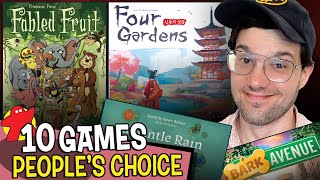
- Beautiful artwork
- Crunchy decisions
- Deceptive depth (simple gateway but strategic)
- Fun resource management puzzle
- Limited resource capacity creates a challenge.
- Requires careful planning for scoring bonuses.
- Competing to build the most pristine garden around the pagoda by completing landscape cards and sets.
- An Eastern Kingdom with a mystical Pagoda.
- The narrative involves a queen, gods, and a competition for her crown through garden building.
- Fabled Fruit
Mechanics (from transcript analysis)
- Area Movement — Moving up tracks to score points based on completed panoramas.
- Pattern Building — Laying out groundwork cards and landscape cards in the correct order to create panoramas.
- Resource Management — Spinning a 3D pagoda to gain resources and managing limited resource slots.
- Set Collection — Completing landscape cards and finishing sets to earn points and create panoramic views.
Video topics + discussion points
Quotes (from this video)
- I love Gloom Haven but due to the time and setup and tear down and having to replay many missions my wife and I haven't finished any of the games until now.
- I love buttons and bugs and for $15 I was able to take the cutest Gloom Haven on the planet which is a phrase I never thought I'd be saying on a business trip with me and play through three scenarios on the desk in the hotel.
- The size and simplicity and the duration all make this game a winner for me and most likely the first Gloom Haven I'll finish.
- I really enjoyed my play of buttons and bugs which I was not expecting.
- I enjoyed it that much I thought it was great and at some point there's a Twist and you go what how okay cool let's do that.
- This coin system has been the most remarkable bridge between different parts of the hobby that just really stands out and shows that it must be something very very special.
References (from this video)

Mechanics (from transcript analysis)
Video topics + discussion points
Quotes (from this video)
References (from this video)
- Stefan Dorra reprint.
- Unique and different game.
- Fairly expensive.
Mechanics (from transcript analysis)
Video topics + discussion points
Quotes (from this video)
- Praetor was going for really cheap. This is like an old-school Euro that again, I never got a chance to play. Kind of from my era of of Euro gaming.
- This was one that has always evaded me, but I remember Rado raving about it many, many years ago.
- Wispwood, which is one of those kind of puzzly um, you know, pattern building style games with different things going on.
- And um, to be honest, I've got so many games here to play and to talk about that um, I'm going to be tied up for quite some time.
References (from this video)

Mechanics (from transcript analysis)
Video topics + discussion points
Quotes (from this video)
- The scoring in The Princess of Florence is really unique and it's one of the main draws for me.
- Pax Pamir is just such a masterclass in creating a really tense and dynamic political game.
- Catacombs is such a fun dexterity game. The flicking mechanic is just so satisfying.
- Root is a prime example of an asymmetric game done right. Every faction feels so different.
References (from this video)

- Simple rules with complex decisions.
- Player-driven scoring and game end.
- Amazing and interconnected game system.
- Blown away by how much it was enjoyed on first play.
- Only played once, needs more plays for confidence in assessment.
- Area majority on a map with a card-driven scoring system.
- El Grande
- Concordia
- Century: Spice Road
- Century: Golem Edition
- Fayum
- For Sale
Mechanics (from transcript analysis)
- Area Majority — Players compete for majority in different regions.
- Card Drafting — Players draft cards to perform actions.
- Hand Management — Managing cards in hand to execute strategies.
- Simultaneous action selection — Players choose cards to play, which then resolve.
Video topics + discussion points
Quotes (from this video)
- This is the heaviest game I've played that I have no issues playing.
- It's just it's just struck this amazing balance that I guess what I love about it, too, is just it's just been so long since it's really been since Feast in some ways that a heavy game that with this much of depth has landed for me so spectacularly.
- This is one of the very best games I've ever played, and unquestionably a 10 out of 10.
- It's just incredible what it does with a relatively streamlined rule set. The amount of player interaction.
- Would you agree that of all the games we play, this is one of the ones that's most like groan-inducing around the table?
References (from this video)

- Promotes strong teamwork and collective problem solving
- Dynamic constraints add replayability and variety
- Short play sessions (~15–16 minutes) keep sessions accessible
- Clear progression through training, beginner, normal, and expert modes
- Thematic alignment with king’s wishes enhances immersion
- High dependence on coordination; can feel rough if players aren’t aligned
- Memory element from constraints can become challenging
- Non-verbal approach (limited communication) may frustrate some players
- The king’s wishes drive how the garden must be laid out; teamwork is essential to satisfy evolving constraints.
- A king’s garden that must be arranged and re-arranged under changing constraints across multiple rounds, guided by a timer.
- Procedural puzzle framing with a thematic monarch controlling the constraints.
Mechanics (from transcript analysis)
- asymmetric information — The information imbalance (one player knows the exact constraint) drives deduction and group coordination.
- Asymmetric Teams — The information imbalance (one player knows the exact constraint) drives deduction and group coordination.
- Connectivity requirement — Tiles must remain connected; splitting into multiple disconnected groups is forbidden.
- Constraint cards — Each round introduces up to three constraint cards; one player sees the full constraint details, others only see the type via the back while the front remains hidden to most players.
- Edge-only modification — Changes to the interior require peeling away from the edge; players cannot reposition interior tiles directly.
- Real-time cooperative tile placement — Players simultaneously place and rearrange tiles to form a target square while adhering to active constraints within a sand timer.
- Scoring by constraint completion — After a round, successful adherence to all active constraints scores points; discarding conflicting constraints incurs a penalty.
- Tile removal and rearrangement — Tiles can be removed from the garden edge and must be placed near a player's supply; moving tiles in the middle or within the garden is prohibited.
- Training modes and scalable difficulty — The game includes training exercises, then beginner, normal, and expert modes, plus a solo mode for solo players.
Video topics + discussion points
Quotes (from this video)
- this is a simultaneous Cooperative game played in real time and without talking to each other about the game
- the king's wishes on how he wants his garden
- this is a team game and it's impossible for one player to do all the work
- an experience that changes the longer that you play
- the game holds true to a feeling of teamwork and a sense of meshing well with each other
- build the King's Garden over and over again with your family and friends
References (from this video)
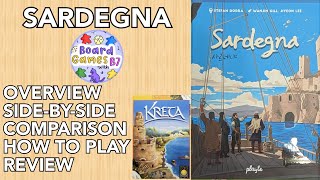
- Excellent area control with accessible, fast turns that scale well across player counts
- High production values: artwork, component quality, and the transforming box
- Small-form factor enhances portability and travel suitability
- Reprint of a beloved classic (Creta) with updated artwork and components
- Strong thematic integration and a visually appealing board/design
- No significant drawbacks highlighted in the video; the tone is largely enthusiastic
- island settlement and influence through forts and villages
- 14th-century Sardinia
- historical/medieval
- Creta
- Keta
Mechanics (from transcript analysis)
- Alternate Sentin and Sentinel rules — An advanced variant allowing the copying of a previously played character card to reuse its action.
- Area Control — Players compete to control provinces via placement of forts, villages, priests, and ships to gain influence and win scoring grounds.
- Card-driven actions — On each turn a player plays a card to trigger a specific action (e.g., Admiral, Commander, Priest, Farmer, Architect, Sentinel) and then passes to the next player.
- End-game scoring and province scoring — Provincial scoring occurs when fort cards trigger scoring; most influence in a province yields the points, with ties resolving by defined rules.
- Hand Management — A shared deck of character cards supplies actions; players select and play cards to perform actions and then discard.
- Movement Points — Characters enable movement of ships and villagers between harbors and provinces, with movement points governing how far you can go.
- Movement points and location control — Characters enable movement of ships and villagers between harbors and provinces, with movement points governing how far you can go.
- Resource Management — Agriculture tokens must be collected and aligned with token requirements to build forts and villages for scoring and expansion.
- Resource tokens and building — Agriculture tokens must be collected and aligned with token requirements to build forts and villages for scoring and expansion.
Video topics + discussion points
Quotes (from this video)
- I honestly am still in disbelief and just can't believe that it's finally here with all the recent new versions and reprint type of older games
- this is a must play game for all players who enjoy area control games
- the transforming box is one of the publisher's signature productions
- the game box transforms into the game board as well and that's a signature feature
- I'm in complete joy and so glad that this Gem of a game resurfaced for new players to discover
References (from this video)

- unique pencil-dice mechanic
- engaging replay potential
- easy to teach
- artwork can feel minimal
- board may read as blank to some
- creative garden scoring through spatial placement
- garden planning with colored pencils/dice in a garden grid
- light and whimsical
- Pixies
Mechanics (from transcript analysis)
- dice as pencils / color-drafting — Pencils are dice; players color in garden spots to score based on placement.
Video topics + discussion points
Quotes (from this video)
- break breaking news I really do got breaking news
- it's a co-op family game this is it this is it
- the box art sold me the cards were cute and colorful
References (from this video)
- strong area control feel
- deep strategic options
- some players may find it heavy
- area majority and card-driven deployment
- Mediterranean island politics and influence
- classic Euro
- Seaside
- Sears Catalog
Mechanics (from transcript analysis)
- area majority / market card use — Compete for influence across provinces using card-driven actions.
Video topics + discussion points
Quotes (from this video)
- break breaking news I really do got breaking news
- it's a co-op family game this is it this is it
- the box art sold me the cards were cute and colorful
References (from this video)
- deep strategic possibilities
- nice box and components
- market card purchase oddities
- some find it heavy
- area majority with card-driven deployment
- Mediterranean island political influence
- classic Euro
- Tuscany
- Sardinia is in the same family of heavy Euros
Mechanics (from transcript analysis)
- area majority / card-driven play — Players deploy influence to provinces using cards to gain majority control.
Video topics + discussion points
Quotes (from this video)
- break breaking news I really do got breaking news
- it's a co-op family game this is it this is it
- the box art sold me the cards were cute and colorful