
Description from the publisher:
The next great technological revolution is here. Sentient robots for information, transportation, industry — all at our fingertips. Building them is now the easy part. Programming them has proven to be more complicated. A handful of companies have emerged claiming to pull it off, but only one will win out. Your mission is clear: Procure valuable bots and plug them into your network. They'll have an effect on your systems. Anticipate it correctly, program your bots effectively, and attract the right investors to win and lead the sentient revolution.
In Sentient, players are tasked with choosing from available robots to program in their factory. Each robot that is added modifies your board and attracts the interest of investors for your company. Program your bots efficiently and collect the support of your patrons to build the most formidable operation.
Description from GTS article:
Sentient is a dice-manipulation game by J. Alex Kevern (World’s Fair 1893, Gold West). As with his other games, Sentient is filled with smart, simple, and rewarding choices. Each turn involves choosing an available bot, adding it to your factory, and deciding how to divide your resources between optimizing your bot and wooing investors. Players who enjoy a satisfying puzzle will appreciate the difficulty in adding the chosen bot to their factory. Each slot has a die on either side that will be modified based on the chosen bot card. But, adding another adjacent bot the next turn will modify the dice once again. The dice at the end of the round will determine how efficiently your bots were programmed and will grant you varying points based on the dice numbers. You may have everything perfectly sorted out — that is, until the last bot you choose changes the adjacent dice. Your plan can crumble and points can easily be lost with an errant decision or wrong choice!


Images



- Always a good
Mechanics (from transcript analysis)
Video topics + discussion points
Quotes (from this video)
- Basically, I think this is the third maybe fourth. I think it's the fourth time I've done a top 10 overrated games list, hence more. And I called it you have been warned.
- But actually, surprisingly, despite somebody sharing it on Facebook, which I was not happy about really, cuz I mean I I don't know. I I like my content being shared on Facebook and I do say do it, but that list is a dangerous one to put on Facebook because, you know, we do have this problem in the hobby of toxic positivity.
- No, shut off. It is really is not. I'm doing it because I enjoy it.
- There's certainly examples of this you see in real life and it's just gez, how closed is your bubble that you have to think that that argument still works?
- Do not be misled thinking that you look at this game and it's going to be a charming little farming game. It is everything but.
- This game isn't really a game about cultivating roses. This is a game about debt management.
- This game is multiplayer solitaire through and through.
- This is a solo puzzle.
- Hated this.
- The hobby has become very elitist and very clicky.
- Shame on you if you do it.
- If you are done with the table and you're not playing something next, then get off the freaking table and let someone else use it. Honestly, it is selfish and irresponsible.
- If you are the sort of people who leave your games on a table for hours on end just to hog the table and stop anybody else playing on it. And you essentially don't return to the table for hours on end. [...] If you're doing that to gaming tables, then shame on you.
- For a hobby that is meant to be about, oh, let's be inclusive and let's uh get new people in and stuff like that, it doesn't half do a pretty damn good job of excluding a lot and, you know, being very elitist.
- It's not a good feeling and it is something that is hurting, you know, conventions in general and I think that's the biggest reason that conventions sometimes don't work.
References (from this video)
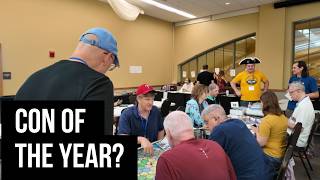
- Fantastic to see how different people built different prisons from identical decks.
Mechanics (from transcript analysis)
- Deck Building — Identical decks were given to people to build prisons in teams.
Video topics + discussion points
Quotes (from this video)
- So, that's where Harold Buchanan and a lot of his volunteers live.
- It was really amazing to get to play games with my friends in my home turf, uh but with, you know, friends that I never get to see there.
- But, Fort Snelling has a lot of really cool Minnesota history.
- So, I have a special interest in this right now because David and I are working on a game called Throw Down That Flag, which is about the first Minnesota Gettysburg, and we've been doing a bunch of research and playing with our system a whole lot and it's been really cool.
- As General Hancock put it, there's no more gallant deed recorded in history.
- It was clear these are people who love their jobs, who love Minnesota history, who really care about artifacts, and it was just such a delight to get to see them and to check out everything that that tour had to offer.
- It reminded me that I still really love the game.
- That felt wonderful.
- But what these cons are really the best for, I think, is spending a lot of time just talking to people.
- And you know, there was something for everybody at this convention, and it really made me happy to see so many people in my home turf enjoying historical games.
- So, I hope they take a walk on the Midwestern side a little more often because it was so wonderful to spend so much time uh among friends and doing what we like to do the most.
- I will be super bummed if we never get to do it here again.
References (from this video)

- Clever combination of mechanics.
- Engaging and replayed frequently.
- Satisfying dice manipulation and strategic depth.
Mechanics (from transcript analysis)
- Algebraic Problems — it's kind of math because you had to like the little algebraic problems you have to solve
- Area Control — Players compete for control of areas on the board.
- Dice game — it's for that really cool dice game for from renegade games that we just really enjoy
- dice manipulation — Involves solving algebraic problems using dice.
- Set Collection — Players collect sets of cards or tokens.
Video topics + discussion points
Quotes (from this video)
- Looks like a beast on the table but when you hear it's like it's an engine building game you like I could play an engine building game
- We sat down to play that game hole holy cow we were literally passing a hat Vil around the table for how much thinking you had to put into that game that surprised me
- this game London when we first saw it at Gen Con when Oscar green said hey guys scream hey come take a look at this
- the cover of the game box and how plain it is but mm-hmm it really some reason fits this game it just looks nice the cover looks elegant and the art is really good and then you actually get into the game and you find this really elegant cool little card game
- engineers it was really cool cuz it's kind of math because you had to like the little algebraic problems you have to solve but it's such a great thing of a dice manipulation game plus the area control game plus a set collection game all merged into one that's one of those I really got to the table a lot in 2017
- and Tony this was actually one of the early games in 2017 that really grabbed us one of those that didn't look that great on the table but then you start playing in and it's one of those that we just played over and over and over again and just just really enjoyed it
- that rule about when that third dragon comes out yes everything stops correct I kept saying it and kept saying it and reminding people boy we had a flip the table moment when that occurred
- oh die another seaman without miniatures look at that
- two seam on one two squirrely Awards and neither games had merci ya don't have to put miniatures in the game to make it go no you don't lure in DOS so good
- it's what I call the reverse work replacement where you're taking stuff off the board and putting it on your board in order to activate things I just thought was a really unique mechanic
- and again tony is one of those shockers for us at the beginning year I had never heard of gentes and we got an early copy and try to try it out and it blew us away
References (from this video)

- Engaging dice manipulation and area control mechanics.
- Leads to a desire for immediate replay.
- Strong thematic elements contribute to the experience.
- Can suffer from analysis paralysis.
- Potential for downtime due to board changes.
- Collecting robots and getting them to do stuff for you.
Mechanics (from transcript analysis)
- Area Control — Players place tokens to claim areas, which represent types of cards collected, contributing to end-game scoring.
- dice manipulation — Players can increment or decrement dice based on conditions on collected cards.
- Set Collection — Collecting cards that contribute to end-game scoring based on specific types.
Video topics + discussion points
Quotes (from this video)
- This little twist is enough to me to make it probably the love-letter version of game then I'm going to play.
- Hats off to DC you got it right this movie is so good if you haven't seen it yet you got to go check this out it treated the character with respect it was a good story.
- It is that decision that it really makes the game kind of tough two times.
- This is a cutthroat game and which is why this is going to make it a really cool game to see play live.
- It's bombing it is taking finally the u.s. realizes that Michael Bay should stop making transformers.
- But it is so much fun I bought a copy instantly.
- This is Emerson's golden ticket he has got a lien he has got the Chocolate Factory
References (from this video)

- puzzle-like drafting
- clever card interactions
Mechanics (from transcript analysis)
- Dice pool drafting — five dice per game; cards in the middle; draft four per round; score points
Video topics + discussion points
Quotes (from this video)
- your videos are great I love your YouTube channel especially your playthroughs
- Lisboa is a beautiful game
- this was the funnest moment that I had at the convention
References (from this video)
- Promotes micro-history and historical interpretation in an accessible way
- Offers a strong example of how games can engage with historical craft
- Niche genre may not appeal to all students
- Micro-history, textual analysis, cultural memory
- Historical narrative set in a 16th-century Austrian town
- Narrative-driven with emphasis on historical interpretation
- Return of the Ordin
Mechanics (from transcript analysis)
- Dialogue-driven storytelling — Branching dialogue and choices shape the historical interpretation.
- Investigation and evidence gathering — Players piece together historical events through careful reading of sources.
Video topics + discussion points
Quotes (from this video)
- authenticity is such an interesting word because authenticity and accuracy are not the same.
- not taking the fact that a game is showing you absolutely everything even though the marketing might claim to be.
- the history of games and history in games, they're not separate.
References (from this video)
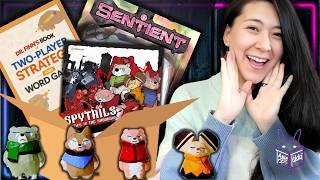
- Excellent puzzly nature
- Strong replayability across player counts
- Improved components in the new edition
- Exciting solo mode
- Tight and well-designed area control element
- Standard card size instead of tarot size in new edition
- Repetitive card art
Mechanics (from transcript analysis)
- Area Control — Players place agents to claim badges/tags that act as multipliers for their scored cards.
- Dice modification — Cards have qualifiers that modify dice values on the player's board.
- Set Collection — Cards have qualifiers for scoring, and tags act as multipliers for these cards.
- solo mode — The new edition includes an official solo mode with dedicated cards and components.
- Tableau Building — Players select cards to place into their personal tableau, which modify dice on their board.
Video topics + discussion points
Quotes (from this video)
- Tactics in the shadows.
- These are the handcrafted wood carved meatballs, which is Mokumo's signature.
- Mokumo's production is always really stellar, even though this is like a pre-production copy.
- The illustrations are so adorable.
- This might be my new favorite quick two-player game to play.
- Calming solo puzzle activity.
- The box components flip over to make different terrain setups, which is pretty fun.
- The actual box itself to make like leveled terrain, which I think is very inventive and cute and also provides a really good storage solution for all the components.
- So, this is like an orientationbased cooperative game, I think.
- This is one of my favorite like midweight puzzly games.
- It plays so differently at two players than it does at four players, even though the rules
- Bringing astronauts together. Which way is up when you're drifting in space with Tether's unique mirror deck, your up is not the same as your opponents.
- Can you see the world from both their perspective and your own? Can you wrap your mind around it?
- one of my favorite like midweight puzzly games.
- This is a game that like I was felt like was begging for a solo mode. um just because it's so puzzly in nature.
- the puzzly part of it is the part that makes my brain the happiest.
- this is definitely a game that I'm always down to play.
References (from this video)
- Excited to play the game.
- Quaker prison game
Mechanics (from transcript analysis)
Video topics + discussion points
Quotes (from this video)
- We're not trying to simulate a battle or simulate. We're trying to evoke feelings, right? And we're trying to communicate key points.
- If you're too accurate, you lose the vibe. And if you're very viby and you're going for that authentic feeling, then you can't have too much chrome on it.
- The dangerous part is the video does a really good job... it just gets off the rails and starts to hallucinate when it jumped from the unit being deployed to the UK...
- We have officially reached the point where there's just stuff out there that is slop and you have to follow up.
- I feel like the artists we've worked with have also impacted our design like mechanically even on the when graphic starts to get done.
- the game doesn't exist without all of those people, right?
- I never get to play my favorite games often and I certainly don't get to play my favorite games a lot.
References (from this video)
Mechanics (from transcript analysis)
- Solo variant — Came up with a solo variant that was posted on BGG and went through iterations.
Video topics + discussion points
Quotes (from this video)
- And so you're thinking about what innovations have happened.
- It's been my pleasure as always to say hello, answer a few questions from all of you lovely people in the chat.
- Board game rule books need to get better. Period.
- Not every game needs a solo mode. Period.
- It's probably more card games or close to more card games and board games.
References (from this video)
- deep, niche thematic focus on penal reform
- innovative spatial and narrative integration
- environmentally conscious component decisions
- early iterations described as 'janky and funky'
- potentially steep learning curve for new players
- penitentiary design and reform schools (silent/Auburn/Pennsylvania systems)
- 19th-century penitentiary reform
- story-driven, spatial reasoning with inmate outcomes
- No Motherland Without
- Here I Stand
Mechanics (from transcript analysis)
- event cards across eras — Event cards drive changes across three eras, influencing the plan and outcomes.
- Events — Event cards drive changes across three eras, influencing the plan and outcomes.
- floor plan design — Players draw and configure a prison floor plan under reform constraints.
- inmate board — An inmate board tracks statuses, transfers, releases, illness, and other states.
- letter tiles and micro-dice interaction — Letter tiles reference prisoners; outcomes interact with a rare dice-like feeling from number results.
Video topics + discussion points
Quotes (from this video)
- it's the nice thing about being this size, doing it smaller
- As designers, we're setting the table
- I want combat in these games to be something that the defender feels too has a decision space
- it's all about tension
- There are opportunities to get people involved in these projects to do development
References (from this video)
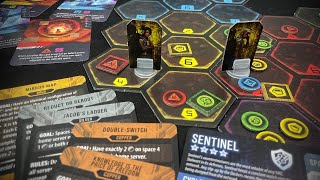
- Deterministic gameplay reduces randomness and aids planning
- Twins provide strong multi-location control and flexibility
- Rich upgrade path with meaningful market interactions
- Mirror map provides a satisfying endgame objective
- High complexity and learning curve for new players
- Deterministic rules can reduce tension for some players
- Tracking sparks, guardians, and server states can be fiddly and require careful tracking
- Cybersecurity, hacking, network defense and offensive program deployment
- A cyber/networked environment with home servers (color-coded) and a market for software upgrades; objective-driven planning against a deterministic AI-like antagonist
- Procedural, deterministic, objective-driven
- Mother
Mechanics (from transcript analysis)
- deck-building — Players build and upgrade program decks using market cards and upgrade areas, managing colors and costs to meet objectives
- ghosting and shifting — Movement and repositioning of cards/programs via shifting and ghost actions to manipulate the network layout
- Jacob's ladder — A sequence where sparks and programs shift downward; interacts with upgrades and objective completion
- mirror map — Endgame objective requiring identical configurations across servers to achieve victory
- spark/spawn system — Sentinel-specific spawn rules place Sparks on server spaces; deterministic spawning (no server die) based on active server and layout
- twins avatars — Two avatars allow control of two active spaces, enabling flexible routing and spawning decisions
- upgrades and market — Acquiring upgrades from the market requires color-cost transactions and knowledge constraints
Video topics + discussion points
Quotes (from this video)
- If we fail any objective card, we immediately lose the game.
- Knowledge is the price of freedom.
- Twin avatars give you more control over where she's going to spawn.
- Mirror map says we need identical configuration of sparks and programs across the spaces of X servers.
- Sentinel is not quite as hard as Mother.
References (from this video)

Mechanics (from transcript analysis)
Video topics + discussion points
Quotes (from this video)
- you're like one of the nicest people ever
- that was a perfect picture round you did awesome
- you got a total of 14 points emerson, which is huge
- look up emerson's games on bgg everybody they're fantastic
- cyber bunny
References (from this video)

- Interesting, clever puzzle design
- Beautiful production and components
- Limited player interaction and social depth
- Downtime and reliance on solitary puzzle-solving
- AI, machine logic and puzzle alignment
- AI robots puzzle environment
- Abstract, puzzle-driven
Mechanics (from transcript analysis)
- Area Control — Control areas by placing workers to trigger card multipliers.
- Area control and scoring multipliers — Control areas by placing workers to trigger card multipliers.
- Card-placement with adjacency requirements — Cards require certain relationships between neighboring dice to score.
- Dice Placement — Dice represent robots; players place them to satisfy card constraints and score points.
- Dice-placing puzzle — Dice represent robots; players place them to satisfy card constraints and score points.
Video topics + discussion points
Quotes (from this video)
- the best thing about legacy of Dragon Hall is that it's brilliantly written
- it's a really clever game that allows for so much bluffing and doublethink
- this just too much there you want to advance that story quicker
- it took us hours and we felt like we were only in the second chapter
- the end of the game there's also these spy cards which basically mean that you lose you cannot win the game
- it's such a brilliant simple bluffing card game
- it's an incredible production the dice are really nice and the artworks very nice as well
- the theme sounded interesting but professor Evil's gameplay just wasn't a fun cooperative experience for us
References (from this video)
- Deep narrative exploration of history and community
- Strong visual and textual design
- Pacing may be slow for some players
- Narrative-driven mystery, social dynamics
- 15th-century Bavarian village
- Character-driven investigative storytelling
- Disco Elysium
- Firewatch
Mechanics (from transcript analysis)
- Investigation and dialogue choices — Players gather clues, interview townsfolk, and decide how to proceed.
Video topics + discussion points
Quotes (from this video)
- Coin Operated Americans is the book that came out of my graduate school project, my dissertation.
- I got really curious about why we think video games are for boys and men.
- There's all kinds of ways people experience and play games.
- A game making you cry is the most profound thing it can do.