/pic5198495.jpg)
Game Info
Year
2019
Collection
Ratings
Creator Score
Mechanic profile
Not enough video data yet
Vibe profile
Not enough video data yet
Description
Shadows of Kilforth is the sequel and stand-alone expansion to Gloom of Kilforth: A Fantasy Quest Game. It is a game of high fantasy with a gothic edge, where 1-4 players, working individually or together, assume the roles of heroes on a journey through a dark world of magic and peril. They will visit strange places, meet stranger people and defeat powerful enemies in their mission to discover mysterious artefacts and mystical spells. Each player follows their hero’s tale, an epic saga from modest beginnings through to a climactic battle that will decide the fate of the world...
—description from the publisher
This project was known earlier as 'Touch of Death: A Fantasy Quest Game'.
Featured Videos


Ask a Rules Question
All mentions
Browse transcript mentions, sentiments, pros/cons, mechanics, topics, quotes, and references.
Total mentions: 4
This page: 4
Sentiment:
pos 2 ·
mix 1 ·
neu 1 ·
neg 0
Showing 1–4 of 4
Video LcqDIFrg6uI
The Dice Tower Analysis at 8:34 sentiment: neutral
video_pk 101056 · mention_pk 281582

Click to watch at 8:34 · YouTube ↗
Overall sentiment (raw)
neutral
Pros
none
Cons
none
Thematic elements
- Fantasy
Comparison games
none
Mechanics (from transcript analysis)
Mechanics unknown.
Video topics + discussion points
No key topics recorded for this video.
Quotes (from this video)
- So, because of that, I actually never got a copy of it um and haven't played it.
- Um so, you drive cars around and shoot at each other. That's basically the game.
- Looks like Carcassonne with Islands. That looks pretty good.
- Do we need a card game version of it? And the answer to that is we really don't. Just play Camel Up.
- This is a war game from Don Greenwood, Avalon Hill.
- But if you like choose your own adventures type games, that's what this is.
- It is a tile laying game that is about as exciting as it looks in this picture here.
- So if you like Klask, um which is a fantastic two-player game, this is just a version for four.
- I really like awkward guests, so why didn't I play the second one?
- He gave it Seal of Approval. A seven out of 10. Well, there you go.
- I think I'm going to have to go with the Bottom of it. It is a fantastic three-player trick-taking game that I like very much and think you definitely should check out.
- If you really like what we're doing here at the Dice Tower, then there are different ways to support the Dice Tower. One of those ways is through Patreon.
References (from this video)
No references stored for this video.
Video QeCKLvz2tIM
The Dungeon Dive Review at 0:32 sentiment: positive
video_pk 61284 · mention_pk 153970
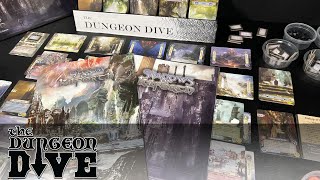
Click to watch at 0:32 · YouTube ↗
Overall sentiment (raw)
positive
Pros
- Solid standalone experience with the flavor of the base game
- Excellent option for players who want expansion content in a standalone form
- Maintains the ambitious scope and atmosphere of Kilforth
Cons
- Requires understanding of base game's mechanics to fully benefit from standalone
- Fiddly nature persists; learning curve remains steep
Thematic elements
- Expansion-driven adventure with new mechanics and integration with the base game’s systems.
- Standalone expansion set in the Kilforth universe; continues the overland fantasy exploration.
- Supports player-driven storytelling with keywords and saga structure, like the base game.
Comparison games
- Gloom of Kilforth
Mechanics (from transcript analysis)
- An expanded range of items, allies, and spells — New equipment and allies add to the pool and influence outcomes; some allow unique actions.
- Ancient evil concept and plot cards — Facing an ancient evil with its own powers and a plot card deck that introduces new quests and effects.
- Expansion/superset integration — Can be played standalone or integrated with Gloom of Kilforth; combines sets with shared mechanics.
- Quest, keyword, and luck-driven progression — Adventure cards, keywords, and rewards drive story progression and challenge resolution.
- Same dice-pool system with four stats — Fight, knowledge, sneaking, influence; dice pool and action structure remain, with new content.
- Time/turn limit and Knight deck — Inherited from base game; a fixed turn count with a deck mechanic that modifies board state.
Video topics + discussion points
No key topics recorded for this video.
Quotes (from this video)
- this is a really cool aspect
- I love that system because each item that you discover is now kind of like a little mini side quest
- this game is fiddly
- while the art is very very good it is very beautiful it's also a little bit maybe too beautiful in some ways
- there are a lot of moving pieces there are a lot of keywords there are a lot of exceptions to a lot of rules
References (from this video)
No references stored for this video.
Video I4IzI-8fY70
Meet Me At The Table Playthrough at 0:00 sentiment: positive
video_pk 7057 · mention_pk 109831
Click to watch at 0:00 · YouTube ↗
Overall sentiment (raw)
positive
Pros
- Strong narrative drive with interludes and chapters that reward exploration and risk-taking
- Deep mechanic set that interlocks deck-building, resource management, and tactical combat
- The veil/hidden-information mechanic adds anticipation and strategic nuance
- Rich atmosphere and thematic cohesion, with evocative setting and flavor
- Flexible pathing through Badlands and other locales via maps and tokens that encourage experimentation
Cons
- Rule complexity and occasional ambiguity can lead to misplays (as observed in trophy vs asset handling and weather card effects)
- The density of systems (deeds, keywords, market actions, and encounter types) can be intimidating for new players
- Token management and bookkeeping can become fiddly in longer sessions, potentially slowing play
- Some card interactions (e.g., polymorph painting, doom tokens, or loot vs gold value) may require house-rule clarifications
Thematic elements
- Mythic investigations, occult intrigue, gaunt heroism, and gothic horror themes as players hunt ancients and unravel conspiracies.
- A dark fantasy world centered on Kilforth, with locations such as Badlands, forests, mountains, towers, shrines, and urban ruins; exploration across a mapped globe with peril and mystery.
- Campaign-like, saga-driven progression with chapters and interludes that push the story forward through rewards, relics, and evolving character arcs.
Comparison games
- Descent: Legends of the Dark
- Gloomhaven
- Arkham Horror
Mechanics (from transcript analysis)
- AP (action point) driven play — Each character operates on a pool of action points to move, search, fight, or perform special actions across locations; AP economy drives planning and risk assessment.
- Chapter rewards and progression — Completing chapters grants new cards, spells, or abilities, shaping future decisions and expanding strategic options for the saga.
- Deck-building / asset and rumor management — Players collect and use cards that become either assets or rumors; assets are usable items/spells, rumors are temporary or converted rewards that can be traded or turned into assets via actions.
- Deed actions and keyword synergies — Keywords (like pious, stealth, etc.) enable deeds that bypass tests, grant immediate rewards, or unlock powerful interactions; class-specific keywords unlock unique routes.
- Encounter decks and exploration — Locations draw encounters (enemies, allies, hazards) from various decks, driving exploration rewards and tactical combat decisions.
- Gloom and location effects — Certain locations can become gloomed, changing how you approach encounters and forcing relocation or strategic retreats to avoid penalties.
- Interludes and chapters (story arcs) — Narrative segments that advance the overarching saga, offering rewards, new allies, or power-ups upon successful completion; chapters progress the storyline toward the ancients.
- Market actions and ally/asset economy — A market phase lets you heal, draw allies, purchase assets, or discard rumors for gold; allies and items reinforce your capabilities for upcoming challenges.
- Skill tests (study, influence, sneak, etc.) — Tests use different skill tracks to resolve encounters, influence outcomes in interludes, and unlock rewards; failures can trigger consequences or new paths.
- Veil/face-down dice and card manipulation — Dice can be veiled to modify rolls, and certain events or skills allow altering dice pools or outcomes; this introduces tactical hidden information and timing decisions.
Video topics + discussion points
No key topics recorded for this video.
Quotes (from this video)
- The coolest thing ever.
- I'm having an absolute blast trying to get to these ancients.
- We did it, we were successful in completing our interlude.
- Absolutely amazing.
- This is such a good mechanic I like that.
- Wow, absolutely amazing; that was awesome.
References (from this video)
No references stored for this video.
Video hYMMDQed10A
AzureDeath | Solo Board Gaming Review at 0:00 sentiment: mixed
video_pk 858 · mention_pk 110455
Click to watch at 0:00 · YouTube ↗
Overall sentiment (raw)
mixed
Pros
- strong card-driven design that supports deep strategy and narrative
- works well with a single character, aligning with RPG-style expectations
- rich saga structure and interludes to drive story progression
- factions add strategic depth and replayability
- expansions bring new challenges and variety, expanding the trilogy
- thematic setting with a compelling oriental motif
Cons
- steep learning curve and rules can be unclear or ambiguous at times
- RNG can spike (notably in certain boss encounters) and disrupt balance on occasion
- expansions amplify difficulty, potentially alienating casual players
- some card effects are worded in ways that require external reference for clarity
- setup and mastery require learning aids or cheat sheets to streamline play
Thematic elements
- dark fantasy, mythic questing, perilous journeys
- Oriental-inspired fantasy world; adventuring RPG with map exploration
- story-driven with saga finales and modular encounters
Comparison games
- Gloom of Kilforth
- Call of Kilforth
Mechanics (from transcript analysis)
- action point pacing — Certain locations grant or drain action points; players must pace actions carefully to survive and progress.
- Action Points — Certain locations grant or drain action points; players must pace actions carefully to survive and progress.
- ancients as boss encounters — End-of-saga bosses with specialized mechanics that test efficiency, preparation, and resource management.
- Boss Battler — End-of-saga bosses with specialized mechanics that test efficiency, preparation, and resource management.
- card-driven engine — Core gameplay unfolds through a deck of location, encounter, and knight cards that drive exploration, events, and combat.
- Deck Building — Players acquire items, allies, and spells; loot is managed via a finite, slim loot bag that influences ongoing risk and reward.
- deck-building and loot management — Players acquire items, allies, and spells; loot is managed via a finite, slim loot bag that influences ongoing risk and reward.
- expansions increase difficulty and variety — Expansions introduce new ancients, classes, and mechanics, typically raising difficulty and enriching options.
- factions — Doomguard and Rosen Knights factions influence card effects and offer strategic choices, with potential faction changes later.
- interludes and saga structure — Interludes act as finale-like segments; sagas require tests or keywords to progress toward a conclusion.
- location abilities and map-wide effects — Locations grant or cost actions; some effects affect the whole map rather than just a single location.
- timer/depth via knight deck — A knight deck acts as a days counter; discarding cards and managing the deck increases tension and pressure.
Video topics + discussion points
No key topics recorded for this video.
Quotes (from this video)
- I think it's the most interesting and challenging ancient design that I've seen across the three titles.
- it's card driven and I just love card driven games.
- the loot bag is a lot more slim; it's a bit more tame.
- I cannot see myself playing without these playmats.
- the system is brutal enough as it is but I'm still having great fun.
- this is a super fun card driven adventuring RPG.
References (from this video)
No references stored for this video.
Transcript Navigation
Showing 1–4 of 4