/pic6021323.jpg)









Shamans Deep Dive
What the Community Thinks About Shamans
Every channel that covers Shamans lands in the same place: this is a trick-taking game that does something genuinely new by welding a hidden-role layer onto the card play. Board Game Critique frames it as a slept-on favorite, calling out the way it "genuinely occupies territory nobody else has claimed" among the hidden-role games on the market. Board Game Garden covers it twice, once as a monthly recommendation and again ranked among a personal top ten trick-taking list, and both times leads with the card art before getting into the rules. Watch It Played treats it differently again, spotlighting it as a team pick that multiple members of the channel gravitated toward independently and framing the appeal through comparisons to other social deduction and trick-taking games.
The channels differ mainly in what they emphasize rather than in verdict. Board Game Critique digs into the mechanical engine, the offsuit rule and the ritual system, as the reason the game earns a spot on an underrated list. Board Game Garden leans on the emotional pull of the presentation and on repeated personal plays with friends. Watch It Played leans on genre comparisons to explain why the mash-up works. None of the four sources raises a serious objection to the design; the disagreement, such as it is, is about which part of Shamans deserves the spotlight.
Core Mechanics That Define Shamans
Trick-Taking Where Breaking Suit Is Always Legal
Rounds are built around standard trick-taking structure: a lead suit is played and the rest of the table follows in turn. What sets Shamans apart, according to Board Game Critique, is that players are never required to follow suit at all. Every card that does not match the lead suit pushes a shadow pawn a step closer to the moon, and if the pawn reaches the moon before the round ends, the Shadow side wins. Board Game Garden describes the same structure from the table: once all cards in a trick are played, the cards that broke suit are set aside in matching zones on the board, while the cards that followed suit are compared, with the lowest card winning a token and the highest card leading the next trick.
Hidden Roles, Rituals, and Artifacts
Each player is secretly dealt a role, Shaman or Shadow, at the start of a round, and the two sides want opposite outcomes from the shadow pawn's position. Board Game Garden explains that the tokens won by low cards in a trick can move the pawn, award points for collecting matching pairs, force a player to reveal their role, or hand out a dagger that can eliminate another player later. Board Game Critique adds the second engine on top of that: completing an entire suit of cards triggers a ritual, and the two sides want to trigger different rituals, since one swaps role cards between players, one scores points, one eliminates a player with a dagger artifact, and one pushes the pawn back away from the moon. Because both factions have a reason to chase these ritual triggers, the board stays active rather than turning into a waiting game.
The Shamans Experience
Constant Paranoia Over Who Broke Suit
Board Game Garden captures the moment-to-moment tension directly: playing as a Shaman without the lead suit in hand means hoping the rest of the table does not assume you are secretly a Shadow. Board Game Critique frames the same uncertainty as the core of the design, arguing that because breaking suit is always legal, seeing someone play off suit never tells the table for certain whether that player is a Shadow acting deliberately or a Shaman who simply lacked the card. That ambiguity, layered on top of visible card play, is what both channels describe as the game's defining feeling at the table.
A Game That Rewards Betraying Your Own Side
Board Game Critique also points to an individual scoring layer that sits on top of the team competition: a Shaman sitting one point behind a teammate can deliberately let the Shadows win a round just to keep that teammate from reaching the win condition first, which keeps suspicion alive even among players who are nominally on the same side. The same reviewer notes the whole experience wraps up in thirty to forty minutes with no filler and no downtime, so the tension stays compressed into a short session rather than dragging.
What Makes Shamans Stand Out
A Genre Fusion Nobody Else Has Tried
Board Game Critique is explicit that the combination of hidden-role play with trick-taking is territory it had not seen attempted elsewhere and had not seen repeated since. The offsuit rule doing double duty as both a scoring mechanism and a bluffing tell is the piece both Board Game Critique and Board Game Garden single out as the game's most original idea.
Distinctive, Praised Card Art
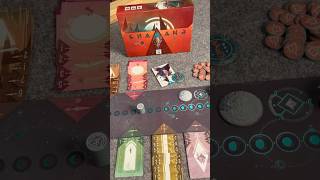
Board Game Garden calls the card art some of the most beautiful they have seen in a game, describing every suit's cards as stunning, and credits publisher Studio H for the production. That same channel returns to the art as the first thing worth mentioning in a separate video months later, underscoring how much the presentation stands out on repeat viewing.
Potential Drawbacks
Hidden-Role Games Are Not for Everyone
Board Game Garden is upfront that hidden-role and social deduction mechanics are not usually a favorite, since those games often come down to lying to other players' faces and talking a way out of accusations. Shamans wins that reviewer over specifically because deception plays out through actions at the table rather than through verbal bluffing, but that also means players drawn to talk-heavy social deduction may find the experience plays differently than expected.
A Fixed Player Range
Board Game Critique lists the game as built for three to five players. That range rules out a two-player pairing or a solo session, so groups that regularly play in smaller configurations will not be able to bring Shamans to the table.
If You Enjoy Shamans
Watch It Played compares the mash-up of social deduction and trick-taking directly to Don't Mess with Cthulhu and The Crew, describing Shamans as feeling like a mix of the two while still standing on its own. Board Game Garden separately points to Veiled Fate as a comparable social deduction game, noting that both titles let players deceive each other through actions rather than through talking their way out of suspicion.
What Reviewers Are Saying
"This is Shaman by Studio H. It is an interesting blend of trick taking as well as deduction, and not only is the gameplay super fun, super unique, but it also has the most beautiful art I've ever seen in cards."
— Board Game Garden
"Someone played off suit. Were they a shadow pushing the pawn intentionally or a shaman with no matching cards? That persistent uncertainty about intent layered over visible card play where motivations are hidden creates this cognitive tension that we find deeply compelling every time."
— Board Game Critique
"This is a social deduction trick-taking game that feels like a mix between Don't Mess with Cthulhu and The Crew while also feeling totally unique."
— Watch It Played