/pic4244955.jpg)
Several millennia ago, the tiny planet Solenia lost its day-and-night cycle: Its northern hemisphere is forever plunged into darkness, and its southern hemisphere is eternally bathed in sunlight. Your mission is to carry on your ancestors' honorable task of traveling the world to deliver essential goods to the inhabitants of both hemispheres. While the Day people want you to deliver the rarest gems and stones, the Night people sorely need wood and wheat to survive. Be efficient and outpace your opponents to collect the most gold stars by the end of the game!
A game of Solenia plays out over 16 rounds, and in each round, each player plays one card from their hand onto an empty space of the 5x5 game board. You can play the card on either:
A floating production island, to gain as many resources as the value of the card you played of the type corresponding to this space
A floating city, to fulfill a delivery tile by delivering the resources depicted on it.
You must play your card adjacent to the airship in the center of the playing area or adjacent to another card of yours already played. When someone plays a 0 card, the airship advances one space, then at the end of your turn, you remove the back edge of the board, give players resources based on the cards they have on this strip of the playing area, flip the strip over (turning night to day or dawn to dusk or vice versa), and place it on the other side of the game board.
The game ends when each player has played all 16 of their cards. The player with the most gold stars wins!
—description from designer


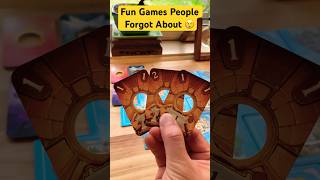
- hand of cards with holes in them used to acquire resources
- acquire contracts and attach them to your ship
- board flips over simulating planetary movement
- Acquiring contracts and attaching them to a ship
- Planetary
Mechanics (from transcript analysis)
- Hand Management — Players have a hand of cards with holes in them.
- Modular Board — The board flips over simulating planetary movement.
- Set Collection — Acquire contracts.
Video topics + discussion points
Quotes (from this video)
- here are five fun unique games that I think people have forgotten about
References (from this video)
- Thematic immersion with a rotating board.
- Intuitive and multi-functional cards.
- Strategic timing is important.
- Modular airship design allows for customization.
- Efficient resource gaining and delivery system.
- Requires careful timing of card plays.
- Some cards might fall off the map.
- Players pilot airships to transport goods and earn gold stars.
- The planet Selenia, with a northern hemisphere in darkness and a southern hemisphere in light.
Mechanics (from transcript analysis)
- Area Movement — Playing a card with zero on it moves the airship forward, flipping map tiles.
- Engine Building — Players gain victory points, resources, and unlock bonuses from their airship.
- Pick-Up and Deliver — Players trigger delivery actions to fulfill delivery tiles.
- Resource Management — Players gain resources like wood, stone, wheat, or water from production islands.
- Tile Placement — Players play cards onto the game board adjacent to previously played cards or within traveling distance to the mothership.
Video topics + discussion points
Quotes (from this video)
- With hundreds of board games being released each year many board games often slip under the radar or have been purchased and left in a cupboard still in their shrink wrap to gather dust or even worse to not have even seen a single play before being traded off or shipped off to somebody else.
- In this new video series I attempt to brush off the cobwebs blow off the dust and go in search of five board games that you may have forgotten about or you might not have even heard of.
- It's by an Australian designer and I really love supporting Australian board game designers.
References (from this video)

- Clever central airship mechanic
- Accessible and fast-paced play
- Iconography can be dense; theme may feel abstract to some
- lightweight resource acquisition with central airship mechanic
- Splendor
- Patchwork
- Tales of Arabian Nights on the ocean
Mechanics (from transcript analysis)
- airship cycles with day/night tokens — Move the airship and flip dusk/day tiles to determine scoring and tokens.
- airship track with day/night phases — Central neutral airship moves; day vs night phases yield different tokens and bonuses.
- card drafting with resource extraction — Draw and place cards to gain resources; use cards to fill slots and earn bonuses via top windows and bottom rewards.
- card-drafting with hole-in-the-middle cards — Draw and play cards to gain resources; books/tiles provide ongoing bonuses as you upgrade your board.
- resource management with adjacency and bottom bonuses — Resources populate storage areas; cards provide bottom bonuses for patterns and adjacency
Video topics + discussion points
Quotes (from this video)
- I think this is a really great design from any dice drafting perspective it's very clean.
- this game was an absolute blast to play and I don't think I ever want to play it again
- I would like to have this one in my collection
- the central neutral airship that is effectively flying around a small planet
References (from this video)

- Thematic integration and engaging card interactions
- Clear engine-building potential when understood
- Asymmetric modules felt unbalanced and overly complex for a light game
- Some players disliked the asymmetry and draft randomness
- resource delivery between day and night; asymmetric bonuses
- planet with day and night sides; Zeppelin moving on a conveyor belt
Mechanics (from transcript analysis)
- asymmetric bonuses and day/night sides — flip sides grant different bonuses; draft asymmetries
- hole-in-card bonuses — cards with holes reveal bonuses when placed adjacent to the Zeppelin and other cards
- spend resources to unlock tiles — resources are spent to activate bonuses and unlock endgame points
Video topics + discussion points
Quotes (from this video)
- I would totally play key flower again
- I am never gonna use those asymmetric tiles again
- Selenia is incredibly light
- it's a tableau building style game
- the market in the middle does not actually refresh until the end of the round
- it's a neat card game
- I would definitely play villagers again
References (from this video)
- constellation-building; tile drafting
Mechanics (from transcript analysis)
Video topics + discussion points
Quotes (from this video)
References (from this video)

- Lovely components (neoprene mats)
- Aesthetic and theme are appealing (Southwestern US, starry skies)
- Engaging puzzle with multiple scoring paths and objectives
- Tight, competitive play
- Layout can be tougher and placements tricky; rules can feel heavy at times
- Advanced variant and extended setups may add complexity
- astral/space, stars and planets
- Southwestern United States
- Patchwork
Mechanics (from transcript analysis)
- cashing star to gain a planet — Cash in a star tile to obtain a planet, subject to having no connecting branches.
- End Game Bonuses — First to fill a sky triggers bonuses; end-of-game scoring objectives and planet sets.
- end-of-round and end-of-game scoring — First to fill a sky triggers bonuses; end-of-game scoring objectives and planet sets.
- outer/inner orbit placement — Spaces are divided into inner and outer orbits with placement constraints.
- round tracker and 12 rounds — The game runs 12 rounds with first player order mechanics.
- scoring by stars, branches, and planets — Points come from star connections, branch control, end-of-round objectives, and planetary bonuses.
- Snake draft — Draft order reverses each round, taking one of each available tile.
- three star clusters and three branches draft — Each round uses three star clusters to draft and three branches to draft for placement.
- tile drafting and placement — Players draft and place tiles into their maps with adjacency rules to build scoring constellations.
Video topics + discussion points
Quotes (from this video)
- this is a tile Drafting and tile placement game
- we will go in a snake draft order taking one of each
- this aesthetic is definitely doing it for me
- it's a very tight game it's always good to have a tight game
- Glimpse looks of like Patchwork in the sky it is actually true
- Planet scoring so each Sky scores two points for each different planet within it
References (from this video)
- Gorgeous component and artwork.
- Highly recommend for fans of Ronnie Nitzia or completionists.
- Great puzzle and area control elements.
- Didn't excite as much as other tile placement games.
- No game-breaking moments.
- Fairly dry game overall.
- Not going to appeal to everybody.
- Butterfly
Mechanics (from transcript analysis)
- Area Majority — Scoring is heavily based on having the majority of creatures in an area. Ties are broken by total bugs, but at least one majority is needed to win.
- Hand Management — Players draw cards from a personal deck and use them to place tiles, requiring careful planning and flexibility.
- Tile Placement — Players place tiles and score them when an area is completely surrounded, based on creature majorities.
Video topics + discussion points
Quotes (from this video)
- hello everyone I'm Stella and this is Tara from Maple University today we are back with five games in 30 minutes or under 30 minutes we'll try our best
- The premise is that you only score points for the cards that you complete the cards that you get once you get them all covered with coins you get your coins back and then you flip it down into a scoring pile
- It becomes a game of extreme balance because there's never a benefit in winning something by a lot you want to win everything by the absolute minimum amount
- This is a little icebreaker game
- I really like the way the game progresses as well because all of these tracks you move up them more quickly with smaller sets to at the start of the game and you need larger sets at the end of the game so it even has this big shift where in the first round it's probably most effective to like play a bunch of one and two card sets just to bank these points that you'll score at the end of every round and then as you go more on you get more specialized and it's harder to to get these big sets and the points aren't necessarily worth as much
- It's such a simple twist but it works so effectively
References (from this video)

- theme not liked by speaker
- trust in Queen Games' Kickstarter handling
- strawb bro
Mechanics (from transcript analysis)
- auction / tile placement — reprint of a Feld title with auction and town-building elements
- Tile Placement — reprint of a Feld title with auction and town-building elements
Video topics + discussion points
Quotes (from this video)
- I am such a data nerd
- I highly recommend you going out and buying the board game stats app
- the board game stats app is only $7.99 in the Canadian App Store
- It is so pretty
References (from this video)

- It will be a completely new thing for me.
- Games that are for more than two players are immediately disregarded by the speaker.
- Strasbourg
Mechanics (from transcript analysis)
- Auction — It is an auction game.
- two-player variant — Features a two-player variant designed by Stefan Feld.
Video topics + discussion points
Quotes (from this video)
- it's a great big box uh like it's a campaign right well like not it goes over several sessions but I don't think like a completely ongoing thing.
- I've heard it described as like a well I've actually heard a mix of people saying that it's like too many bones 2.0 and that it's like a mix of um too many bones and H Marcus I haven't played uh H Marcus but I've heard good things maybe I'll get stri at some point mixed together with the Elder Scrolls lured stuff I'm completely on board for this I cannot wait to play this.
- it is completely like to to try and put you off if uh if you're not familiar and you're into Euro stuff it is completely dice chucking and there there is like there is Choice there is strategy and stuff into it but more than any of that there is Dice chucking there's rooll to move there's rooll to hit there's rooll to wound there's there's so much dice in this.
- and so many things crop up in these um random cards that you're drawing whether it's the gear that you find whether it's those um events that um that come up or the the enemies that you tend to find that like you can you can see it happen even in like the the few episodes that I did of that playthrough like it's partly like just the human thing of wanting to recognize patterns but it comes up with these satisfying uh stories so often based on just a big pile of Randomness it is crazy that it can do that.
- Shout out to bromstone is so good they had a big Kickstarter I think that was a couple of years ago now and it's projected for this year who knows if it will deliver.
- if you get it and like it it is such a big rabbit hole that you can fall into like this game has been going for a long time like is like 2013 or something original Shadow to bromstone 2014 this game has been out for a long time and like 194 expansions.
- Liz Boa is winning so I think we're going to be playing Liz boa next year next week.
- is still getting disappointingly low votes that's my personal I'd like to give uh the the re revised uh Pathfinder ago uh and the reckon is actually
References (from this video)
- Deep strategic gameplay
- Engaging political and diplomatic elements
- Satisfying negotiation mechanics
- Can be long
- High player count dependency for optimal experience
- City-state politics, diplomacy, and warfare
- Ancient Greece
Mechanics (from transcript analysis)
- Area Control — Players vie for control over regions on the map.
- Combat — The game involves direct conflict between players' forces.
- Diplomacy/Negotiation — Players engage in negotiation to form alliances and make agreements.
- Resource Management — Players manage resources to fund their actions and military.
Video topics + discussion points
Quotes (from this video)
- I went back and read it all. I I I went back and after I took a break and you know whatever like pet you wouldn't went and sat with one of my dogs for a little while I went well you're a big fan if I'm not mistaken right yeah I am I mean and then I found out that he basically stole all of Sandman or like the he was inspired by another author allegedly never and never well allegedly yeah and then um never gave them any credit whatever um which what is stanman I don't even really know what it is
- It is a game that I have played several times and I think it is a really good game. It is a game that really captures the essence of city state politics and diplomacy.
- The game is really about trying to forge alliances with other players and then betraying them when it is convenient for you to do so.
- It is a very tense game, especially when you are playing with a group of people who are willing to engage in the diplomatic and political aspects of the game.
- I think that Helenica is a great game for people who enjoy strategic depth and player interaction.
References (from this video)
- Very smart system of hand management and deck management.
- Clever special powers on cards that manipulate bids and break rules.
- Randomly generated board adds variability.
- Much better than the original Strawber, especially with the two-player rules and card powers.
- The host dislikes losing due to random luck from the neutral player's bids.
- Can be a bit too cutthroat as a two-player game.
- Too many auctions can make the game drag.
- A city
- Strawberg
- Bora Bora
Mechanics (from transcript analysis)
- Area Majority — you're trying to grab territory. You're trying to get in good with merchant guilds.
- Auction — We have a deck of 15 cards that are numbered 1 to six. And we draw [...] as many cards as we want. [...] And we basically make um simultaneous secret bids.
- Hand Management — So you got to be careful. You got to be dugist. This is the core of the game. a very very smart system of hand management, um, deck management.
- Variable player powers — now with Valencia, they've got cool special powers on them as well that let you manipulate the bid and break the rules of the game and all kinds of really fun stuff that really elevates the game.
Video topics + discussion points
Quotes (from this video)
- And countryside is a freaking phenomenal.
- This is one of the best engine building games I have played this year.
- It is very likely going to make it into my top 10 games of the year. It is that good.
- My number three of the month is Rising Cultures.
- Number two is Druids of Adora.
- It's classic feld, making a comeback.
- Number one, Furnish Duel.
- A game that will not be coming out until 2026 will very likely make it into my top 10 games of 2026.
References (from this video)
- mechanically straightforward with interesting twists on bidding
- ties into objective cards and resources for board dominance
- Straussborg
Mechanics (from transcript analysis)
- Auction / Bidding — players manage a hand of cards to bid across progress tracks and allocate resources to win rounds and achieve objectives
- bidding — players manage a hand of cards to bid across progress tracks and allocate resources to win rounds and achieve objectives
Video topics + discussion points
Quotes (from this video)
- it's quite unlike any other Feld
- mishmash of kind of that felian euro and mechanical excellence kind of blends well with a more in-your-face bombastic Euro... meatrashy style game
- mechanically pretty straightforward but there are some interesting twists on the bidding mechanism
- older school roll and right style game
- I quite like that little trade-off
- it's a very simple resource management contract fulfillment game which is not normally my jam, but this one has some cool twists
- overproduced in a good way
- the initiative system where all of the different pieces are put in this column and only the ones in the top half can be used to move
References (from this video)
- Unique push-your-luck bidding system (on paper)
- Dislikes negative points for uncompleted objectives.
- The difference between winning and coming second/third in auctions is not significant.
- Points are drip-fed and feel too slight and incremental.
- The mechanism for selling goods feels like an extra hoop for the sake of it.
- Too many cards in the deck making rounds feel too toled up.
- Objectives lack wiggle room and force a rigid game plan.
- Lack of polish and attention to detail in components and art.
- Game feels bland and soulless.
- Doesn't utilize the bidding mechanism to its optimum standard.
- Falls far below the standards held for Stefan Feld games.
- Valencia
- Ticket to Ride
- Ra
- The King is Dead
Mechanics (from transcript analysis)
- bidding — A push-your-luck bidding system where players use cards from their personal deck as bids over five rounds.
- Card Drafting — Players top-deck cards from their personal deck, deciding whether to keep drawing or stop.
- Objective Cards — Players are given goal cards at the start of the game which count as negative points if not completed.
- Set Collection — Acquiring goods which can then be sold in an auction to gain points.
- Worker Placement — Placing people on the board to gain points and fulfill objectives.
Video topics + discussion points
Quotes (from this video)
- And all in all, I just thought this game felt pretty pretty bland and pretty soulless.
- This one, I think, has been kind of being reviewed at slightly lower level, so there might be something to that. But I can only go on what was presented to me with this Valencia edition. And there is no doubt about it, this is not staying around in my collection.
- The way that the points are drip-fed to you throughout the game is just too incremental and too small and kind of slight.
- I would have really have loved to have seen that kind of war of attrition shine through a bit more when you really do have to pace yourself with the bids you have.
- You know, I've played a ton of auction games, a ton of bidding games. And while on paper, I really like that push-your-luck bidding mechanism, this game though didn't utilize it to its um to its optimum standard, I think.
References (from this video)

Mechanics (from transcript analysis)
Video topics + discussion points
Quotes (from this video)
- It sucks.
- Not sustainable.
- Longer conversation, effectively big box productions are more viable via crowdfunding than they are via traditional retail models.
- I like the Unstoppable system.
- I hope you have a better week than I'm going to have.
References (from this video)
Mechanics (from transcript analysis)
Video topics + discussion points
Quotes (from this video)
- I love the main ship with the transparent base it does look at times like it's floating and also it serves as a suitable base as you need to see the tile or yet the card under the ship as well.
- The strategy is deeper than the rules which are like not only you got to collect the resources but the cards placement opponents cards and bonus element when the tiles force you to try you to think ahead a little bit more.
- It has some luck elements with the order of cards that comes out for some it might feel like it depending on like a little bit but you get a remember you also need to strategically place your order cats to fulfill the order so it's not just luck base.
- Playing with four players seems to be quite competitive on the boards that the main board too seems to be a bit too easy I think probably the best number player would be three players it's competitive enough and also enough to make the game interesting.
References (from this video)
- Nice artwork and components
- Functional design of components
- Cute theme
- Deeper strategy than rules suggest
- Good replayability
- Asymmetrical variability through variants
- Theme not strongly felt during gameplay
- Can have long downtime
- Four player count might be too easy on the main board, three players recommended
- Order fulfillment, delivering vital goods
- The floating world of Selenia
- Lots of Waterdeep
- Samara
- Splendor
- Century: Spice Road
- Century: Going
Mechanics (from transcript analysis)
- action selection — Players choose one card from their hand to play each turn, triggering immediate and delayed effects.
- Card placement — Players play one card from their hand to an unoccupied space on the board, gaining immediate and delayed benefits. Cards must be placed adjacent to existing cards or the airship, or farther away by paying extra resources.
- Hand Management — Players have a personal hand of three cards and play one each turn.
- Order Fulfillment — Players aim to complete orders for a face-up common supply by visiting the correct type of city (day or night).
- Resource Management — Players manage resources with limited capacity and compete with others for the same resources and orders.
- Set Collection — Collecting specific types of day or night orders can lead to better bonuses.
Video topics + discussion points
Quotes (from this video)
- I love the main ship with the transparent base it does look at times like it's floating and also it serves as a suitable base as you need to see the tile or yet the card under the ship as well.
- The strategy is deeper than the rules which are like not only you got to collect the resources but the cards placement opponents cards and bonus element when the tiles force you to try you to think ahead a little bit more.
- It has some luck elements with the order of cards that comes out for some it might feel like it depending on like a little bit but you get a remember you also need to strategically place your order cats to fulfill the order so it's not just luck base.
- Playing with four players seems to be quite competitive on the boards that the main board too seems to be a bit too easy I think probably the best number player would be three players it's competitive enough and also enough to make the game interesting.
References (from this video)

- Aims to generate reflection on important themes.
- Focuses on community and shared experience.
- Compact design fitting into a small box size.
- Can be emotionally difficult to play.
- May feel uncomfortable due to the abstraction of serious reality.
- How people react to and find purpose amidst violence, and the struggle of a community dealing with violent outbreaks.
- A community in Mexico affected by a wave of violence
Mechanics (from transcript analysis)
- action selection — Players choose different actions to perform in order to achieve their goals.
- Hand Management — Players manage cards they receive and can pass to others.
- Set Collection — Players collect cards representing different people in the community to form families, and assembling all families leads to winning the game.
Video topics + discussion points
Quotes (from this video)
- I realized that I wanted the game more to be about the community and about how it is affected by these kind of violent outbreaks
- even though this was a difficult topic it shouldn't have to be a very big game
- the iteration right before this one was the one that you probably heard about which is the one of the journalist
- the purpose of the game isn't maybe to be the most joyful is to generate that reflection on which to chew a little bit on
References (from this video)
- Fast-paced and quick to start a new game if one player gets ahead.
- Brings something new to the deck-building genre with its unique currency system.
- Satisfying deck thinning and permanent gem source mechanics.
- Enjoyable art style.
- Good fit alongside other deck-building games.
- Can be frustrating at times, particularly when a game is running away.
- Can have a lot going on in the play area, requiring careful tracking to avoid mistakes.
- Star Realms
- Hero Realms
- Splendor
- Dominion
Mechanics (from transcript analysis)
- combos — Cards have combo mechanics where playing another card with the same icon or keyword in the same round grants an extra effect, enabling engine building.
- Currency system — Features three distinct gem currencies (red, blue, green, and wild) required to buy and activate cards, adding a layer of strategic decision-making.
- Deck Building — The core mechanic involves building a deck with cards purchased from a market, drawing hands, playing cards, and discarding them. It's compared to Star Realms and Hero Realms.
- Hand Retention — Players can hold on to two cards between rounds rather than discarding everything, which helps mitigate some frustrating aspects of deck building.
- Point accumulation — The game is a points accumulation game where the goal is to reach 60 influence. Players can gain influence or take points away from opponents via corruption.
- Raising (Deck Thinning) — Players can 'raise' cards, removing them from the deck. Raising two cards, including a specific gem, turns it into a permanent, free-to-use source of that gem each round.
Video topics + discussion points
Quotes (from this video)
- what makes this game quite different is that there are three currencies so there's red blue and green gems
- so there'll be a big part of this game that is about raising cards out of your deck getting a lean mean deck as well as getting free permanent gems on the table
- i love love love the gem mechanics
- it can be very frustrating at times i have definitely found moments of frustration to the game through the game but you know that's that's i say that that's and that's end game frustration when it's kind of running away from you anyway
- i just think they've built something here that is different it really stands it apart from other deck builders i've played
- it's almost like splendor where you get the you get the card and it's a permanent source of gem it has that feel it's not splendor it's not that but has got that feeling of efficiency and a permanent money currency
References (from this video)

- Innovative three-gem currency with a persistent engine-building mechanic
- Fast-paced deck-building with clear tension and escalation
- Striking and thematic artwork described as distinctive
- Can require careful tracking of seals and permanent sources, which may be fiddly
- Some cards or interactions were described as potentially broken or very powerful, requiring rule clarification
- Hero Realms
- Star Realms
- Dominion
- Splendor
Mechanics (from transcript analysis)
- Corruption vs. Influence track — Players gain influence to reach 60, while corruption effects can deduct influence, affecting endgame results.
- Deck Building — Players start with a 12-card deck, draw six, purchase from a market using gem resources, then discard and redraw.
- Deck Manipulation — Certain cards allow looking at top cards, drawing, and choosing which to keep or discard.
- Deck-building with market — Players start with a 12-card deck, draw six, purchase from a market using gem resources, then discard and redraw.
- End-of-round finish condition — The game ends at the end of a round when a player reaches 60 influence; the highest total wins.
- Influence Points — Players gain influence to reach 60, while corruption effects can deduct influence, affecting endgame results.
- Permanent vs temporary resources — Some gems become permanent sources, while others are spent as temporary resources for actions.
- Race to accelerate — There is a 'race' action to remove cards from a deck to accelerate toward sources.
- Raise-to-source mechanic — Some gems can be raised to become permanent sources that provide ongoing effects across rounds.
- Sealing and conversion — Cards can be sealed and become sources or be played with special interactions; seals persist as part of gameplay.
- Three-gem currency and color-specific costs — Gems come in blue, green, and red; card costs are paid in specific gem colors with wild gems available.
- Top-deck manipulation — Certain cards allow looking at top cards, drawing, and choosing which to keep or discard.
Video topics + discussion points
Quotes (from this video)
- this is a deck building
- the final tally is higher this one we had a lot of expensive cards at the start it forced us into gems early
- it's old grimy but i don't know it's like it's not quite grimy but it's got a titanic movie or something
- the three currency thing
- the first person to get to 60 influence
References (from this video)

- Astronomy, star clusters, planets
- Night skies / astronomy-inspired
Mechanics (from transcript analysis)
- Astral tiles and bonuses — Close a dark branch by flipping an astral tile, then place it to resolve bonuses.
- Caching in star clusters — When drafting a star cluster, players can cache it for a planet on the planet track.
- Compound Scoring — Star clusters score points based on the number of stars and their adjacent connections.
- Drafting — Players draft two tiles per drafting phase from available options in rows.
- end-of-game scoring — Final scoring considers star clusters, planets, skies, and objective tiles.
- End-of-round cleanup and replenishment — Leftover tiles are returned; if no planets remain on the track, clusters are swept and replenishment occurs.
- Planet scoring — Planets score only if they have no adjoining connections.
- Star cluster scoring — Star clusters score points based on the number of stars and their adjacent connections.
- Tile Placement — Place drafted tiles onto Skies with positional restrictions (adjacency to existing features, circular vs. straight edges).
Video topics + discussion points
Quotes (from this video)
- Solani draws its inspiration from Navajo traditions of astronomy
- Solani is played over 12 rounds
- Drafting and tile placement game
- secondly you'll score points for stars
- this point each player's Maps will be completely full
- to play Solani we hope that you enjoyed this video
References (from this video)
- Two-player only keeps things tight
- Solid cooperative trick-taking option among many
- Not the favorite among the presenters
- Some players prefer alternatives like Ja Versus
- Sailing and survival under pressure
- Two-player cooperative trick-taking with sailing theme
- Cooperative, puzzle-like with symbol-driven decisions
- Ja Versus
Mechanics (from transcript analysis)
- Simultaneous Actions — Symbols determine actions like sailing, taking damage, healing.
- symbol-based actions — Symbols determine actions like sailing, taking damage, healing.
- Trick-Taking — Players cooperate to navigate a trick-taking system with shared goals.
- two-player cooperative trick-taking — Players cooperate to navigate a trick-taking system with shared goals.
Video topics + discussion points
Quotes (from this video)
- it's a lighter casual Family Style game has some Randomness in it
- I enjoyed my time playing it
- this is a weird game this is a game where you speak we had to kind of do a little bit of work
- it's basically Cascadia just very boring
- I had so much fun with Contra Baner
- this is not my favorite and but we don't have a lot of trick takers so we can play with two
- I would rather play Ja Versus
- I think this is going to be a great one for that situation
References (from this video)

- Fast, cooperative, and strongly team-building
- Quiet, focused play that lends itself to a calm holiday vibe
- Good for players who enjoy logic and sequencing challenges
- The silent mechanic may be challenging for some players who talk more easily
- Less appealing to those who prefer verbal communication or chaotic play
- cooperation under constraints; ordered reasoning without verbal cues
- Quiet, focused game night where participants cooperate in a silent/soft-communication environment
- calm, methodical, and occasionally tense as teams try to align
- The Crew
Mechanics (from transcript analysis)
- ascending order sequencing — Players must play cards in strictly ascending order to progress, with escalating difficulty and hidden information.
- Silent communication — No talking is allowed; players rely on nonverbal cues and game state to coordinate.
- team-synchronization — The team must act in concert, using shared understanding of the card set and order constraints to win.
Video topics + discussion points
Quotes (from this video)
- it's quick it's really really funny and it has some twists and turns
- which actually is a public domain game
- it's simple it's straightforward
- it's very quick and funny
- one player plays the victim... another player plays the criminal and all the other players play detectives
- the other team has a summary
- you have to sing the opposition
- it's silent game where you can't talk and create this story by texting each other
- the cinematic music in the background
- it's meditative for sure as well
References (from this video)

- Remake of acclaimed Stausbourg
- Adapted for two-player with neutral player
- Art by Vincent Dutrait (favorite board game artist)
- High-quality auction mechanics
- auctions
- city of Valencia
- economy
- Stausbourg
Mechanics (from transcript analysis)
Video topics + discussion points
Quotes (from this video)
- I'm not here to talk about that I'm here to talk about games
- catch-up games has been on fire
- I love his Cooperative design sensibilities
- how does this game not already exist
- I want more games that tell in 2025 a positive story about how we can work in unison with nature
- 2025 might be the year of co-ops
- pure Feld simple Elegance that leads to deep challenging decisions
- Coming of age is by far my number one most anticipated game
References (from this video)
- Unique moving landscape mechanism
- Special game design
- Rarely played solo
- Resource management
- Space exploration
- Black Angel
Mechanics (from transcript analysis)
- Moving landscape — Tiles move as ship progresses, similar to Black Angel
- Resource Management — Managing resources with unique card mechanism
- Tile/Map Shifting — Tiles move as ship progresses, similar to Black Angel
Video topics + discussion points
Quotes (from this video)
- I want to make sure the games I own actually get played more often
- In each episode of the series, I'll show you four games for my to sell pile
References (from this video)

- light and approachable
- base rules preferred over advanced rules
- The Sanctuary
Mechanics (from transcript analysis)
- Hand Management — collecting and using resources to accomplish goals
Video topics + discussion points
Quotes (from this video)
- this is experimentation month
- I want to be less stubborn
- the sticker shock issue really rears its head
- please give me feedback about this specific log
- it's a big box if it was a smaller box I think you'd be much more likely to have a state in the collection
- I think it's really important to be introspective and be honest with myself
References (from this video)

- Stunning visual design and thematic cohesion
- Weighty enough for mid-weight players while remaining accessible
- Potentially abstract for some players who prefer direct combat or interaction
- Needs clear iconography for quick play
- astral navigation and pattern-building
- constellations in the night sky with tiles
- poetic, serene
- Orion (astral-drafting vibe)
Mechanics (from transcript analysis)
- set collection / drafting — Collect constellation cards to score based on alignment and coverage.
- tile laying / drafting — Players draft and place tiles to form constellations on a shared board.
Video topics + discussion points
Quotes (from this video)
- this is ridiculous
- I came home with a copy of that as well
- face dropping Tom Bassel there
- I'm a sucker for a gimmick
- it's basically deduction like clue mixed with trick taking
- look at that butt now
- this game's going to blow your mind
- blueprints of Mad King Ludwig
- a really cute Christmas thing
- I'm pumped for the retail release of this