












































Space Base Deep Dive
What the Community Thinks About Space Base
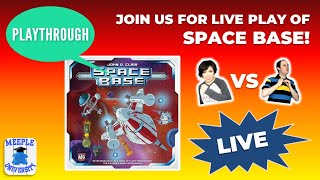
Reviewers across quick overviews and long-form podcasts describe Space Base the same way: a dice game that turns into an engine builder, where every roll at the table does something for every player. Meeple University calls it an elegant, top-block building engine game and says it eliminates the parts of Machi Koro they did not enjoy, like attacking opponents. Three Minute Board Games frames it as "basically better Machi Koro" for a similar audience, while the Secret Cabal Gaming Podcast says Space Base has done the best job of putting together this style of dice-sharing game, ahead of both Machi Koro and Card Kingdom.
Rolls in the Family rates it highly for its pure fun factor but disagrees with itself on the details: one host settles on an 8.5 out of 10 and the other on an 8, with the gap coming down to how much each minds a race-to-forty ending that can cut a player's engine off before it peaks. Ilia and Tyler, tracking their monthly plays, keep returning to Space Base and its Terra Proxima campaign expansion, calling the base game approachable and fun even as they debate whether the campaign material adds more complexity than they want. The Discriminating Gamer placed Space Base at number 74 on a personal top-100 list, down from 23 the year before, but still calls it a hoot that both new and repeat players enjoy.
Core Mechanics That Define Space Base
Dice Rolling With a Choice to Split or Sum
On a turn, the active player rolls two dice and can either add them together to activate one numbered slot or use each die separately to activate two slots, as Three Minute Board Games and Meeple University both walk through in their overviews. The Secret Cabal Gaming Podcast points out that this choice reshapes the usual dice-game odds: instead of the middle numbers dominating the way sevens and eights would if the dice were always summed, splitting the roll means the low numbers one through six come up more often. Three Minute Board Games adds that rolling a double lets a player claim its benefit twice, doubling the payout on their own turn or on someone else's.
Tableau Building Through Ship Upgrades
Each player starts with ships numbered one through twelve docked at their station. Spending the credits earned from a roll buys a replacement ship from the display, and the old card flips over and tucks underneath the board to become a passive ability that triggers on other players' turns, exactly as the Secret Cabal Gaming Podcast and Three Minute Board Games both describe the deploy step. Rolls in the Family frames the result as customizing the rewards available on your own turn and on everyone else's turn at the same time, which is what most of the strategic planning in the game revolves around.
The Space Base Experience
Something Happening on Every Turn
Every reviewer singles out the same feeling: nobody just waits for their turn to come around. Three Minute Board Games says the best thing about the game is that everyone stays engaged, since players get to do things on other players' turns too. Rolls in the Family calls it a mechanic they will love in any game that includes it, since something happens on every single turn instead of everyone waiting around for their own.
A Sudden Sprint to Forty
The Secret Cabal Gaming Podcast describes a first playthrough where the table sat at six to ten points for most of an hour before everyone rocketed toward forty in about ten minutes, calling the escalation crazy compared to how slowly the game opens. Rolls in the Family flags the same shape as a drawback as much as a thrill: because there is no fixed turn count, a player can get caught off guard by an opponent's sudden push to forty, ending the round before their own engine had a chance to pay off.
What Makes Space Base Stand Out
Compact Cards That Save Table Space
Meeple University praises the slim card size, arguing that an engine-building game like this would usually demand a lot of table space, but Space Base's cards stack neatly and take up little room even once flipped to their passive side. They add that the cartoon-style ship art serves its purpose and gives the game a little visual personality even though the theme itself fades into the background once the mechanics take over.
Charge Abilities and Directional Powers
The Secret Cabal Gaming Podcast highlights cards that charge when triggered and can be spent later, plus cards with arrows that activate a neighboring slot in either direction, as the source of real strategic depth layered on top of the dice. Rolls in the Family gives a concrete example: a card that charges when a player rolls a four can later shift a future roll one or two spaces, making an unlikely target like eleven or twelve much more reachable.
Potential Drawbacks
Charge Abilities Confuse New Players
Rolls in the Family says that without fail, new players ask how the charge cards work about ten minutes into their first game, and that no explanation fully avoids the confusion, even though they consider the mechanic necessary to keep the game interesting. Three Minute Board Games makes a related point: some special cards are not clear about their effects at first glance, which sends players to the rulebook and can slow down early sessions.
Luck Can Undercut a Built Engine
Rolls in the Family is blunt that Space Base is still a game where a player can live or die by the dice, and that a well-hedged strategy can still fail to hit the numbers it needs. They also note that the race-to-forty ending sometimes leaves a player who was unlucky, or simply mid-build when someone else crosses the line, without the payoff their engine was working toward. Ilia and Tyler add that the Terra Proxima campaign material can pile on more complexity than they always want from what is otherwise a quick, approachable game.
If You Enjoy Space Base
Reviewers reach for the same handful of comparisons. Three Minute Board Games points to Machi Koro for a similar real-world dice-and-cards setup and to Roll for the Galaxy for another space-themed dice game. The Secret Cabal Gaming Podcast makes the same Machi Koro comparison and also sets Space Base against Card Kingdom, saying Space Base replaced both games on their shelf. Rolls in the Family places it alongside Quacks of Quedlinburg as a game built around the same pure fun of loading up a system of luck and watching it pay off. Meeple University adds Gizmos to the list, though they point out Gizmos does not give players anything to do on opponents' turns the way Space Base does.
What Reviewers Are Saying
"It's just a super super fun game. I love Space Base and in fact this is another one I was playing not too long ago with my wife and my stepdaughter and they both got a huge kick out of it."
— The Discriminating Gamer
"It is the price you pay to have the high and excitement that come with dice, but it doesn't feel great to build up this custom tableau and then never see it really work because of something you couldn't control."
— Rolls in the Family
"Space base is a fast-paced fun game with a lot of interesting little puzzles built into it and it will appeal to a wide variety of people. Its simple core rules make it family and casual friendly but the probabilities and card interactions will hook in many hobby players."
— 3 Minute Board Games