/pic5826797.jpg)









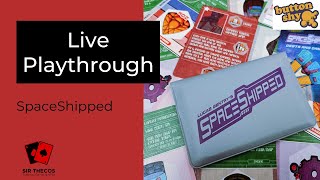


SpaceShipped Deep Dive
What the Community Thinks About SpaceShipped
SpaceShipped occupies a rare space in the Button Shy wallet-game catalog: a solo-friendly, mechanically dense design that rewards repeated plays and careful thinking. Designed by Lucas Gentry, it draws praise from Danielle and The Board Game Garden for how much it squeezes out of just 18 cards and for the satisfying arc of a complete game that plays in a single short sitting. Those who engage with it often find themselves coming back for one more run, chasing an elusive winning score.
Core Mechanics That Define SpaceShipped
Multi-Use Cards in Service of Economic Strategy
Every one of SpaceShipped's 18 cards serves multiple purposes depending on how it is played. A card might act as goods to trade, as currency, or as an upgrade to your ship, and that flexibility is the heart of the design. Danielle praised exactly this, noting how the multi-use cards make the game feel far larger than its tiny card count. Each card becomes a decision point, forcing players to weigh competing uses and plan several turns ahead. The Button Shy wallet format enforces ruthless economy, so nothing in the deck is filler.
The Buy-Low, Sell-High Economy
The game's central loop revolves around buying goods cheaply, selling them dear, and reinvesting profits into upgrades. The Board Game Garden walked through the math of timing transactions and hitting target value ranges to earn bonuses, describing the system as simple but very cool. The puzzle lies in sequencing: cash flow, upgrade timing, and reading what the market offers all interlock. Misjudge a trade and the whole run can unravel, which gives every decision real weight despite the pocket-sized footprint.
The SpaceShipped Experience
A Satisfying Compact Challenge
SpaceShipped delivers a complete strategic arc in a short sitting, making it ideal for quick solo sessions without the commitment of a longer campaign game. The game offers genuine challenge, and Danielle was candid that consistent wins are not guaranteed, yet failure rarely feels arbitrary. Each loss teaches something about market timing or upgrade priority. The satisfaction comes not from sprawling narrative but from optimizing a tight system and watching your ship improve through careful financial decisions.
A Puzzle Disguised as Space Trading
Beyond the theme of buying low and selling high, SpaceShipped functions as a numerical and positional puzzle. Every turn presents multiple valid paths: upgrade your ship now or wait for better goods, chase a high-value sale or play it safe. The puzzle-like structure makes the game approachable even for players who prefer crunchy optimization over immersive narrative. It is the kind of game that invites reflection mid-play about whether a different sequence of plays would have paid off better.
What Makes SpaceShipped Stand Out
Design Density That Respects Your Time
Button Shy's wallet format demands ruthless economy, and SpaceShipped maximizes that constraint. There are no filler cards, no chrome that fails to serve the system, and no wasted tutorial rounds. You learn by doing, and the game trusts your competence. The result feels weighty despite its portability, and reviewers describe surprising depth for something that fits in a shirt pocket.
Replayability Through System Depth, Not Randomness
While card order introduces variability, the heart of SpaceShipped's replayability lies in its system interactions. Different market configurations reward different strategies, and learning to read the cards, anticipate sales, and optimize trading chains feels like mastery rather than luck management. This appeals to the same audience that loves lighter economic games and puzzle-focused Euros, players who want their decisions to matter.
Potential Drawbacks
Winning Is Genuinely Difficult
SpaceShipped does not hand you victories. Danielle acknowledged playing repeatedly without a win and being entirely fine with it, but for players seeking a more forgiving solo experience or a relaxing evening game, the difficulty can frustrate. You are solving an optimization puzzle where a single poor trade cascades into a loss. This is by design, but it is worth knowing going in.
Iconography Requires Attention
The multi-use card design, while elegant, asks players to track what each card is doing at any moment. Reading a card as goods, currency, or upgrade depending on context can occasionally lead to a pause to reorient. The game keeps these moments light, but it does add a small friction point compared to more icon-redundant designs, particularly during a first play.
If You Enjoy SpaceShipped
SpaceShipped pairs naturally with other Button Shy wallet games that emphasize tight systems and multi-use cards. Sprawlopolis shares the puzzle-in-a-pocket satisfaction and solo focus, while Tussie Mussie showcases the same elegant economy of design in a tiny package. For players seeking the buy-low, sell-high loop on a larger scale, Century: Spice Road and Splendor offer more expansive takes on the trading economy. The through-line is games that respect your time and reward system mastery over luck.
What Reviewers Are Saying
"I really, really like this game. I've yet to win, but I enjoy it, it is fun, and if you know anything about me, I don't usually win my games, and that's completely fine by me."
— Danielle
"I love the multi-use of all 18 cards. It really feels like it's more than 18 cards because of how well they were able to design it."
— Danielle
"You're going to write a number into the top box, and then you're going to count those three numbers. The two top numbers are going to get moved to the next three, and those are going to be the two numbers at the bottom. Very simple, but very cool."
— The Board Game Garden