/pic8365415.png)






































Stamp Swap Deep Dive
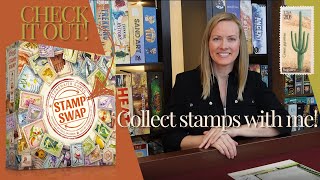
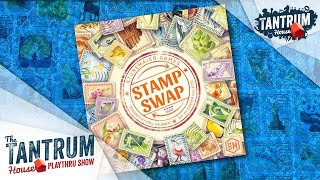
Stamp Swap arrived in 2024 from designer Paul Solomon, the same mind behind Honey Buzz, and published by Stonemaier Games. The premise is charmingly specific: you are attending a three-day stamp collecting convention, trading tiles with fellow hobbyists and arranging a curated collection on your personal stamp book. What reviewers discovered underneath that cozy theme is a tightly wound I-cut-you-choose engine wrapped around a spatial puzzle, all running in roughly 60 minutes for one to five players.
What the Community Thinks About Stamp Swap
The thematic frame is one of the game's most discussed qualities. Players spend Friday, Saturday, and Sunday drafting stamps, swapping piles, and placing tiles on individual player mats that function as their collection books. Rodney Smith of Watch It Played walks through a setup that includes colored stamps in five themes (space, monuments, animals, flowers, and vehicles), cancelled and faded stamps with quirky scoring implications, rare gold-foil stamps worth major points, and tiny forever stamps that determine a majority bonus at game end.
The convention fiction holds together throughout play. Points accumulate round by round through exhibitor cards that reward specific themes or colors, contest cards scored once each round, and a grand finale scoring at the close of Sunday. The whole arc feels purposeful: you are building a collection across a weekend, decisions made on Friday locking in forever, Saturday stamps layering on top, Sunday completing the book.
Core Mechanics That Define Stamp Swap
Drafting with Deception
Each round opens with a collect phase where players take turns drafting stamps one at a time until everyone holds six items. Some stamps are revealed face-up; others are placed face-down, visible only to the player who picks them up. That information asymmetry is the first lever of player interaction. Jess and Sean from Allies or Enemies describe how face-down stamps generate a genuine metagame: a player who consistently puts bad stamps face-down gets read quickly, while occasionally tucking something valuable face-down flips that expectation. The bluffing layer is described as one of the most replayable aspects of the game, something that deepens between familiar opponents over multiple sessions.
Splitting and the Psychological Moment
After drafting, each player reserves one item they will keep no matter what, then splits the remaining five into two piles of unequal size. The first player then selects one pile from another player, that player keeps their remaining pile and immediately selects from the next player, and so on around the table. The pile-splitting decision is the emotional center of the game. Jamie from TabletopTikTok captures this tension while walking through a solo playthrough, narrating how she is trying to hide a rare stamp in a pile while making the other pile attractive enough to draw the AI away.
Rare stamps, worth eight to twelve points, cannot be reserved, so any player who drafts one must offer it up for splitting. That single rule creates recurring dramatic moments across every game session multiple reviewers mentioned.
The Stamp Swap Experience
Where Stamps Land Matters
Once each player acquires their stamps from the swap phase, those tiles go onto a personal player mat in an arrangement chosen by the player. New stamps can be freely repositioned during the current round, but once a round closes those tiles are frozen permanently. Stamps from Friday cannot move when Saturday arrives. This creates a layered spatial puzzle that compounds over the three rounds: early placements constrain later options in ways that are only fully visible in hindsight.
The scoring goals drive placement directly. One contest card might award points for small squares connected into a single group. Another rewards canceled stamps along the board's edges. The finale contest card is revealed at setup and applies to everyone at game end, adding a shared spatial constraint from the first turn. Jenna from The Board Game Garden spends considerable time on stream planning around perfect corners, a finale where four stamps meet exactly at one point, noting that her specialist card allowing free rotation dramatically changes what arrangements are possible.
Compound Scoring Layers
The scoring architecture is multi-layered in a way that draws comparisons to Calico. Each round, players score exhibitor cards (ongoing bonuses tied to specific colors or themes), the first-player token (worth two points at show time), and one contest card of their choosing from four available. Players must score three different contests across the three rounds, leaving one unscored. That "skip" decision is openly discussed by Stella and Taran from Meeple University during their playthrough, each reasoning through which contest to defer.
End-game scoring adds forever stamp majorities, the printed values on all stamps (including negative values on faded stamps), two points per specialist card held, and the finale contest. Allies or Enemies note that much of the point scoring arrives at the end, meaning the score track can be misleading during play and final results sometimes surprise everyone at the table.
What Makes Stamp Swap Stand Out
How Count Changes the Game
Stamp Swap scales differently at different counts. At two players the game is quick and intimate. Allies or Enemies describe playing in roughly fifteen minutes at two players, with the I-cut-you-choose still functioning effectively because the psychological dynamic between two familiar opponents is direct and personal. The phantom third player holding three forever stamps, a rule in the two-player game, means first place in the majority is hard to lock up without real effort.
At higher counts, more stamps enter the pool each round, the drafting phase extends, and splitting decisions become more complex because more players may want different things. Jess from Allies or Enemies points out that players prone to analysis paralysis will slow the game significantly at four or five, especially during the splitting phase, though that phase does happen simultaneously, which helps. The game's 60-minute box estimate assumes a moderately paced group.
A Gateway with Depth Inside
Multiple reviewers place Stamp Swap alongside Between Two Cities as an accessible, lighter game with genuine decision texture beneath the surface. Jamie from TabletopTikTok calls it underrated and points to its fantastic solo mode as a particular strength, uncommon for an I-cut-you-choose design where the mechanism seems inherently multiplayer. Meeple University's playthrough surfaces the gateway appeal: the rules are learnable inside a single round, yet the specialist and exhibitor card variety keeps experienced players finding new configurations.
Potential Drawbacks
Pinsetta and the Appraisal System
The solo opponent, named Pinsetta, operates through an appraisal token system that simulates the pile-choosing logic of a human opponent. Players assign appraisal tokens to each tile in their own pile based on criteria the AI values: rare stamps receive four tokens, forever stamps and value-two-or-three stamps receive one each, and the AI's preferred stamp sizes receive two extra. After splitting, a decision card is drawn that may remove tokens from one pile, and the AI takes whichever pile ends the appraisal with the most tokens.
Foster the Meeple plays her first solo game on stream at medium difficulty and narrates how the system creates genuine tension even without a human opponent. She must plan not just what she wants but what the AI wants, then structure piles to steer those outcomes. The solo mode runs at three difficulty levels, with level three described as genuinely punishing.
Puzzle Character and Replayability
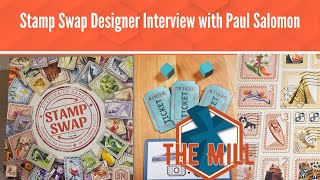
The solo game is described repeatedly as a "puzzly" experience by reviewers who enjoy it in that mode. Jamie from TabletopTikTok frames the solo as an optimization puzzle about which contest to score early, what arrangements enable the finale condition, and how to avoid giving Pinsetta exactly what she values. The Board Game Garden stream shows the designer, Paul Solomon, watching live and answering rulebook questions in the chat, including a clarification about whether double-small-stamp tiles count as a single or two separate tiles for appraisal purposes.
The Physical Stamps
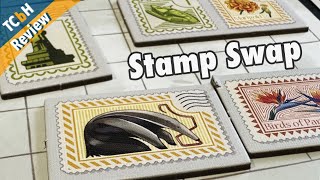
The stamp tiles are the clear star of the production. Reviewers across every video mention them. The stamps come in four sizes (small square, large square, short rectangle, and long rectangle), with double-small tiles that occupy a long-rectangle shape but score as two separate stamps. Rare stamps carry shiny gold foil and are noted by multiple reviewers as particularly beautiful, with Meeple University and Allies or Enemies both remarking that all the rare stamps feature chocolate imagery, a detail attributed to designer Paul Solomon's well-known fondness for chocolate.
The five color borders use distinct patterns to help distinguish them: Allies or Enemies mention discovering the dual-coding of color and theme early helps navigate the visual complexity. A few reviewers note that monuments and space stamps can look similar, requiring careful reading of the stamp background rather than the illustrated subject.
Minor Friction Points
Jess from Allies or Enemies has a notable complaint about the score track: with only every-fifth-space numbered, mentally counting forward after scoring larger point totals becomes an unnecessary friction. She advocates for every-space numbering as a general board game improvement. The player mat grid is also noted by Allies or Enemies as slightly wider than the stamps, which frustrates players trying to align tiles precisely, an issue felt more acutely by players with the instinct to keep their collection books neat.
If You Enjoy Stamp Swap
Stamp Swap is not trying to be a heavier strategy game. Allies or Enemies place it firmly at the lighter end of Stonemaier's catalog, alongside Between Two Cities rather than Wingspan. It belongs on the table when the group wants something that plays in under an hour, rewards reading people as much as optimizing points, and delivers tactile pleasure from physically arranging tiles on a board.
The game fits groups who enjoy a moderate puzzle element without needing to track a dense economy. Players who dislike any loss of control over their tiles will have friction with the I-cut-you-choose mechanism; that is a genre preference, not a flaw. Players who enjoy the negotiation layer and the cat-and-mouse of splitting and choosing will find the metagame rewarding across many plays with the same opponents.
The solo mode broadens the game's appeal significantly. Reviewers who would not normally highlight a solo mode mention it specifically as a strength here, noting it captures the tension of the core mechanism better than most solo implementations of drafting games. Anyone who enjoys optimizing a spatial puzzle against a ticking constraint will find the solo worth returning to at higher difficulty levels.
Jamie from TabletopTikTok describes the game as "really underrated" and notes it does not come up in conversation as often as its quality warrants. For a cozy, thematic, approachable tile placement game with a psychological snap in the middle, that assessment holds up across all the footage reviewers have put on camera.
What Reviewers Are Saying
"Stamp swap is kind of like a tile placement game, but we're also going to be scoring different things throughout the game."
— Foster the Meeple
"It is so much about like past behavior as well, because Jess tends to try and trick me with the minus ones and so I just don't go for those, and she knows that now, so now every now and then she puts something awesome by itself."
— Allies or Enemies
"I think this game is really fun. I like the look of it... I think the solo is actually fantastic and you don't get a lot of I cut you choose in the solo."
— Jamie, TabletopTikTok