














Stars of Akarios Deep Dive
What the Community Thinks About Stars of Akarios
Reviewers treat Stars of Akarios as one of the more ambitious space games in recent memory. Board Games UnLocked placed it as an honorable mention on a 2022 top-ten list and described it as basically Gloomhaven in space, with planet exploration that borrows from Seventh Continent. Meet Me at the Table included it in a list of top campaign games and called it a ship battling game that works really well, after admitting some early concern about how a space theme would hold together. The overall tone is enthusiastic but measured. Most reviewers praise the blend of tactical ship combat and narrative exploration, while noting that the rules take real effort to absorb before the game starts to flow.
Core Mechanics That Define Stars of Akarios
Dice Placement and Stress
On a turn, players assign action dice to actions on their player board. The faces cover move, attack, wild, and stress results. Assigning a stress face raises the stress track in exchange for a stronger action, and the track carries real consequences. Reaching level 3 and level 5 adds miss cards to the modifier deck, so every extra push makes the next attack less reliable. Reaching level 7 and level 10 triggers trauma. When a pilot hits 10 and gains more stress, the track wraps back to zero and a trauma gear is marked on the character sheet. From then on, every trauma card drawn costs one extra card for each trauma already marked, which makes trauma something players actively want to avoid.
Modifiers, Advantage, and Target Lock
Attacks resolve by drawing from the modifier deck, which mixes ordinary modifier cards with miss cards and bolster cards, including a times-two bolster that can swing a fight. Attacking from the flank or rear grants advantage, which means drawing two modifier cards and keeping the better one. Disadvantage works the opposite way. Radar Jam is a clear example, giving a target disadvantage on its attacks until the end of its next action phase. Target lock marks an enemy so that any ship attacking it gains advantage regardless of direction, which turns the lock into a shared objective for the whole table. Stealth lets a ship attack with advantage on its first strike, and a stealthed ship cannot be targeted until it fires again. Other tech effects include pierce, push, pull, stun, slow, hull breach, and hack, so ship-to-ship fights rarely feel like simple damage rolls.
The Stars of Akarios Experience
Space Combat and the Sparrow
Combat pits the squad against Ronin Scouts, Ronin Frigates, Synthetic Fighters, Cruisers, and eventually a Titan, and each enemy type reacts differently to positioning. Proton blast weapons hit a wide arc, so a single shot can threaten several enemies at once, and the squad must decide whether to spend supply on one target or spread damage. The Sparrow serves as home base between missions. Players pool credits there to buy ship upgrades, resupply, and reduce trauma, and the ship is shared by everyone at the table. Because the Sparrow can be equipped with upgrades even when it is off the board, its actions remain available in scenarios where it never leaves base.
World Exploration and Progression
Between battles, the squad explores tile maps on foot. Each pilot tracks energy, which depends on the number of players, and the energy track is reduced each round. Points of interest come in five kinds: explore and move, investigate, skill check, dock, and stop. Players commit dice to a point of interest and try to match its requirements, with a stress reroll available once per round when results fall short. Skill checks use strength, dexterity, intelligence, and charm, and an unlucky roll can be rescued by spending stress. Space exploration uses the Galaxy Atlas and sticker-based discovery, so a map steadily grows as the campaign moves forward. Pilots level through their own skill trees, and new pilots enter with the squad's global skill points already filled in, which keeps late additions from feeling underpowered.
The planet exploration sections drew particular attention from one reviewer, who looked forward to the adventures on alien worlds more than anything else in the box.
What Makes Stars of Akarios Stand Out
Ship and Pilot Variety
Each starting ship, including Argonaut, Invictus, and Merkava, carries tags such as command, heavy, stealth, and assault, and each has its own hull and shield ability. Tech upgrades only fit ships with a matching tag, so a stealth-tagged Invictus can use cloak or jam, while a command ship can take target lock. Violet Ray and Enver show how this plays out in practice. A squad can chase different tactics across the campaign, and pilots and ships acquired later can be claimed by anyone at the start of a scenario. Ship upgrades are chosen by the table, which gives the group a real say in how each vessel develops.
Campaign Structure and the Drones Expansion
Scenarios are arranged across acts, and the campaign rewards players for progressing through them. Ships can eventually hold up to two engines and two weapons, so the loadout grows as the story advances. The Drones of Akarios expansion adds six drones with abilities that trigger based on the act being played, which gives the squad another set of tools to build around. Grant's GameRex described the 1.5 release, published by Open Owl Studios, as a reworked version with rule and balance revisions, and that kind of ongoing support appeals to players who want a campaign that keeps growing.
Potential Drawbacks
Rules Density and Table Time
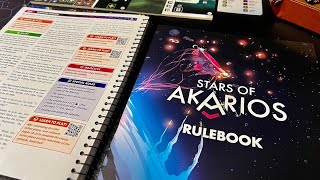
The rules are the most common criticism. The rulebook covers stress thresholds, trauma, modifier cards, advantage, target lock, and the world exploration loop, and first-time players often need to keep the reference open. Reviewers noted that play can run from roughly 30 minutes to 120 minutes depending on the scenario and how much exploration the group takes on. Nights Around a Table spent a long stretch explaining the world exploration phases, and the sheer number of options can make early turns feel slow. Tracking energy, stress, trauma, supply, and dice across two parallel modes asks for focus that not every group will enjoy.
Presentation and Card Art
The Dungeon Dive described the card art as sterile, even while praising the planet exploration. That reaction suggests the visual presentation may not match the depth of the mechanics. Viewers who want a richly illustrated experience may feel the art does less than the systems do, and that gap can be noticeable in a game built around story beats.
If You Enjoy Stars of Akarios
Board Games UnLocked's own shorthand for Stars of Akarios, basically Gloomhaven in space, points directly at the campaign structure and mission-to-mission progression players should expect if they come from Gloomhaven. The same reviewer's note that the planet exploration borrows from Seventh Continent singles out the on-foot investigation and skill-check loop as the clearest echo of that game. Groups that like dice placement with a sense of risk will appreciate the stress economy, and anyone who enjoys ship-to-ship tactics with shared objectives will find plenty to plan around. The game suits tables willing to invest in learning its systems, and it rewards that patience with a campaign that keeps adding new tools for the squad to use.
What Reviewers Are Saying
"basically gloomhaven in space"
— Board Games UnLocked
"this seems like the coolest part of the game to me"
— The Dungeon Dive
"a ship battling game, and it works really well"
— Meet Me At The Table