/pic5950845.jpg)



































Strike Deep Dive
What the Community Thinks About Strike
Strike has emerged as a surprising hit in the board gaming community, praised for its simplicity, accessibility, and genuine fun factor. Reviewers consistently highlight how the game transcends traditional gaming boundaries, appealing equally to casual players, competitive gamers, and families. The game's infectious energy and quick playtime have made it a go-to choice for game nights and social gatherings, with players reporting that it gets pulled out repeatedly once it hits the table.
Core Mechanics That Define Strike
Dice Rolling Into the Arena
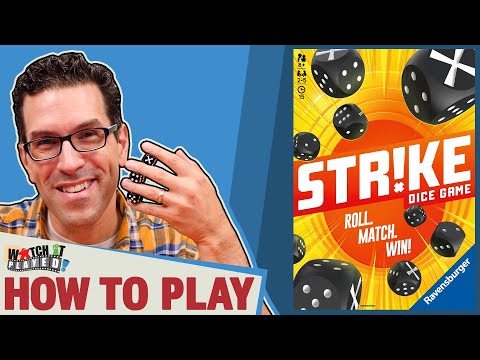
At its heart, Strike is about the physical act of throwing dice into a foam-lined arena built into the game box. Players choose one die at a time and roll it into the arena, aiming to manipulate outcomes through placement and throw technique. Any X faces that appear are immediately removed from play. The core decision loop is elegant: when you roll, you check if any of your newly thrown dice match existing ones. If they match, you collect those dice and your turn ends. If they don't match, you face a choice to keep pushing your luck by throwing another die or passing to the next player.
Push Your Luck Tension
The brilliance of Strike emerges in its push-your-luck mechanism. Each throw adds more dice to the arena, creating more opportunities for matches but also more risk. The critical rule that forces the next player to throw all remaining dice if you clear the arena creates dramatic swings in momentum. This one rule transforms the game, generating moments of genuine tension and exciting comebacks that shouldn't happen in a five-minute game but do, creating an electric table energy.
The Strike Experience
Raucous, Physical Fun
Strike thrives on its tangible, kinetic quality. The act of throwing dice generates laughter and excitement in a way few modern board games achieve. Players can flick dice hard into the arena or roll them gently, and there's inherent physical comedy when dice bounce in unexpected ways or when someone throws too hard and launches a die completely out of the arena, eliminating it entirely. The game creates these naturally funny moments that arise from the physics of the situation rather than game mechanics, keeping players engaged and entertained throughout.
Accessible Party Energy
One of Strike's greatest strengths is how instantly accessible it is to any group. There's virtually no learning curve. Teaching the game takes under a minute, and anyone can jump in immediately. This accessibility combined with the short five-minute playtime means it works in almost any social context, from casual gatherings to end-of-game-night wind-downs. Players note that it creates a shared, collaborative energy at the table, even though only one winner emerges. The simplicity means players can chat, banter, and enjoy the social experience while playing.
What Makes Strike Stand Out
Brevity Without Sacrificing Depth
Strike accomplishes something rare in board games: it plays in roughly five minutes yet generates meaningful decision-making and tension. Each turn presents a genuine strategic choice about risk tolerance. Players must calculate whether the dice in the arena present good odds for finding matches, how many dice they can afford to lose, and whether the group dynamics suggest aggressive or conservative play. The decisions are simple enough for anyone to grasp but complex enough to matter, creating a game that satisfies both casual and experienced players.
Multiple Play Opportunities in One Session
Because Strike plays so quickly and teaches so easily, a single game night often includes numerous rounds. Reviewers note that once Strike comes out, it gets played eight, nine, or even ten times in a row. This makes it invaluable for coffee shops, Airbnbs, casual gatherings, and families. The low commitment barrier means skeptical players are willing to try it, and the engaging gameplay keeps them coming back. Adults and children, experienced gamers and newcomers, all find themselves eager for another round.
Potential Drawbacks
Heavy Reliance on Randomness
Strike is fundamentally a luck-heavy game. The roll of dice determines outcomes far more than player skill, and there's limited ability to mitigate poor luck once you've committed dice to the arena. Players who prefer games where strategy dominates outcomes may find Strike frustratingly random. While some skill exists in dice-throwing accuracy and tactical choices about when to push luck, the underlying randomness means even optimal play doesn't guarantee success. This randomness is actually a feature for many players, but it's worth noting for those seeking tight strategic gameplay.
Minimal Strategic Depth for Experienced Gamers
Because decisions are simple and limited, Strike offers little strategic variation across plays. Once players understand the mathematics of probability and have played a few rounds, the core decision-making remains largely unchanged. Experienced gamers seeking strategic complexity, engine-building, or long-term planning will find Strike lacks these elements. The game's appeal is immediate excitement and social fun, not cerebral challenge or strategic mastery. This makes it excellent for casual play but less satisfying for players prioritizing strategic depth.
If You Enjoy Strike
Players who love Strike's quick, physical, and luck-driven nature should explore other dexterity games like Crokinole and Tumbling Dice, which share similar tangible satisfaction and accessibility. For those wanting comparable push-your-luck mechanics with slightly more structure, Coco Nana and Love Letter offer quick-playing alternatives. Strike's strength lies in casual social gaming, so other five-to-fifteen-minute party games that emphasize interaction and laughter work well alongside it in collections.
What Reviewers Are Saying
"I don't think there's a game that's more dumb fun than Strike. And I mean that with as a complete compliment. Strike is a game where you are gladiators in a battle, and there's just such a fun silly time for the entire family."
— Brothers Murph
"Strike has been an absolute home run as evidenced by how many times I've gotten it to the table. I've played it over 170 times in less than two years because when it gets pulled out, people keep playing it. It's a great one to talk while you're playing."
— Rolls in the Family
"Strike is one that if you play it at a convention you will end up with curious people coming over to see what the heck you're having such a good time playing. It's got dice rolling, it's got push your luck, it teaches in about 30 seconds and plays for about 10 or 15 minutes."
— Shut Up Sit Down