








Stuffed Fables Deep Dive
What the Community Thinks About Stuffed Fables
Stuffed Fables, published by Plaid Hat Games in 2018, draws a consistent response from reviewers: it is a warm, theme-first game that works best when the table is willing to commit to its storybook premise. Several channels frame it as an entry point into a new format rather than a conventional board game. Board Games UnLocked placed it among the most anticipated games of 2018, and The Dice Tower later ranked it in its collection list while calling it the favorite of designer Jerry Hawthorne's titles in that collection.
The shared premise is easy to summarize. Players are stuffed animals who come alive to protect a child from a scheming mastermind and the minions that follow. Pair of Dice Paradise describes the game as an adventure-book experience that moves through the milestones of a child's life, and Where There's a Wheel, There's a Play highlights its campaign-book feel, noting that the story unfolds across the pages of an adventure book that opens flat on the table.
Reviewers agree on the strength of the theme and presentation. Where they diverge is on who the game suits. Some reviewers view it as a family game that parents can share with young children, while others treat it as a cooperative campaign for adults who still enjoy storytelling. Board Game Sanctuary is the most direct about the cost of that depth, warning that the game is slightly text and rule heavy and that players should be ready for that before sitting down.
Core Mechanics That Define Stuffed Fables
Dice Bag Drawing and Colored Actions
The central mechanic is the dice bag. On a turn, a player draws five dice from the bag, and each color determines what that die can do. Reviewers describe the result as a system where nearly every die has a use. White dice restore stuffies injured in battle, red dice handle melee attacks, green dice handle ranged attacks, yellow dice search, and blue dice power special actions. Purple dice act as any color. Reviewers note that the choice of which dice to spend, store, or combine turns each draw into a small planning problem. The Dungeon Dive frames the dice as the moment-to-moment engine that keeps players busy, and The Dice Tower highlights the bag-building and dice-pulling elements as the core of how the game feels in play.
The bag also drives the game's pacing. Black dice enter the bag as turns pass, and once enough accumulate, minions emerge or attack and the bag is reset. Reviewers who like tension appreciate that the rhythm of drawing, spending, and resetting keeps the threat present without requiring a separate timer or deck.
The Adventure Book as Board
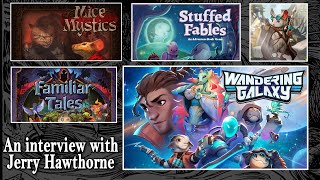
The second defining system is the adventure book itself. Stuffed Fables is described as the first title in Plaid Hat Games' AdventureBook line, in which the book serves as the rules reference, story guide, and game board at once. Each open spread shows a map or illustration that is central to play, while the facing page holds the choices, narrative text, and special rules for that location. Designer Jerry Hawthorne's background in the Mice and Mystics line is visible here. The Dungeon Dive's interview with Hawthorne covers how the team had to fit both the map and the story onto a single book, a constraint that shaped the layout and the pacing of each chapter.
Because each page is a chapter that connects to a larger branching story, the book also carries progression. Items, special discovery cards, and the outcomes of earlier scenes change what happens later. Reviewers who value narrative describe this as a campaign that remembers what the players did.
The Stuffed Fables Experience
Whimsical Storybook Charm
The most consistent word reviewers use is adorable. Board Games UnLocked describes the characters as cute and the premise as a delightful fantasy about stuffed animals who must save their beloved little girl from an evil mastermind. The teddy bears and other plush characters are part of the appeal, and reviewers consistently mention how the art and presentation carry the story. Playing feels like turning the pages of a children's book, with scenes that stay light even when the minions are threatening. The Dice Tower's reviewer connects this feeling to a bedtime-story experience and to memories of reading adventure books as a child, which gives the game a sense of wonder that many reviewers find hard to replicate.
Gateway Accessibility for Mixed Groups
Reviewers tend to describe Stuffed Fables as approachable, even though its rules take time to absorb. The dice colors are intuitive once a player has seen them in use, and the cooperative structure means no one is eliminated for a bad turn. Board Games UnLocked notes that the design is geared toward families with little kids, while Pair of Dice Paradise points out that the game remains accessible to younger players and older players alike. Board Game Sanctuary balances this by warning that the text and rules can slow down a table that is not prepared for them. The experience is therefore strongest when one player takes responsibility for the book and the others focus on the dice and the story.
What Makes Stuffed Fables Stand Out
A Narrative That Holds Together
Reviewers return again and again to the story. Board Game Sanctuary praises the game for having a strong narrative and theme that runs through each session, and Where There's a Wheel, There's a Play identifies the campaign structure as the reason it was one of the titles they were most eager to bring to the table. Because the story is built into the physical book, players read the current page, make a decision, and see the consequences carry into later chapters. This is a stronger hook than a single scenario, and it is the main reason reviewers say they keep coming back to the game.
A Clear Lineage From Mice and Mystics
Many reviewers place Stuffed Fables in the same family as Mice and Mystics. Board Games UnLocked describes it as almost a sequel to that game, with the same sense of small creatures facing a world that is too large for them, but with stuffed animals in place of mice. The Dungeon Dive's interview covers the shared design lineage and how Hawthorne approached the adventure book format. Reviewers who already know Mice and Mystics find that familiarity makes the new game easier to appreciate, and those who do not know it still respond to the same warmth and attention to detail.
Potential Drawbacks
Text and Rule Density
The most common concern is that the game asks a lot of reading. Board Game Sanctuary warns that it is slightly text and rule heavy, and that players should be prepared before setting up. Because the story, the map, and the rules share one book, a new player can spend time searching for the right page at the moment a decision is needed. Reviewers who enjoy reading aloud tend to accept this trade, but groups looking for a fast filler game may find the pace slower than expected.
Narrower Appeal for Adults
Board Games UnLocked acknowledges that the game is adorable but not for everyone, and that it is geared more toward families with little kids who are being introduced to gaming. Adult players who prefer heavy strategy or competitive tension may find the cooperative structure and gentle tone limiting. Reviewers do not present this as a flaw in the design so much as a matter of audience, but it is a fair caution for groups that want a mature, challenging experience.
If You Enjoy Stuffed Fables
Players who enjoy the storybook structure of Stuffed Fables will find a natural companion in Mice and Mystics, the title reviewers most often name as its predecessor in spirit. Both games share a sense of small characters confronting an oversized world, along with cooperative play and a strong narrative spine. Players who are drawn to the way the adventure book doubles as a board may also want to look at Oathsworn: Into the Deepwood, which offers the same kind of immersive, story-driven campaign. For players who prefer a different kind of thematic adventure, Thunder Road Vendetta delivers a more direct focus on action and theme while keeping the table firmly cooperative.
What Reviewers Are Saying
"This is my favorite of the Jerry Hawthorne designs in the collection right now, although I have been hanging on to many of them because I really like Jerry's design aesthetic. Stuffed Fables is about a group of stuffed animals that come alive at night and go on adventures to protect their little girl."
— The Dice Tower
"Absolutely adorable. Fables is that it has a very strong narrative and theme too, emanates throughout each game. His beautiful blend of role-playing-like game mechanics that will appeal to lots of different family gamers."
— Board Game Sanctuary
"Stuffed Fables was, I think, your first story book game, where you open up a book and one side is the game board and the other side is the story and the rules that pertain to that game board."
— The Dungeon Dive