



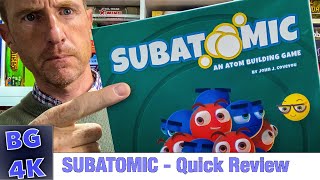


Subatomic: An Atom Building Game Deep Dive
What the Community Thinks About Subatomic: An Atom Building Game
Reviewers come to Subatomic: An Atom Building Game as a deck-building game first and a science-themed game second. BoardGameBollocks, the channel behind the most detailed critique here, put its mechanical identity bluntly: once you have digested the rulebook, the engine feels familiar because it is basically Dominion with a reskin. That familiarity is the central tension in how people talk about the game. Players who already know the genre settle in quickly, while newcomers get an approachable introduction wrapped in a chemistry theme.
Meeple University approached the game from a different angle. Its walkthrough opened with a short science lesson on molecules, atoms, and particles before any rules were introduced,. The channel taught from the print-and-play version, noting that the game had been successfully funded on Kickstarter but had not yet shipped as a hard copy. 3 Minute Board Games, touring a shelf that included the game, offered only a passing mention, though its enthusiasm for a related deck builder helps place Subatomic within the same genre.
Core Mechanics That Define Subatomic: An Atom Building Game
Deck-Building Through Tiered Purchasing
The purchasing engine is where the Dominion lineage shows most clearly. The board offers a row of single subatomic particles and a row of larger subatomic particles, and each card carries its cost at the bottom and its benefit at the top. Meeple University explained that the top row is cheaper with a smaller benefit, while the bottom row costs more and returns more, and that a purchased card goes onto the discard pile to cycle back later. BoardGameBollocks added that when a card is bought, the row shifts down and becomes cheaper, so cards on the board grow less expensive the longer they sit there. Every purchase strengthens the deck, and that stronger deck is what allows a player to build atoms and claim elements later.
Face-Up and Face-Down Play as Resource Conversion
Every card in hand can be played in one of two ways, and that choice sits at the heart of each turn. Played face-up, a card supplies particles toward the player's atom or pays the cost of a purchase or an element claim. Played face-down, a card produces one energy token, so the hand is effectively being converted into a spendable currency. Meeple University stressed that this departs from many deck builders, because unplayed cards stay in hand at the end of the turn while played cards are discarded. BoardGameBollocks noted that energy can be used for several different actions. It can be spent to sweep a card row, to draw an extra card, or to annihilate two cards from hand, and the annihilation cost climbs each time that action is taken.
The Subatomic: An Atom Building Game Experience
Juggling Three Points of Focus
BoardGameBollocks praised the way the game asks players to balance three interchangeable priorities at once. The player board is where markers move up tracks to meet element costs, the card rows supply the cards that make the deck more capable, and the scientists inject an element of unpredictability. The reviewer noted that every turn raises the same questions: whether to strengthen the hand first, whether to chase a scientist that speeds up hand building, or whether to go straight for goals. Because the three priorities work together, the game never lets a player fixate on just one of them for long.
Learning the Rules and the Science
The learning curve is where opinions diverge most sharply. BoardGameBollocks found the rulebook unnecessarily bloated for a game of this simplicity, pointing to the lengthy setup and a layout that sends players flipping between the rules and the component listing. The reviewer wished for diagrams with a card circled beside the rule it illustrates, and admitted the group struggled to make sense of the book at first. Meeple University took the opposite route in its teaching video, opening with the science and only then walking through each action in turn. The channel's premise was that the game becomes more fun once players understand the concepts behind the tracks and particles, so the theme is not just decoration but part of how the rules make sense.
What Makes Subatomic: An Atom Building Game Stand Out
Scientists That Bend the Rules
BoardGameBollocks argued that the scientist cards are the feature that keeps the game from being a generic deck builder. Each scientist carries a special ability that can break the normal flow of play. Albert Einstein, for example, can free energy and add the same number of particles to the player's atom, while opponents may be forced to pay for the same effect. Marie Curie lets a player look at another player's hand and copy two of their subatomic cards, after which the other players may discard and redraw. Meeple University noted that the scientists come in four decks of three, with an energy cost that rises for each card, so acquiring one earlier in the game is cheaper. The reviewer summed up their importance in a way that captures the design intent: without them, the game would be a very dull, generic deck builder.
A Research-Backed Theme
BoardGameBollocks was genuinely impressed by the booklet included in the box, which explains the science behind the game. At the back, the credits list writers, editors, and reviewers with doctorates, and the reviewer described the thoroughness of that background work as a real strength. Because the booklet explains what each component means, players can look up the concepts on the table and connect the cards to the chemistry they represent. The reviewer especially recommended this for families, since it gives children interested in science a concrete reason to engage with the game. Meeple University's decision to open with the atomic model reflects the same idea: the chemistry is presented as the basis for understanding the game.
Potential Drawbacks
A Familiar Formula Without Original Mechanisms
BoardGameBollocks was candid that the generic deck-building core is also the game's biggest liability. The reviewer described the deck-building mechanism as lifted straight from Dominion and wrapped in a scientific theme, and argued that the game suffers from clone syndrome. Anyone who already owns Dominion or Marvel Legendary has little reason to add Subatomic to the collection, since the experience is largely the same. The reviewer called the formula tired and outdated and said the design has no real original mechanisms. That is why the recommendation is narrowed to players who have not yet tried a deck builder and who are curious about science.
Endgame Tempo That Tips Quickly
The pacing is the other sharp criticism. BoardGameBollocks observed that the elements do not become more expensive as the hand grows more powerful, so the early game is a struggle, with players stuck with weak starting cards. Once stronger cards enter the deck, players begin claiming element cards left and right, and the game ends abruptly. The reviewer's verdict on the design was that the game speeds up far too quickly towards the end.
If You Enjoy Subatomic: An Atom Building Game
Because reviewers consistently framed Subatomic as Dominion in a new coat of paint, Dominion is the most natural next step for players who want the same deck-building engine in its original form. BoardGameBollocks named Dominion, Marvel Legendary, and Arctic Scavengers as the reference points for the genre, and it said that anyone who already owns Dominion and Marvel Legendary has little reason to buy Subatomic. For players who like the deck-building core but want more interaction at the table, 3 Minute Board Games described Arctic Scavengers as one of the most underrated deck builders out there because it is way more interactive than Dominion. That makes Arctic Scavengers a strong pick for players who enjoy Subatomic's purchasing and card-cycling rhythm but want the table to feel more connected.
What Reviewers Are Saying
"It's kind of easy to get your advantage mechanics because we've seen all this before. It's basically Dominion, that with a reskin."
— BoardGameBollocks
"Without understanding what the concepts in this game mean you're just playing an abstract game, so it's a little more fun if you know the science."
— Meeple University
"The scientist cards really open the game up. If they weren't there it would just be a very very dull, boring generic deck builder."
— BoardGameBollocks