













Summit: The Board Game Deep Dive
What the Community Thinks About Summit: The Board Game
Reviewers describe Summit: The Board Game as a mountaineering race built around tile placement, shared weather, and a constant drain on food, oxygen, and weight. The game comes from Inside Up Games and started as a Kickstarter. Board Stupid reports that the title sold out in Europe and the UK for more than a year before returning to stock, and the designer presents the production with obvious pride, including custom embossed cards. Most reviewers agree that the components feel like a premium product.
The praise is consistent on the theme. Felicia and Giancarlo score the game 7 out of 10 and say its chaos captures the feel of a dangerous expedition, comparing the experience to an episode of an HBO series about Everest. Quackalope introduces the game as a board game about mountain climbing, expeditions, yetis, and freezing on a cliff while following a rope ladder. Rolling Dice and Taking Names enjoyed the session and singled out the event cards as the element that made the game memorable for them.
The reservations center on luck and swingy outcomes. Felicia and Giancarlo argue that the tactical choices around supplies are undercut by event cards, die rolls, and drawn tiles. Quackalope describes the competitive mode as harsh enough that the game can feel unforgiving. Reviewers generally treat these concerns as a question of whether a player wants to be in control of the outcome.
Core Mechanics That Define Summit: The Board Game
Tile Placement on Ropes
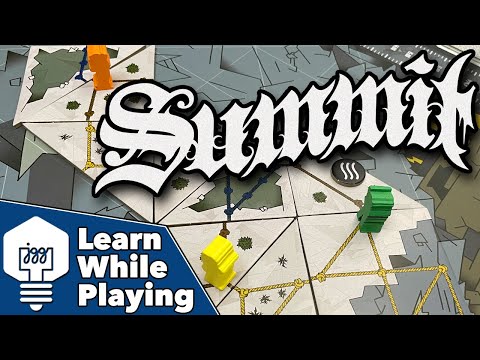
On a turn, a climber moves along the knots that act as spaces, and a player who reaches the edge of a tile can play one from a hand of tiles to continue. Felicia and Giancarlo explain that tile placement follows matching rules, such as long edges meeting long edges. The ropes come in three colors. Brown is neutral, blue ice tiles add spaces that slow movement, and yellow thin air tiles cost oxygen when entered. Rolling Dice and Taking Names says the group enjoyed placing tiles, and one host noted that certain rope colors are slippery and harder to climb, which adds a spatial puzzle on top of the route itself.
Player Boards, Supplies, and Weight
Each climber has an asymmetric player board that tracks food, oxygen, weight, health, and speed. Before the ascent, players choose how much food and oxygen to carry, and every supply adds weight that slows the climber down. Rolling Dice and Taking Names found the trade-off the most interesting part of the design and praised the board layout, with its clearly marked tracks and the way moving one value changes the others. Items also add weight, and the more powerful ones tend to be heavier. Sherpas can resupply a climber at camp, which gives the supply decisions a second layer of planning.
The Summit: The Board Game Experience
Event Cards, Weather, and the Yeti
Each turn ends with a blue event die and a white weather die, and the results can change the whole mountain. Felicia and Giancarlo describe the blizzard track as the main threat, since every climber who is not in camp must pay for the level it reaches. Rolling Dice and Taking Names notes that the blizzard track can end the game for everyone if it rises high enough, which turns the weather into an opponent of its own. Quackalope's gameplay session adds the Yeti and sanity mechanics, where rolls can push the creature toward a climber and reduce speed, health, or supplies. In that session, one climber reached the summit with very little food left, while the other died on a sled ride down the icy slope.
Modes, Difficulty, and Pacing
Summit offers solo, co-operative, and competitive modes. Felicia and Giancarlo note that the game plays in around 20 to 30 minutes, which keeps sessions brisk. In competitive play, the karma track adds or removes victory points, and it tops out at 12, which Rolling Dice and Taking Names describes as a point where a player can no longer gain karma and must spend it to keep it useful. The game also includes difficulty levels that lengthen the mountain and intensify the weather. Board Games for One lists the game at $70 for one to six players, which makes it a sizable purchase for a casual table.
What Makes Summit: The Board Game Stand Out
A Race Against the Mountain
The strongest argument for the game is how tightly its systems serve the expedition theme. Felicia and Giancarlo say the chaotic nature of a dangerous endeavor is captured well, and that the components and presentation reinforce the sense that the climbers are fighting for each step. Quackalope frames the game around mountain climbing, expeditions, and yetis, so each session tends to produce its own story of survival.
Expansion Support and Replay Value
Felicia and Giancarlo say the Yeti expansion gives the game real replay value, and the wider range of cards and modes gives groups a reason to return. Board Stupid notes that the expansions have been released alongside the base game and fit into a large box, which makes the full system easy to store and play. The designer also describes the title as their first game, which gives it a personal and polished character that reviewers have noticed.
Potential Drawbacks
Luck and Event Swings
The main criticism is that event cards can overturn careful planning. Felicia and Giancarlo say that a player who carefully manages food, oxygen, and weight can still have those plans destroyed by a single draw. Rolling Dice and Taking Names found that an event which granted an extra turn to a player who was ahead was frustrating, because a well-managed board could be undone in a single moment. Quackalope describes the game as potentially the most ruthless board game the reviewer has seen.
Competitive Play and Backstabbing
The competitive mode adds take-that moves that can hurt other players, and Rolling Dice and Taking Names found that the group held back early because the karma cards felt weak until a player reached the top of the karma track. Some reviewers would like to see more liberal use of karma during the ascent, and they note that a player who maxes out the track loses flexibility in hand. Players who prefer cooperative games may prefer the co-op mode, which removes the player-versus-player element.
If You Enjoy Summit: The Board Game
Reviewers most often connect Summit to Robinson Crusoe, because the weather dice and survival pressure create a similar sense of an outside force working against the players. Rolling Dice and Taking Names also compares the push-your-luck feel to Clank, suggesting that a higher difficulty could make the climb feel like a decision about how far to risk going. The mode structure has been compared to The Lost Expedition, which also offers solo, cooperative, and competitive play. Players who enjoy the film Everest or the tension of a survival race will likely find the theme appealing, while those who want firm control over their outcomes may prefer a more deliberate game.
What Reviewers Are Saying
"Sure, you have tactical choices, which is great in terms of managing food, oxygen, and weight, but it almost doesn't matter because event cards, die rolls, and tiles drawn quickly throw those tactical plans out the window and make any sort of long-term strategy impossible to play out. As such, I don't see this being a game for everyone."
Felicia and Giancarlo
"I was hoping for a little bit more interaction with the tiles but I think it's just how they came out and got drama because there are a ton of tiles in this game. I really really really enjoyed the event cards I think that's what made this game for me."
Rolling Dice and Taking Names
"It is potentially the most ruthless board game I have ever seen to the point where there is a card in the game that if all players agree one of these event cards immediately kills someone upon drawing it, like that's how unforgiving this game can be."
Quackalope