/pic6428410.jpg)
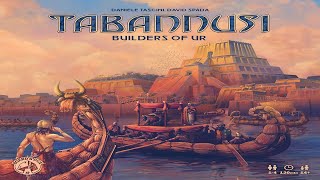
Set in ancient Mesopotamia, a cradle of civilization, at a time when the location of Ur was a coastal region, players work to build the Great City of Ur, expand its districts, and establish themselves as powerful builders.
Tabannusi: Builders of Ur features a stunning board showing the city of Ur divided into 5 regions, each tied to a specific color die. There are 3 building districts, 1 temple district, and 1 port district.
Each turn, your worker will activate one of these districts. When activating a district, you must first take a die from the district. This die matches the color of the district and serves two functions:
1) The die itself becomes a resource of its color.
2) The value of the die determines which district your worker will activate on the following turn.
Through various actions you will be able to expand your influence in the various districts, expanding construction sites and turning them into buildings to score valuable victory points. But you will also exert your influence in the temple district in order to earn the king's favor. In the port district you can obtain ships with important abilities and for scoring victory points.
You must spend your actions wisely and always make sure that you keep an eye on the general timing of the game. The moment a district is emptied of dice, a scoring will occur.
—description from publisher

- Unique and different from other T-series games
- Offers strategic depth and replayability due to variability
- Tight gameplay and scoring that can lead to close games
- Interesting player interaction that can feel 'anti-Euro' but works
- Can be rewarding once the scoring and strategy click
- Good at two players
- Initial confusion with scoring and mechanics
- Limited long-term planning due to dice variability
- Can feel chaotic and muddy
- Not beginner-friendly
- Can lead to analysis paralysis for some players
- Water and Gardens mechanics are less effective or necessary at lower player counts
- Can be frustrating if players don't understand the dice nuances
- Builders of Ery
- Téotihuacán
- Tawantinsuyu
- Terracotta Army
Mechanics (from transcript analysis)
- Area Majority — Control of districts and adjacent buildings seems to play a role in scoring.
- Dice Drafting — Players take a die at the start of their turn, which dictates their movement options.
- Resource Management — Players manage resources like gold, and different colored dice/resources to build.
- Set Collection — Players collect buildings and resources to fulfill scoring conditions on cards.
- Track Advancement — Players advance markers on various tracks, which provide points and benefits.
- Worker Placement — Implied through the discussion of placing workers and using actions on the board.
Video topics + discussion points
Quotes (from this video)
- The weirdest mechanic in this game is the fact that when you start your turn you take a die and that dictates where you now move
- because the ability of not knowing what other people are going to take for dice there's very little long-term planning
- you reward your enemy a lot in this game
- this one just feels muddy yes but not in a bad way nope
- This is a euro game that has a very anti-euro mechanics in it
- On the scale of one to ten what would you give Tábánúshí it's a seven for me
References (from this video)
- Excited by the network of grids and how buildings are placed on them.
- Intrigued by the mechanic of revealing the next region to be activated.
- The dice pip mechanic spreads out action investment and forces players to spread out across the board.
- Master architects building in Er
Mechanics (from transcript analysis)
- Area Control — Players claim spaces in different districts and invest in areas to score points.
- Dice Drafting — Players take dice from an obelisk, and the pips determine movement.
- Set Collection — Players collect claim markers and invest in the port for bonus effects.
- Track Advancement — Players increase their status on three mastery tracks.
- Worker Placement — Players use little workers to move to different regions on the board.
Video topics + discussion points
Quotes (from this video)
- welcome to another episode of talking sanctuary where we talk about life and board gaming in general and it's completely unscripted except for this little book here where i've written some of my notes
- i just want to say a massive massive thank you to all the people who are subscribed to this channel people who constantly like the channel watch the videos comment share talk about board games on this platform itself all of those interactions don't go unnoticed and all of those interactions mean a huge great deal to me
- and without further ado it's time to get on to my top five anticipated board games to play in 2022 yes
- wow that just absolutely impresses me
- wow that is beautiful
- this game ticks all of those boxes and that's something that i just really want to play and want to play now
- thank you once again for supporting me and board game sanctuary i look forward to seeing you in the new year with some more crazy funny and also awesome board game content this is danny signing out
References (from this video)
- Good Euro strategy game
Mechanics (from transcript analysis)
- action selection — Players put citizens and hoplites out.
- Dice as Strength — The number on the die shows its strength, and they can be upgraded.
Video topics + discussion points
Quotes (from this video)
- My number three is the Royal Society of Archaeology from Hutch Games.
- Mine is Bohemians. This is from Portal Games.
- Countryside is the one I picked for this one.
- My number two also involves animals sort of. It is Aquaria.
- My most anticipated Essen 2025 game is Kingdom Crossing from Sorry We Are French.
- Well, my number one is Wispwood from CGE.
- We've enjoyed Castle Combo a lot with our group.
- Lord of the Rings Duel, which has been very popular, is getting an allies expansion.
- And then Windmill Valley Oh, yep. Really enjoy Windmill Valley. It's I don't know if you can see it. See it. Windmill Valley, that's getting the Blooming Sails expansion.
- And then one other honorable mention is called Twisted Trumpets from Play to Z.
- What is it? We would love for you to tell us in the comment section after you like this video, what your most anticipated Spiel game is going to be.
References (from this video)

Mechanics (from transcript analysis)
Video topics + discussion points
Quotes (from this video)
- We are finally doing it. Yes, it's been a few years we wanted to do this thing and now we are finally doing it and we are so excited.
- I will tell you we are playing and ranking the T-Series of games.
- We haven't played all of these games before and we have played through most of them now.
- I just finished setting up Tabanusi and we are excited.
- Tabannusi is probably not my favorite game of this series, but we haven't played it for almost 5 years.
- When we have played this one, we will then be making rankings, two lists, one for me, one for Stunner.
- We will be filming it. We will make taste, edit it, or put it on the channel because that's what we do and we are so excited for this.
References (from this video)
- accessible action-dialing via dice
- interesting market/barge mechanic
- family-friendly pacing
- setup can be heavy
- not as deep as heavier euro games
- city-building and district development using dice
- fantasy Er; ancient/medieval-inspired city-building
- competitive euro feel with thematic flavor
- Viticulture
- Seven Wonders
Mechanics (from transcript analysis)
- action selection — the chosen die value determines which action space the player can use
- Dice Drafting — players draft dice from a central barge to determine actions
- End Game Bonuses — scoring occurs as districts and wonders are completed; end conditions can end the game
- End-game scoring — scoring occurs as districts and wonders are completed; end conditions can end the game
- tile/board progression — construct buildings across districts and manage scoring effects
Video topics + discussion points
Quotes (from this video)
- it's a deck-building game
- pull the levers
- banter on the show
- best part of this whole thing is they got stickers