




















Terminus Deep Dive
What the Community Thinks About Terminus
Terminus stands out as a heavy economic game that has earned significant praise from experienced gamers who appreciate its intricate design. The game presents a subway-building simulation with a rondel mechanism, market manipulation, and positive player interaction that creates a collaborative building environment. Multiple reviewers cite the game's tightness and elegance in handling complex systems, though many note that a single playthrough leaves them eager to explore deeper strategy. Gamers appreciate how Terminus rewards tactical decision-making while avoiding the runaway leader problem that plagues many economic games through its shared-map design where helping opponents often benefits you as well.
Core Mechanics That Define Terminus
Rondel with Market Dynamics
At Terminus's heart sits an elegant rondel action selection system combined with a shifting marketplace. Players move a marker around a circular track of six colored action zones, advancing as far as they wish but only moving forward, never backward. This creates meaningful decisions about action order while the market-driven economy ensures that resource prices fluctuate based on player demand. Early-round actions remain affordable as players gradually purchase supplies, but prices climb as the economy heats up. Reviewers praise how this forces constant calculation: should you leap ahead on the rondel to grab a cheap action, or stay near a critical location you might need next round?
Network Building with Positive Interaction
Rather than competing for isolated routes, players construct interconnected subway lines that benefit from interaction. Building stations next to opponent infrastructure generates income for both players, a mechanic that eliminates the typical competitive tension of route-building games. This semi-cooperative dynamic appears throughout: completing connections yields energy bonuses, shared development tiles offer benefits to neighbors, and strategic placement creates symbiotic growth. Reviewers highlight how this transform the genre, making cooperative play emerge naturally from the rules rather than forcing players into zero-sum competition.
The Terminus Experience
Cerebral Economic Puzzle
Terminus delivers that satisfying crunch of heavy economic games without requiring a PhD in rulebook interpretation. The core mechanics are intuitive, but the number of viable strategies creates a rich decision space that rewards deep thinking. Players must balance collecting the right resources, timing their investments, managing capacity constraints, and reading opponent intentions, all while navigating a dynamic market. The game generates what reviewers describe as "pleasant brain burn," where sessions end with players eager to reverse engineer their suboptimal plays and try new approaches immediately.
Tactile and Satisfying Production
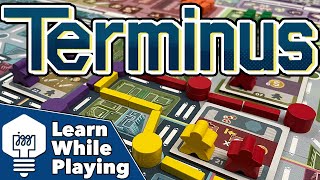
The physical experience of Terminus contributes meaningfully to engagement. Chunky cardboard tokens, colorful construction cones, blueprints, and permits create a tactile economy that feels substantial to manage. The shared board reveals the interconnected nature of the city as routes expand, and watching rival networks weave past and through your own stations generates genuine moments of satisfaction when successful connections multiply. Graphics design remains clean without sacrificing visual interest, helping players process the economic information without friction.
What Makes Terminus Stand Out
Economic Richness Without Simulation Bloat
Many economic games achieve depth through exhausting bookkeeping or byzantine resource chains. Terminus accomplishes its complexity through elegant mechanical interlocking rather than rulebook density. The rondel metering action availability, the market constraining currency flow, and capacity limits on player boards create natural scarcity and decision pressure. Reviewers repeatedly cite surprise at how much strategic depth emerges from relatively simple components, comparing the experience favorably to legacy economic designs while noting the streamlined execution prevents slogging through unnecessary steps.
The Shared Map Transforms Competitive Dynamics
Most route-building games pit players against each other for scarce connections. Terminus inverts this by rewarding proximity and connection to opponent networks. This philosophical shift removes the kingmaking risk where a single player's bad plays dominate others while making helping opponents strategically sound. Players face genuine "should I help them or help myself more" decisions rather than either pure cooperation or pure competition. The design elegantly solves the semi-cooperative puzzle that stymies many attempts at interactive economic games.
Potential Drawbacks
Unforgiving Learning Curve
Reviewers stress that first plays often disappoint. The interacting systems mean suboptimal early choices compound into mid-game disadvantage. Unlike forgiving economic games where weak strategies merely score fewer points, Terminus punishes planning mistakes through resource bottlenecks and capacity constraints. New players frequently find themselves unable to execute their intended strategies by round two, leading to frustration even as experienced players realize the tightness that creates such strategic depth. Multiple attempts are necessary before the decision framework clicks.
Variable Game Length and Downtime at Certain Player Counts
Three rounds provide reasonable play length with experienced players, but the simultaneous-action elements don't fully prevent downtime in higher player counts. Reading opponent intentions, calculating optimal market purchases, and resolving the rondel's turn order can create analysis paralysis, especially when players attempt to optimize every decision. The game doesn't punish downtime as harshly as some Eurogames, but it remains a consideration for players sensitive to player count effects on pacing.
If You Enjoy Terminus
Fans of heavy economic games will find natural homes in the Brass family (particularly Brass: Lancashire), The Underground, Lisboa, and Food Chain Magnate, though the latter strips away Terminus's positive-interaction elements entirely. Weather Machine offers similar economic richness with different mechanics, while Earth shares Inside Up Games's design philosophy of elegant systems producing unexpected depth. Players seeking less forgiving versions should explore challenge titles like Kanban or Dominant Species. For those appreciating the network-building elements specifically, Steam and other Martin Wallace designs reward route optimization, though with more traditional competitive zero-sum geography.
What Reviewers Are Saying
"The game is meaty, it's definitely going to be rewarding to players, and you are going to completely flounder your first game because you're not going to have any idea how to do well."
— The Broken Meeple
"It mixes this really interesting rondel system that's pretty tight with this kind of market manipulation, as well as a track-making game where you're interacting, but all of the interaction is kind of positive."
— Allies or Enemies
"This game appeals to me for its connectivity and route building with the subway terminals, and I like the fact that the economy shifts and resources become more scarce."
— The Board Gaming Doctor