/pic6326925.jpg)


























That Time You Killed Me Deep Dive
What the Community Thinks About That Time You Killed Me
That Time You Killed Me has captured the attention of abstract strategy enthusiasts across the board gaming community. Paula Deming placed it at the #1 spot in her top 10 two-player games, calling it "an abstract strategy game about time travel with a liked campaign narrative and boxes of goodies to unlock." The game consistently garners praise from reviewers who appreciate its innovative mechanics paired with its unusual presentation for the abstract genre. While some initially found the base game simple, repeated plays and exploration of additional modules have convinced many reviewers that the game grows stronger with each scenario unlocked.
Core Mechanics That Define That Time You Killed Me
Multi-Board Time Travel System
The signature mechanic centers on three simultaneous boards representing past, present, and future. Players control pawns across all three temporal spaces, with actions in earlier eras creating ripple effects forward. Before You Play describes it precisely: "decisions in the past directly impacting on the game state in the present and the future, a time traveling twist on traditional strategy games." Players must manage the spatial relationships between their pieces across all three boards, using time travel as both offense and defense. Moving forward in time allows you to jump to an equivalent space on the next board, while moving backward creates a copy of yourself, adding a strategic depth uncommon in abstract games.
Limited Actions and Resource Scarcity
Each turn, players select one of their pieces and perform exactly two actions. Actions are constrained: move one orthogonal space, travel forward in time to an equivalent space, or travel backward leaving a copy behind. This severe action economy forces brutal decision-making. Sir Thecos noted the design's elegance: "the most you can move in one turn is two spaces if you use both your actions doing it, and because of the size of each era board that often leaves you vulnerable to the other player." The scarcity creates constant pressure, as players cannot act in the same era two consecutive turns, forcing them to commit to their next location's era at the end of each turn.
The That Time You Killed Me Experience
Mental Intensity and Tactical Precision
Reviewers consistently describe the game as deeply cerebral and thinky. Before You Play emphasized that "you're thinking the whole time, it's really really thinky, you're really trying to outwit with your opponent." The game requires constant forward planning across multiple turns and multiple boards simultaneously. Each decision carries weight because the intersection of your piece positions across time creates the board state, and mistakes compound quickly. Players describe the tension of feeling perpetually one move behind, particularly early in their learning curve, as they struggle to anticipate how actions in one era will create vulnerabilities in another.
Escalating Strategic Depth
The campaign structure reveals complexity gradually. Before You Play's reviewers noted that their first play felt foreign and simplistic, but subsequent encounters with modules 2 and 3 transformed their understanding. "The first time we played it the first time we played it it was like 70 percent less enjoyable," the reviewer admitted, but "after we played the next two boxes i found myself enjoying the game more and more." Adam in Wales notes that the expanded content adds "chaos and bloat which makes forward planning really challenging," yet this very unpredictability keeps the game fresh across multiple plays. Strategy players describe an evolution from seeking immediate tactical wins to understanding the true meta-game: chipping away at opponent resources rather than forcing elimination.
What Makes That Time You Killed Me Stand Out
Time Travel as Thematic Integration
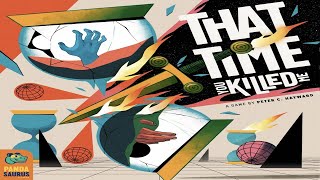
Adam in Wales identifies the core innovation: "time travel is notoriously difficult to simulate effectively in tabletop games and as such it's a really underutilized theme. The effect of actions in the past rippling forward through the present into the future is certainly a standout mechanism and an innovation." The game doesn't simply use time travel as flavor text. Actions mechanically ripple forward, planting a seed creates a shrub in the next era, then a tree in the era after that. The thematic integration feels earned rather than pasted on, with the rulebook contributing flavor text that adds personality without obscuring the mechanics. This approach distinguishes That Time You Killed Me from most abstract games, which typically offer no narrative structure whatsoever.
Production and Packaging Innovation
Adam in Wales observed that the presentation itself represents innovation for the abstract strategy genre: "pandasaurus have masterfully taken an odd little concept and turned it into something truly desirable." The box design borrows from modern campaign and legacy games, with multiple nested boxes containing new components and rule modules. The stunning graphic design, influenced by Saul Bass's retro aesthetics, immediately signals that this is not a traditional abstract. Sir Thecos appreciated the magnetic component boxes in expansions, where "the front cover is like the monster board that you pull off it's magnetic you pull off that put off to the side and that's your play area." This attention to production demonstrates how abstract strategy can evolve without sacrificing mechanical purity.
Potential Drawbacks
Steep Learning Curve and Initial Disappointment
Before You Play's reviewers candidly discussed their first impression: "the first time we played this game it was with this specific scenario obviously and all of it was very very foreign right, the idea of moving around the different boards and just like how does that even work." The base scenario (Growth) proved less interesting to many than subsequent modules, leading some players to initially undervalue the game. Sir Thecos noted that abstract strategy enthusiasts expecting elegance and streamlined rules may find the modular expansion approach less refined than games like Quarto or Yinch. The commitment required to explore the full game can deter casual players who don't want to invest in repeated plays before enjoyment crystallizes.
Accessibility and Niche Appeal
Despite its innovation, the game occupies an awkward middle ground. Adam in Wales observed: "the game falls between two stools, it's a very traditional abstract game packaged like a modern thematic game. Some gamers are gonna be disappointed to discover the abstract gameplay once they get over that beautiful art and witty storytelling. Equally fans of traditional abstract games are going to find this one a challenge to fully adopt." The game demands players who appreciate both mechanical depth and willingness to engage with narrative campaign elements. Sir Thecos's rank of C-tier reflects this tension, though he acknowledged the base game's potential to rise with additional plays. For pure abstract fans seeking elegance, Quarto or Camasado may satisfy more immediately.
If You Enjoy That Time You Killed Me
Reviewers placed That Time You Killed Me alongside several comparison games. Paula Deming recommended it to players who enjoy Shobu (with its split board mechanic), Azul (for accessible abstract strategy), and Onotama (for additional mechanical layers). Adam in Wales mentioned Tak and Camasado as comparable abstract titles that have received recent recognition in the market. For players drawn to the time travel mechanic specifically, Sir Thecos suggested Philosophy as another abstract with elegant mechanical systems. Those attracted to the campaign structure should explore other modular abstract games like Hive (which has multiple expansions changing gameplay) or War Chest (which combines abstract movement with tactical unit powers). Board Game Coffee's recommendation list included Boop (another adorable two-player abstract with perfect information), Santorini (with its building and climbing focus), and Mythic Mischief (the faction-based abstract with asymmetrical powers). The connecting thread: these are games where spatial manipulation and forward planning create satisfying puzzles rather than relying on luck or randomness.
What Reviewers Are Saying
"You're trying to set yourself up and enact all these ripple effects through time to get the better of your opponent, it's really good and it's really tricky and more rules and variations get introduced as you play through the game making it more and more interesting each time."
— Paula Deming
"The effect of actions in the past rippling forward through the present into the future is certainly a standout mechanism and an innovation, and pandasaurus have masterfully taken an odd little concept and turned it into something truly desirable."
— Adam in Wales - Board Game Design
"I played it i dug it, is it because you want it's time travel chess and it's really well done there's a whole bunch of modules i kind of want to dive into."
— Board Game Coffee