





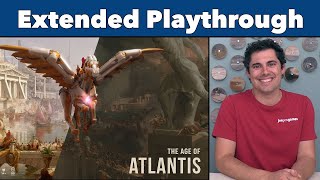
The Age of Atlantis Deep Dive
What the Community Thinks About The Age of Atlantis
Reviewers who have spent real time with The Age of Atlantis generally agree that it is a clever, densely interlocking game that rewards careful planning. They disagree on whether its complexity and table time justify a permanent place on the shelf. The most enthusiastic account comes from a full three-player playthrough by Getting Games, which walks through all three ages of the game and closes by noting how many different interlocking mechanisms the game asks players to juggle at once. Hungry Gamer ranked it fifteenth among the eighteen games played at Kublacon Prime 2025, yet the comments on it were warm. The channel called it a very clever design that blends worker placement, resource collection, and tableau building, and said they want to play it again.
Not every reviewer is pushing it to the table. BoardGameCo discussed the game while culling their collection and admitted that they enjoy it but rarely get the chance to play it, which led them to decide that other games deserve the slot first. Board Gaming Ramblings covered a copy that a co-backer had played and that the hosts themselves had never gotten to the table. Their verdict was that a game can be good and still lose out when a shelf holds many other fun options. The shared view is that The Age of Atlantis is a rewarding, engine-driven title whose biggest barrier is getting enough people together to make it sing.
Core Mechanics That Define The Age of Atlantis
Worker Placement
Worker placement sits at the center of every turn. Players have a limited pool of peasants, Atlanteans, and myths, and each one is placed on an action location such as a capital, temple, mill, barracks, or town hall. Each placement triggers that location's action, so the choice of where to send a worker is often the most important decision of the round. Getting Games shows how morale shapes these choices. Pushing a worker down to zero morale grants an extra action right away, but during the morale status phase every zero-morale worker costs its owner favor. The Atlantean charity phase then restores morale on a sliding scale: the player with the most political power receives no charity, while trailing players receive help bringing their workers back up. Hungry Gamer described the overall feel as having a worker placement vibe, but one that also leans heavily on resource collection and building an engine over time.
Contracts
Contracts are the game's most visible goal system. Players take a contract from the tavern and pursue its condition, which may involve delivering specific resources, defeating enemies, or visiting blessed territories a set number of times. Each contract carries a progress cube that moves as the requirement is met, and completing it pays political power, sometimes with a bonus from a technology. Getting Games describes contracts as a strong way to convert actions into points, and during the playthrough the reviewer lamented that the table could have squeezed in one or two more before the game ended. The same reviewer observed that contracts often reward activities players would already be doing, so the real skill lies in choosing which contracts to chase and when to commit actions toward them.
The Age of Atlantis Experience
Mythology
The game draws its atmosphere from Greek and Roman mythology. Armies from both traditions advance across the map, and myths act as demigod champions that gather resources, move across the board, and fight. Getting Games highlights how a myth's attack value can be upgraded until it defeats a Greek army in one action, which makes the player feel like a mythic hero clearing the city of monsters. Poseidon also acts as a presence on the board, blessing territories that reward players who place workers there. The result feels less like a neutral economy and more like a story about a city that depends on divine favor and heroic action to survive.
Tense
Tension builds steadily because the game tracks how close every player is to disaster. The favor track sits next to Poseidon's Fury, a spot that threatens to flood regions and remove everything standing in them. Getting Games repeatedly describes feeling pressure to climb back up the track before the flood arrives, and admits that offerings sometimes become a necessity rather than a choice. Because armies keep moving toward the city, players can see danger approaching without knowing exactly when it will strike, which keeps each turn uncertain until the change of blessing and military advance phases resolve.
What Makes The Age of Atlantis Stand Out
Asymmetric Noble Houses
Reviewers consistently point to the asymmetric houses as a source of distinctive play. Each player's tax stations and entry fee bonuses reward them when opponents use their buildings, which gives every house a reason to shape the board around its own strengths. Getting Games credits the winning player with leaning hard into this asymmetry, stacking points from tax stations and from a research tax that paid green whenever opponents researched. The same review points out that the red player collected many entry fees but only earned a single point each time, and the reviewer believes that house could have benefited from upgrading its building bonuses earlier. This is the kind of asymmetry that rewards players who read the whole table rather than just their own engine.
Clever Interlocking Systems
Multiple reviewers describe the design as clever in the way its systems connect. Hungry Gamer called it a very clever game and emphasized its engine building, which rewards players who plan their tableau over several rounds. Getting Games praised how morale, favor, contracts, and achievements all feed into one another, so that a decision about a single worker can affect favor, flood risk, and end game scoring at the same time. Achievements are also structured to guide the endgame: when enough of them are claimed, the game ends, which gives players a clear timeline to plan toward.
Potential Drawbacks
A Punishing Learning Curve
The most consistent criticism is that the interlocking systems punish mistakes, especially in a first game. Getting Games played The Age of Atlantis for the first time, and the reviewer admitted forgetting that a flood also removes every myth standing in the affected area, calling it the biggest error at the table. Red lost both of its myths when a flood swept through their area, which the reviewer believes swung the game and may have cost red a shot at second place. The reviewer also acknowledged that many players missed contract opportunities and blessed-territory bonuses because they were focused on survival. The reviewer's conclusion was that this kind of mistake is a natural part of learning such a layered game, but it does mean that new groups may need a patient first session to understand how everything fits.
Strongest With Three Players and Limited Table Time
Hungry Gamer felt that The Age of Atlantis thrives with at least three players. In a head-to-head game, the reviewer's opponent built a stronger engine, but the reviewer held the lead and was able to push the game to its conclusion. That result suggests the head-to-head experience can feel lopsided compared with the full table. Board Gaming Ramblings and BoardGameCo both point out that the game is easy to set aside when a collection offers many quicker or more frequently played alternatives, which means it can struggle to earn regular table time even among fans who enjoy it.
If You Enjoy The Age of Atlantis
None of the reviewers drew a direct comparison to another title, so the following recommendations are based on mechanics that Hungry Gamer described in the same review. Players who enjoy The Age of Atlantis's worker placement and the pressure of its Poseidon's Fury track will find similar satisfaction in Project EOS Rise. Hungry Gamer described it as a crisis management game that brings in a substantial amount of worker placement, along with light RPG-style leveling and dice-driven combat. The comparison is strongest for players who like managing several threats while still trying to optimize the placement of every worker.
Players who value the asymmetric houses of The Age of Atlantis will also enjoy Ahoy from Leader Games. Hungry Gamer called it super asymmetric, with a dice placement system and factions that play very differently from one another. That sense of distinct, competing identities mirrors the way each noble house in Atlantis pursues its own path while still reacting to what its opponents do.
What Reviewers Are Saying
"The green player won and I think that is largely because they leaned very well into their asymmetric benefit ... they got a ton of points for their tax stations, as well as that research tax which they deployed pretty much as soon as they could and that worked out really well for them."
— Getting Games
"I just think this is a game that thrives when you have at least three players. We played head to head and I was able to see that he had built a good engine and I did not have much of an engine but I had the lead and so I was able to push the end of the game and no one could really stop me."
— Hungry Gamer
"I like this game, but I think I am ready to get rid of it. I think I'm ready to acknowledge that it's not getting prioritized or played, but I do enjoy it."
— Alex Rack, BoardGameCo