/pic1951629.jpg)
/pic4286631.jpg)
In an ancient world forgotten by time, enormous titans terrorize the land. Five tribes have been fleeing from the titans for centuries, but things are about to change. Growing city-states pledge to end the reign of terror, determined to take on the titans and make the world a safer place for all. Each city-state competes to attract the tribes, eager for the strength of the combined peoples, who are now leaving behind old traditions with the hope that the titans can be defeated once and for all.
In The Ancient World, players compete to grow the largest and most influential city-state by managing citizens, treasury, and military and by defeating titans. Players take turns sending citizens to take special actions or using military cards to attack titans. One of the actions a citizen can perform is to build Empire cards, which give more citizens, money, and abilities.
A city-state's influence in the world is measured by sets of tribe banners that it owns. Each Empire card has one or more tribe banners, and tribe banners can also be gained by defeating titans. Players gain victory points (VPs) for sets of tribe banners. After six rounds, the player with the most VPs from sets of tribe banners wins.
This page includes videos and mentions from the whole The Ancient World (Red Raven Games) family. Drill into a specific game below.
/pic1951629.jpg)

- Asia
Mechanics (from transcript analysis)
Video topics + discussion points
Quotes (from this video)
- here's how I like to organize my board game collection alphabetically and by barcode and serial number no let me show you
- this section has some of my favorite game set in Asia have you thought about organizing your board game Boxes by color from lightest to darkest
- my next shelf contains my favorite train games
- these are my favorite vertical rectangular box shaped Euros here is where I keep the ancient world T-Series games
- have you thought about sorting your games by box size and what about by average BGG waiting or even based on the size of the thickness of the rule book
- I don't know I feel like grouping my games thematically
- here are my abstract style games with the kind of a building thing here are my nature themed games including this one on display
- how about sorting them by cost or by the designer surname
- there's just so many creative ways to do it and my games that are all designed by Ryan lock uh what about the pser games in this room uh I think I might sort those out next year
References (from this video)
- Favorite Red Raven game
- Love it
- Kingdoms warding off Titans who seek to attack and cause havoc across their land, inspired by Attack on Titan.
Mechanics (from transcript analysis)
- Card Drafting — Empire cards are gained by setting sail.
- Resource Management — Ambrosia is mentioned as something that can be fed to a Titan, implying resource management.
- Tableau Building — Players build a tableau of different actions.
- Worker Placement — Workers are sent to different places around the board for actions like setting sail, gaining empire cards, or attacking Titans.
Video topics + discussion points
Quotes (from this video)
- one of my favorite animes is a show called Attack on Titan
- this probably one of your favorite Red Raven games the ancient world I love it
References (from this video)
- Wonderful art style and great looking game.
- Solid worker placement game with an interesting, compelling theme.
- Large variety of civil cards offer depth and good replayability.
- The pay-a-coin mechanic when workers share a space feels odd and somewhat in-between.
- No particularly standout or amazing mechanics; it's good but not great.
- Suffers from comparison to Above and Below.
- Nomadic tribes under threat from titans must join forces with fledgling towns to defeat them.
- ancient land
- Above and Below
- Lords of Hallows
Mechanics (from transcript analysis)
- Area Control — Implied by the competitive nature of building the first great city and controlling tribal areas.
- Card Drafting — You can use an Explorer to look at the next five empire cards and store one for later.
- Combat — Challenging Titans requires selecting military units and paying coins to match their strength.
- Set Collection — Collecting matching tribe banners is the key to victory.
- Worker Placement — Actions are taken by placing workers on the board and claiming associated benefits.
Video topics + discussion points
Quotes (from this video)
- Terrible titans stride across this ancient land destroying all they come across.
- The single best thing about the game is the art and I kinda hate saying that a little as it undercuts Ryan as a game designer who makes games it would be good without his great art.
- There's also no particularly standout amazing mechanics in the game it's good but it's not great.
References (from this video)
- Good worker placement design
- Likeable theme and art style
- Did not 'wow' the players
- We like the theme.
Mechanics (from transcript analysis)
- Worker Placement — this is a pretty good worker placement design.
Video topics + discussion points
Quotes (from this video)
- This is like a polyomino game, which you may know that I really love.
- The production quality is great. The art style is great. The theme is pretty cool, but the game somehow didn't work for us at all.
- This one really, really surprised me. This is good.
- And I think it's very well designed, but that's almost a given with Ryan Lockett games.
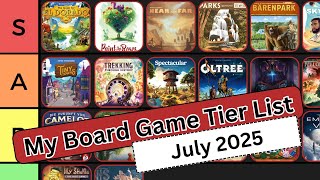
- Parks always gets an S tier, especially the first edition.
- Spirit Island is rising up in rank higher and higher. It has always been S tier game for me, but it's like rising up my like list of most favorite games.
- This game is very polarizing. I understand that some people really love this and some don't like it at all.
- Deal of merchants. Always Srank. This is like one of my most favorite deck builders ever.
- It can be kind of broken, a little bit unbalanced, very luck heavy, but it's a very, very good design as well.
References (from this video)
- thematic depth and strong narrative cohesion
- rich combination of buildings and military options
- high complexity and long playtime
- steep learning curve for new players
- mythic, tableau-based civilization development
- ancient civilizations / city-building
- epic, thematic
Mechanics (from transcript analysis)
- combat and defense against mythical threats — ward off attacks with military and cards
- Tableau Building — build a city with buildings providing powers and resources
- tableau-building / card-based engine — build a city with buildings providing powers and resources
Video topics + discussion points
Quotes (from this video)
- board games are tactile they're made to be played with
- it's such a thematically rich fun experience
- this game is about attracting different types of birds into your habitat
- I love word games because not only do they represent a lot of IDs that we have in everyday life
- the tension points of the trail ... there's weather that plays into it
References (from this video)
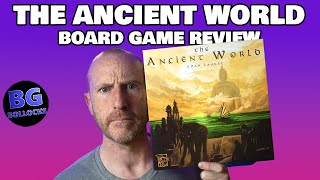
- Skill-based blocking adds strategic depth to placement decisions
- Stunning artwork and visual design (Ryan Lockett influence)
- Gradual reveal of power through round progression and deck swaps
- Two-dimensional tokens feel underwhelming; 3D minis would improve aesthetics
- Titans aren't threatening until engaged; early randomness can unbalance the game
- Second edition improvements may make this version feel incomplete or dated
- Ancient power struggles, titans ravaging the world
- Ancient world / myth-inspired ancient civilizations
- Deck-building combined with worker placement and titan encounters
- Stone Age
Mechanics (from transcript analysis)
- blocking / strategic placement — Skill levels and blocking create layered decisions about where to place workers to block others or reserve slots.
- combat with Titans — Defeat Titans by matching required weaponry (swords or arrows) with armies, paying incremental coin costs as rounds progress.
- deck management / deck progression — Swap from deck A to deck B mid-game to gain access to more powerful cards; manage the drop of lower-tier cards.
- Deck Manipulation — Swap from deck A to deck B mid-game to gain access to more powerful cards; manage the drop of lower-tier cards.
- economy / feeding — Earn coins, spend to recruit or upgrade; feed workers at round end or they suffer penalties.
- round-based progression — Six rounds with three phases each: preparation, action, end-of-round; round track advances and card slots change.
- Set Collection — Gain favors from defeated Titans and empire cards to score points on a personal score track.
- set collection / favors — Gain favors from defeated Titans and empire cards to score points on a personal score track.
- Worker Placement — Place workers with varying skill levels on spaces to perform actions; higher-skill workers restrict placement due to existing workers.
Video topics + discussion points
Quotes (from this video)
- some fucker's already gone there
- artwork in this is absolutely stunning
- Titans aren't really that much of a threat until you decide to kick their ass
- the Titans aren't really that much of a threat until you decide to go and kick their ass