













The Duke Deep Dive
What the Community Thinks About The Duke
Reviewers who cover The Duke agree on its core appeal: a compact two-player abstract with a movement system that rewards planning and a physical presence that makes it easy to carry anywhere. Brian McDonald of Brains On Games calls it a favorite game of all time and describes keeping a copy in the car trunk to play it at restaurants and on picnic tables. The game's wooden pieces and small footprint are the reasons Brian McDonald gives for returning to it so often.
The disagreements are about how to label the experience rather than whether it works. Brian McDonald, in a second Brains On Games review, treats The Duke as a test of visual-spatial prediction and fluid reasoning, describing the skill as symbol translation applied to pieces that change direction every time they move. Jason Hardy, the Catalyst Game Labs line developer featured in a convention booth tour on Board to Death TV, frames it as more tactical than chess and more dependent on reacting quickly. Both descriptions point at the same tension: a board you can read carefully, but a bag that keeps changing what you have to read.
Several reviewers also note that the game has grown into a larger family. Brian McDonald describes expansions built around Conan, King Arthur, the Three Musketeers, Robin Hood, and Robert E. Howard, and says the collection outgrew the original box, so a custom one was made. Rodney Smith of Watch It Played notes that the base game already includes special tiles with enhanced abilities, which means the expansion material extends a system that is complete on its own.
Core Mechanics That Define The Duke
Tile Placement from a Random Bag
Each turn, a player either moves a tile already in play or draws a random tile from their bag and places it on the board. Rodney Smith explains that a newly drawn tile must start on its starting side and must go into an empty space fully adjacent to the player's Duke. If the Duke is surrounded so that no empty space is available, the player cannot draw at all. A new tile also cannot capture on the turn it arrives, and it must be placed even if it could be captured on the very next turn. That constraint turns each draw into a commitment, and it is a large part of why Brian McDonald finds the early game hard to plan.
Double-Sided Movement Tiles
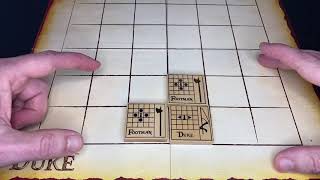
Every troop has two faces, and the movement grid on each face determines what that piece can do. Rodney Smith walks through the Footman, whose starting side allows one step in any orthogonal direction, and whose reverse side allows diagonal moves and a two-space advance that cannot be broken into single steps. Brian McDonald points out that the grid symbols mean a player needs less memory for how each piece moves, but more visual-spatial work to predict where pieces will be after several turns. Solid circles mark ordinary moves, hollow circles mark jumps, solid triangles mark slides, and stars mark strikes that capture without moving the tile. The Duke can slide any distance along a clear path, while the Assassin must make a mandatory jump before it can slide. Because the tile flips after each move, a piece that looked safe last turn can become a threat on the next.
The The Duke Experience
Tense Tactical Pressure
Watching a full game through Watch It Played makes the tension visible. Players call "guard" whenever a tile threatens an opposing Duke, and that call forces the opponent to answer before doing anything else. Rodney Smith's game with Luke Smith includes a long sequence in which nearly every Duke move opens a new threat, and in which the Duchess and Marshall both arrive from the bag at critical moments. Jason Hardy describes the same pressure in more general terms, saying the game asks players to react and adjust rather than follow a fixed plan. The result feels less like a slow chess endgame and more like a scramble in which each choice narrows the next one.
Family Nostalgia and Portable Play
Brian McDonald's account centers on shared play rather than the rules, describing a son and a younger brother playing The Duke at restaurants, on picnic tables near a soccer field, and in the back of a car, and crediting the game with helping the son build a sense of being a strong spatial thinker. The feeling Brian McDonald describes is mastery: a child who lays traps for an adult, anticipates responses, and wins often enough to believe in the skill. Because the game fits in a bag and its pieces do not blow away, it can travel into the kinds of spaces where a board game would normally stay at home.
What Makes The Duke Stand Out
Wooden Components That Travel Well
Brian McDonald praises the game's physical construction more than once. Brian McDonald notes that the pieces are made of wood, so the game does not blow away the way a set of loose cards and pieces can, contrasting that with setups that scatter. Brian McDonald also calls the Duke small enough to take on a trip without much planning, which is why it sits in the car. For many reviewers, that combination of durable components and a compact box is what keeps The Duke in regular rotation.
Reference Sheets That Teach Quickly
Rodney Smith of Watch It Played is an unusual reviewer in that Watch It Played explicitly does not review games in its series, yet praises the Catalyst Game Labs reference cards in detail. The base game includes a double-sided card that shows every movement symbol on one side and the special tile abilities on the other, and Rodney says that approach gives a teacher everything needed on a couple of sheets. The same cards also make the game easier to keep at the table, because players can check a symbol without stopping the game to consult a rulebook.
Potential Drawbacks
Bag Randomness Makes Planning Harder
The randomness of the bag is the feature that reviewers praise most often and the one that frustrates players most directly. Brian McDonald notes that it is much harder to memorize openings or midgame plans in The Duke because a player never knows which piece will come out of the bag next. In Rodney Smith's full game, Rodney tells Luke Smith about relying on luck when choosing to draw rather than move, and a draw of the Marshall shifts the position in a way that neither player fully anticipated. Players who want a fixed plan may find that the bag removes too much control, while players who enjoy improvising will see it as the point of the design.
Stuck Tiles and Forced Responses
The second concern is the number of ways a position can lock up. Rodney Smith warns that a tile can become stuck when no legal move exists, using a Duke that cannot slide backward off the board or forward past a friendly tile. Rodney also shows how a guard call can force an opponent into a narrow set of legal responses, which means a careless placement can cost a turn or a Duke. Jason Hardy calls the game tactical rather than strategic, and the description of having to react quickly fits the same pattern. Newcomers may need a couple of games before they recognize these traps early.
If You Enjoy The Duke
Players who enjoy The Duke's movement grid and its emphasis on predicting an opponent's next move will find related satisfaction in Chess, the reference point that both Brian McDonald and Jason Hardy reach for when they describe the Duke. Chess keeps each piece's movement fixed from the start, so the planning shifts from reading flipped tiles to memorizing patterns and openings. Players who like the Duke's sense of a shifting battlefield may find that the same kind of looking ahead carries over, even though the rules are very different.
What Reviewers Are Saying
"It's a lot harder to memorize starting strategies or mid game strategies in a game of the Duke because you never know what piece you're going to pull out of that bag to place on the board."
— Brian McDonald, Brains On Games
"I do have to say these are a great idea Publishers you really should do this and Catalyst game Labs good job I really appreciate this as someone who usually has to teach the games this gives me everything I need to know on a couple of sheets it's fantastic."
— Rodney Smith, Watch It Played
"this is a little more tactical. It requires you to be able to think on your feet and to react."
— Jason Hardy, Board to Death TV