



The Few and Cursed Deep Dive
What the Community Thinks About The Few and Cursed
Reviewers tend to describe The Few and Cursed as a deck builder that has been pulled out of its box and set down on a map. The comic book roots and the post-apocalyptic setting come through clearly, and the reviewers who covered it agree that the core idea is appealing. Meeple University summed up its appeal by calling it "a pretty nice mix of a deck builder on a board using icons to take your actions," and most of the other channels reached a similar conclusion from different angles.
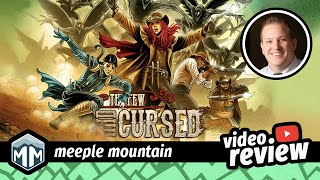
Getting Games approached the game from the table, walking viewers through setup, the round structure, and the cursed track before offering any opinion. Their coverage leans toward the game's sense of possibility, with the cursed and uncursed paths both presented as viable routes to a win. Meeple Mountain was enthusiastic about the open-ended nature of the design and treated the hand management as the real star. Rolling Dice and Taking Names came in more cautiously. Their reviewers enjoyed the experience but pointed to readability problems that they felt held the game back from being easy to recommend to a casual group.
The shared view is that The Few and Cursed rewards players who are willing to learn its systems and commit to a plan. Players who want a lighter, more immediate deck builder may find it demanding, while players who enjoy building an engine across a board tend to come away impressed.
Core Mechanics That Define The Few and Cursed
Icon-Driven Deck Building
The deck building in The Few and Cursed works differently from the usual model. Each round, players draw two new cards, keep one, and discard the other, which gradually shapes the deck without a traditional purchase row. The icons in the top left corners of the cards are the currency of action. Movement icons carry a player across the board, attack icons allow them to fight enemies, and draw icons keep the hand moving. Meeple University described the approach as a deck builder that uses a board and icons together, and Meeple Mountain noted that the icons make the game feel like a more flexible version of the familiar genre.
Because every card can be read as a set of options, the decisions are less about raw efficiency and more about what a player wants to do on a given turn. Reviewers pointed out that stacking icons gives a player room to choose their actions, and that the text effects on some cards are easy to forget during play. That mix of icons and occasional text is part of what gives the deck building its character.
The Curse Track
The curse mechanic sets The Few and Cursed apart from many of its peers. Many actions raise a character's curse level, and when that level reaches the threshold, the character card flips to a new side with a different passive power. The cursed side usually brings stronger abilities paired with a meaningful weakness. Getting Games walked through the cursed track in detail, showing how cursed locations on the board and certain cards can push a character toward the cursed side and how the uncursed side can be reached again. Their coverage frames the curse as a deliberate tradeoff rather than a penalty that players can ignore.
Reviewers consistently described the curse as a source of tension. Players weigh the power of a cursed ability against the cost of moving further along the track, and that decision gives the game a push-your-luck edge in the middle and late rounds.
The Few and Cursed Experience
Sandbox Freedom
The feeling that comes up most often in the reviews is freedom. Meeple Mountain described the game as a sandbox, saying that players can pursue points in many ways, including taking on bounties, visiting specific locations, or heading out to the edges of the board for stronger artifacts. The reviewer compared the open structure to Clank! and noted that many people who enjoy Clank! will find the same deck building appeal here, with the sandbox approach adding much more room to choose a path. Rolling Dice and Taking Names echoed this, describing the game as sandboxy and noting that players could go after artifacts or stay in one area to build up a particular strength.
That freedom has a cost. Some reviewers felt that the number of possible plans can make early turns feel uncertain, but for players who enjoy shaping their own strategy, the openness is a major part of the appeal.
Push-Your-Luck Tension
The curse track and the movement costs create a steady sense of risk. Reviewers described the feeling of pushing a character toward the cursed side to unlock a stronger power, knowing that the weakness may come back to hurt later in the game. The return trip to San Andreas, which players must make when they run out of cards, adds another layer, because a player who ventures far to chase artifacts has to plan how to get back before the deck runs dry. Getting Games' playthrough captured this pressure well, with players weighing each cursed action against the points and position they might lose.
What Makes The Few and Cursed Stand Out
Thematic Presentation and Artwork
Several reviewers singled out the look of the game. Meeple University praised the artwork across the cards, board, and rulebook, describing it as wonderful and noting that the visual style carries the comic book feel into the table. Rolling Dice and Taking Names also remarked on the quality of the production and the way the theme comes through in the cards and board. The minis were seen as a welcome extra, though reviewers agreed they are a smaller part of the experience compared with the cards and the board.
Meeple University also felt the theme was carried well by the mechanics. The curse track, the wild west feel, and the apocalyptic setting all fit together, which helps the game feel more like a story than a set of abstract systems.
Asymmetric Characters and a Clank-Adjacent Feel
Each character has a unique starting deck and a different style of play, which gives the game variety from one session to the next. Meeple University described the characters as different in style, and they noted that the starting decks are not the same. Reviewers who played with these asymmetric characters felt that the differences encouraged different strategies, though Meeple Mountain pointed out that some characters suit a cursed approach better than others. Clank! came up repeatedly as a point of reference, and reviewers agreed that the board movement and card-based actions give the game a similar flavor without copying it exactly.
Potential Drawbacks
Readability and Layout
The most frequent criticism concerns the physical presentation. Rolling Dice and Taking Names found the card text and icons hard to read at the table, with one reviewer commenting directly on the size of the font. The reviewer also felt the map could have been better laid out, especially the cursed areas, which made it harder to track where a character could go and what would happen there. These issues did not stop the reviewers from enjoying the game, but they did affect how easy it was to teach and play smoothly.
Theme and Story Depth
Meeple Mountain noted that the theme and story are present but uneven. The encounters draw on the comic book, and there is a short story text that players read when they meet certain enemies. Reviewers felt that the story text is brief and that the random nature of the encounters can make the narrative feel less connected to what a player is doing. For players who want a deeply written setting, The Few and Cursed may feel more like a themed framework than a fully developed narrative.
If You Enjoy The Few and Cursed
- Clank!: Reviewers repeatedly drew the comparison. Meeple Mountain described The Few and Cursed as reminiscent of Clank!, with a similar deck building vibe and movement around a board, while adding a more sandbox structure for scoring.
- Western Legends: Meeple University said that The Few and Cursed was close to what they had wanted from Western Legends. They appreciated that the western feel and the apocalyptic theme combine here, and that the game asks players to combo cards and work for their points rather than letting things come easily.
What Reviewers Are Saying
"Yeah, it's a pretty nice mix of a deck builder on a board using icons to take your actions."
— Meeple University
"so this game is a fun sandbox game that reminds me a little bit of clank"
— Meeple Mountain
"i'm sorry the the font was too small for my old eyes"
— Rolling Dice and Taking Names