
















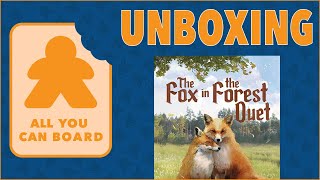




The Fox in the Forest Duet Deep Dive
What the Community Thinks About The Fox in the Forest Duet
Reviewers generally treat The Fox in the Forest Duet as a compact two-player game that offers more depth than its small box suggests. Published by Renegade Game Studios with Foxtrot Games, it takes the trick-taking ideas of the original Fox in the Forest and turns them into a cooperative experience. The transcripts agree that the switch from competition to teamwork is the core of its appeal, though the reviewers differ on how much it ultimately outshines its predecessor.
Carlo, All You Can Board calls the game "a surprisingly fun game" and says Carlo came away impressed, while being careful to add that it is not Carlo's favorite two-player game. The hosts of kovray place the Duet above the original, and in a separate ranking segment on kovray they describe it as a game they have recommended to almost anyone who enjoys two-player games. Across the reviews, the praise centers on the puzzle, the tension between teammates, and the way the game rewards careful thought without punishing new players.
Core Mechanics That Define The Fox in the Forest Duet
Trick-Taking
The Duet uses the familiar rhythm of trick-taking, where one player leads a card and the other follows, with the highest card of the led suit winning the trick. What changes here is the payoff. As kovray explains, whoever wins the trick moves the team's token by the number of grabby paws on the card, and if the token lands on a gem, the team collects it. Reviewers stress that the card played matters less for its raw number than for where the pair needs the token to go. Carlo, All You Can Board notes that the odd-numbered cards carry special abilities, and that a card played as a follower rather than a leader can waste its power entirely. The trick-taking structure therefore becomes a constant puzzle of timing.
The track adds a further constraint. Carlo describes how moving off the forest path costs the team, and how a bad sequence of plays can send the token off the path two or three times in one round. Because the cards are placed face down and cannot be reviewed, each trick is a commitment made with partial information.
Cooperative Game
Every player in the Duet shares a single outcome. Across three rounds, the team works to clear the forest and collect the gems before the game ends. kovray frames the experience as a shared pursuit: the game is hard enough that players often lose or narrowly win, and reviewers say the feeling of doing something together is the reason to return. Carlo observes that the cooperative structure makes the game feel like a shared puzzle rather than a contest, with the difficulty supplied by the deck and the timer rather than by an opponent who is trying to beat you.
The Fox in the Forest Duet Experience
Collaborative
Reviewers describe the Duet as a game that makes two people feel like they are in sync. Carlo says that after enough plays, players start to feel like they are communicating telepathically, because each lead and follow carries a message about what the partner needs. The tension builds as the rounds tick by, and the team must decide whether a single card is worth spending on a risky move. That shared anxiety is a large part of the reason the game stays memorable after a session ends.
Puzzle Solving
Several reviewers return to the word "puzzle." kovray says the first round feels easy, then the game reveals how much planning it requires, and players must plan ahead while hoping the right cards arrive. Carlo describes the feeling of agonizing over which card to play, knowing that one wrong decision can start a chain reaction. Players who enjoy working out a solution with limited information will find this satisfying, even when the answer is not always clear until the final round.
What Makes The Fox in the Forest Duet Stand Out
Limited Communication That Removes Quarterbacking
The most frequently praised feature is the restriction on talking. Players cannot explain their hands or ask for specific tricks, so strategy has to be communicated through the cards played. Carlo says this design eliminates the quarterbacking common in cooperative games such as Pandemic, where one experienced player may dictate every move. Because neither player can control the plan, a newer partner is never reduced to a passenger. Rolling Dice & Taking Names makes the same point from the table, explaining that players cannot say what they hold and must read a partner's intentions from their plays.
Scoring and Difficulty Levels That Invite Replay
Reviewers also single out the way the game measures success. Instead of a simple win or loss, the Duet awards points based on how well the team performs, including bonuses for finishing early or keeping cards in hand. Carlo notes that three difficulty levels let groups grow into the game, and that level three is punishing for experienced players. Together, these features give experienced players a score to chase and give new players a gentler introduction, which Carlo credits with keeping Carlo coming back.
Potential Drawbacks
Plain Components
Not every reviewer is taken with the physical production. Carlo describes the component quality as nothing particularly special, noting that the red gems are simple cardboard squares. Carlo acknowledges that the modest production helps keep the price low, and that the reference cards are a useful addition. Players who value tactile components may find the presentation more utilitarian than they would like.
Swingy Outcomes
The same tension that draws players in can also produce frustrating results. Carlo describes games where a team believed it had a winning position, only to lose control over two or three turns when it held too many high-movement cards. Carlo frames these extreme highs and lows as part of the appeal, but some players may find that a single misplay can unravel a round. The hidden hand and the face-down cards mean that recovery is not always possible, which can make the outcome feel decided before the final trick.
If You Enjoy The Fox in the Forest Duet
Players who enjoy the Duet's trick-taking tension will find a natural companion in the original Fox in the Forest, which uses the same family of card abilities in a competitive format. Players who enjoy the Duet's card-driven puzzle will find similar satisfaction in Arboretum, where careful card sequencing rewards planning. Players who appreciate the shared goal of the Duet but want a larger cooperative challenge will find Pandemic familiar, with the caveat that the Duet removes the quarterbacking reviewers associate with that game.
What Reviewers Are Saying
"I just really like how well this is designed with the limited communication to get rid of that aspect of quarterbacking which tends to plague some cooperative games depending who you're playing with."
— Carlo, All You Can Board
"This is one of those games that you either lose or you squeak out a narrow victory, and it feels just so much fun every single time. It feels like you're doing something together."
— kovray
"You don't get to talk to each other, you don't get to say let me win this trick, you don't get to say here's what I have in my hand."
— Rolling Dice & Taking Names