











The Grand Carnival Deep Dive
What the Community Thinks About The Grand Carnival
Reviewers approach The Grand Carnival as a polyomino game with a strong sense of place. Designed by Rob Kramer, it asks players to build a fairground over seven days, drafting foundation tiles, covering construction sites with attractions, and steering guests along walkways toward the big top. The shared view is that the core turn is clean and quick to explain, while the planning and the scoring add real depth. Peaky Boardgamer walks through the full rulebook in a single how-to-play video, and a group playthrough on The Dice Tower shows how quickly a table of players gets absorbed in the layout puzzle.
Opinions diverge mainly on long-term appeal. Carlo of All You Can Board decided to part with the game in a collection-curation video, calling it a solid game that simply had too many polyomino titles ahead of it on the shelf. Luke Hector of The Broken Meeple was curious rather than committed after a few plays, praising the layout puzzle while wanting more time with it before judging whether it would last. Second Star to the Left, by contrast, argues that the game deserves far more attention than it gets.
Core Mechanics That Define The Grand Carnival
Polyomino Tile Placement
The polyomino system is the spatial center of the game. Each player builds a personal fairground from foundation tiles, and each foundation tile is a small grid of construction sites and walkways. Carlo of All You Can Board explains that attractions can be placed only on construction sites while guests can move only on walkways, so every tile placement is a tradeoff between room for rides and room for visitors. Foundation tiles cannot be rotated, but attraction pieces can be rotated and flipped, which gives players some flexibility when fitting shapes into a tight layout. Scoring then penalizes leftover space: each visible mallet symbol costs a point at the end of the game, so an uncovered construction site is a real loss.
Guest movement adds a second layer to the puzzle. Guests step orthogonally along walkways, and a guest that finishes next to an attraction places a ticket on it. The Dice Tower group found that the most productive moves were the ones that touched several attractions at once, with one player noting that the trick is to group attractions around the same walkway square so that a single guest can add tickets to three of them.
Tricks of the Trade Objectives
Each game uses three randomly drawn Tricks of the Trade cards, and completing a card's objective unlocks an ongoing ability for the player who met it. Peaky Boardgamer lists the kinds of goals involved, such as having five tickets across attractions in total or having a guest finish its movement next to three attractions. Carlo's explanation of the lockout rule is the most precise: once one player unlocks a trick, every opponent gets one turn to meet the same objective or loses access to that trick for the rest of the game. This turns each completed objective into a small race, and it gives the action pawns a second job beyond the fairground itself.
The Grand Carnival Experience
Colorful and Vibrant Presentation
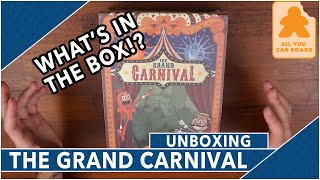
The game's visual identity is a large part of its appeal. Dylan of All You Can Board opened the box and was struck by the artwork and the finish of the components, calling the board and tiles very good quality. The Broken Meeple describes the look as cartoony, with a retro feel that reminded Luke Hector of early animated shorts. The effect at the table is a bright, playful carnival that feels distinct from the more muted polyomino games reviewers mention alongside it.
Solitary and Puzzly Focus
Playing The Grand Carnival feels like working through a personal optimization puzzle. The Broken Meeple praises the efficiency puzzle, because each turn asks a player to choose both an action strength and a way to space out polyomino pieces on a board with limited room. Interaction arrives mostly through the shared Tricks of the Trade cards and through competition for particular tiles, but the satisfaction comes from building a fairground that works.
What Makes The Grand Carnival Stand Out
Numbered Action Selection
The action wheel is the feature reviewers single out most often. Each player has five action pawns, and placing one on a numbered space from one to five sets the power of the action taken that turn, with each number usable only once per round. Michelle of Second Star to the Left called the action selection one of the favorite parts of the game and the feature that sets it apart from other polyomino titles. Carlo compared the system to the strength-based actions in Arc Nova, noting that a higher strength gives access to more options or a bigger piece to cover the fairground.
Variety From Game to Game
The Tricks of the Trade cards give the game replay value. Carlo of All You Can Board highlights that the cards offer variety from game to game, letting players bend the rules by completing specific goals. Because only three of the cards are dealt into each game, the set of available abilities changes from one session to the next, and reviewers describe the result as a fresh puzzle each time rather than a single fixed route to victory.
Potential Drawbacks
A Dense Scoring System
Scoring is the most common point of friction. Carlo of All You Can Board said that the way the scoring works was a major reason for not keeping the game, and the playthrough from The Dice Tower shows why. Points come from matching sets of attraction sizes, tickets on attractions of every size, guests in the big top, a threshold of fifteen tickets, carnival barkers, and mallet penalties, so the final tally takes time to check. The group also noted that the fifteen-ticket threshold is all or nothing, so players who are close to it have to weigh whether to chase it.
Corners and a Weaker Solo Mode
The Broken Meeple cautions that the rules are simple enough to suit casual players, but that newer players may box themselves in. Luke Hector described the solo mode as all right but not particularly great, and suggested that the game shines most with three or four players, where the race for objectives and tiles creates more tension. Players who want a strongly solitary experience may find the solo option thinner than the multiplayer game.
If You Enjoy The Grand Carnival
Players who enjoy The Grand Carnival's efficiency puzzle will find a similar satisfaction in Patchwork, which a reviewer in a polyomino roundup named among the tile-fitting games they love. Players who are drawn to the numbered action wheel will recognize the same tension in Arc Nova, which Carlo of All You Can Board used as the point of comparison for the strength-based actions in The Grand Carnival. Both recommendations reflect the same appeal reviewers describe: fitting pieces efficiently while the choice of action strength shapes what you can build this turn.
What Reviewers Are Saying
"So very cool looking. I love the design of the artwork on here, and I love the finish on these, actually. It's super super good quality. Not cheaping out on that, that's for sure."
— All You Can Board
"Come one come all, the carnival is coming to town and it literally feels like that because the board where you draft your tiles is a train that brought the carnival to town. You're building out a Foundation that you will later put attractions on, so the foundations are just square tiles, but they have paths that you can create to put those polyomino shapes on top."
— Michelle, Second Star to the Left
"This one is definitely one that, as much as the rules are simple to appeal to a casual player, casual players might find that they rub themselves into a corner too easily and that could put them off. So we'll have to see, but this one has intrigued me and I'm definitely up for trying some more."
— Luke Hector, The Broken Meeple