/pic5016682.jpg)

















The Great Wall Deep Dive
What the Community Thinks About The Great Wall
The Great Wall from Awaken Realms has earned substantial respect from reviewers across multiple channels. This is not a casual observation, but rather a recognition of a game that successfully delivers on multiple fronts: a unique hybrid game design, exceptional production values, and compelling mechanical depth. Reviewers consistently praise the core tension between cooperation and competition, calling out the innovative integration of these two modes as genuinely rare in the board game landscape. The game's ambitious scope and beautiful presentation have made it a standout release from the Polish publisher.
Core Mechanics That Define The Great Wall
Card-Driven Worker Placement
At the heart of The Great Wall lies a card-driven worker placement system that one Drive Thru reviewer called "a tight little card driven worker placement game" that represents something genuinely novel. Each player holds an identical hand of action cards such as Work Harder, Betrayal, and Despotism. Players select and play these cards face-down, then in turn order choose whether to play first, second, or third, fundamentally altering the power of their actions. Once played, cards are gone from hand until either the round ends or players deliberately choose to reclaim them, creating a meaningful resource tension. This card-driven structure allows other players to piggyback on actions, with secondary effects triggered by the cards themselves. The mechanic ensures that every turn contains hidden information, strategic ordering decisions, and collaborative action generation, a combination that reviewers found genuinely fresh.
Resource Management Under Pressure
Players must carefully manage four core resources: wood, stone, gold, and chakra (which reviewers sometimes called "sapphire" for the gem-like appearance). These resources fuel everything from hiring soldiers and advisors to constructing wall sections and purchasing new workers. The economy operates through dedicated worker placement spaces along the board's bottom row. However, shame tokens create severe consequences for greed or miscalculation. If a player places workers in a resource spot but nobody else joins them to collectively trigger the action, that player gains a shame token along with their resources, a painful tradeoff. Shame tokens block unused soldiers and are worth negative five points at game end, forcing players to spend precious chakra to remove them. This creates a constant tension between ambitious resource gathering and the risk of isolation.
The Great Wall Experience
Epic in Scope and Scale
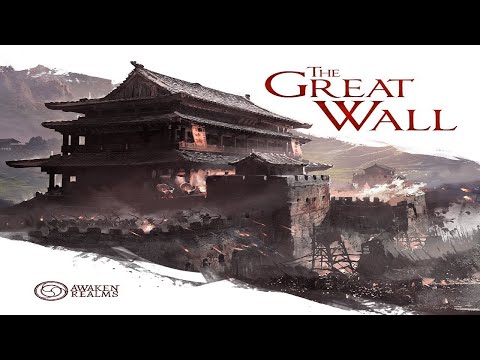
The Great Wall positions players in the Chinese dynasties facing invasion by the Mongol hordes. The game's historical backdrop grounds every mechanical choice: building walls to defend against waves of enemies, deploying soldiers and archers to fight encroaching hordes, and managing the honor and shame that come with victory and defeat. Reviewers described the escalating tension as hordes advance through columns, with each round bringing stronger and more numerous threats. The game board and components create a growing sense of spectacle and danger, with wall sections physically stacking higher as players defend their territory. One Board Games for One reviewer noted that The Great Wall puts Sun Tzu's Art of War into action, grounding the abstract worker placement in historical military strategy.
Table Presence Through Miniatures and Architecture
Awaken Realms has equipped The Great Wall with an impressive array of metal-detailed miniatures and sculpted soldiers distinguished by clan color and unit type. Archers, spearmen, cavalry, and special units are visually distinct and beautifully rendered. The modular wall sections themselves grow dramatically across the game table as players invest resources into construction. Starting bare and vulnerable, the walls gain defensive value with each investment: from simple barricades worth two defense each, to fully realized fortification tiers providing eight, twelve, and sixteen defense respectively. This visual escalation creates a satisfying sense of progression and makes the game's central objective tangible. Reviewers remarked that the game "commands attention when set up" and that even the retail version without deluxe miniature painting delivers excellent table presence.
What Makes The Great Wall Stand Out
Seamless Integration of Cooperative and Competitive Play
The Great Wall offers two complete yet mechanically intertwined game modes. In competitive play, players work toward individual honor accumulation while still collectively defending against hordes, they must cooperate to survive, but compete to excel. In cooperative mode, players share objectives that shift each round, must complete specific goals or take collective shame, and face unpredictable event cards designed to disrupt their strategy. What makes this remarkable is that the core loop remains identical: the same card plays, the same worker placement, the same wall construction and troop deployment. Only the victory condition and tone change. Drive Thru Games noted that finding another euro that seamlessly offers both modes is essentially impossible, making The Great Wall categorically unique. Reviewers consistently praised this dual nature as feeling like two complete games sharing one elegant ruleset, rather than two modes bolted onto one design.
Asymmetric General Powers and Combo-Rich Advisor System
Each player begins by selecting one of multiple general cards, granting unique special abilities and starting resources. One general might multiply honor gains by the number of supporting advisors in play, while another provides consistent flows of specialized cards or resources. Players then gradually acquire advisor cards throughout the game, either playing them face-up for immediate abilities or placing them face-down under their general to amplify that general's special power. The advisor pool is so rich with good options that Dice Tower reviewer Tom Vassel remarked every card looked genuinely awesome. This combo potential extends into multiple strategic pathways: some players focus on powering a single general's ability into an engine, while others pursue diverse advisor abilities. Reviewers noted that Awaken Realms' signature strength for designing synergy appears throughout The Great Wall's card pool, offering multiple ways to generate honor and win through different playstyles.
Potential Drawbacks
Necessary Setup and Teardown Time for Physical Walls
The modular wall sections are beautiful and functionally important to the game's visuals and mechanics, but they require assembly at the start of each game and disassembly at the end. Board Games for One noted that the box storage is not optimized to keep completed walls intact between plays, forcing players to break down and rebuild these three-part structures every session. While not a game-breaking issue, this represents additional friction in setup and breakdown that could be addressed with more thoughtful insert design. Some players may find the extra time investment worthwhile for the aesthetic payoff, while others may view it as unnecessary overhead to an already moderately long game.
Solo AI Balance Requires Manual Difficulty Adjustment
The Great Wall includes solo and two-player modes using the Reed Clan as a controlled third or second player, and a semi-intelligent AI opponent (Kyojusta in solo) for competitive play. Board Games for One reported winning decisively in final solo playthroughs, sometimes lapping the AI opponent by over 100 honor points. While the design allows manual handicapping, starting the AI with 50 or 100 bonus points, or limiting its advisor acquisition, the out-of-the-box solo experience lacks the inherent challenge tuning of games like Wingspan, which include integrated difficulty scaling through automa cards. Players seeking a genuinely difficult solo experience may need to implement house rules or bonus points to maintain engagement across multiple plays.
If You Enjoy The Great Wall
Players drawn to The Great Wall's particular combination of mechanics and themes should explore Gaia Project, which shares the asymmetric faction powers and engine-building progression that make choosing your general and advisor combo so satisfying. Gaia Project similarly rewards investing in technology synergies and offers multiple viable strategies toward victory.
Nemesis, also from Awaken Realms, delivers the same signature miniature quality and combo-rich card systems, though through a very different thematic lens of sci-fi survival. If the production values and layered card abilities of The Great Wall appeal to you, Nemesis leverages similar design philosophy.
For players who specifically prize the tile-building and spatial area control elements, Carcassonne offers a lighter, more accessible entry point into games where players cooperatively build a shared medieval landscape. While mechanically simpler than The Great Wall, it shares the pleasure of watching a tableau grow on the table and the puzzle of optimal placement decisions.
What Reviewers Are Saying
This is a tight little card driven worker placement game that's not a thing I've seen before either. You know you play this card the card's gone until I decide to pick it up, and I'm counting on other players to sort of play these cards.
— Drive Thru Games
The manipulation of the Reed Clan competing with Kyojusta in the solo game to try to be the one that tells the Reed Clan where to put their pieces I really enjoyed that. I love the worker placement and the fighting to get these walls up.
— Board Games for One
Every card you look at like that's awesome, that's awesome, that looks like it's really cool. It's not too complicated, but there's a lot of fun places to maneuver through strategies, and I definitely recommend it.
— Drive Thru Games