







The Hanging Gardens Deep Dive
What the Community Thinks About The Hanging Gardens
Reviewers generally describe The Hanging Gardens as a sharp, fast, and tightly designed card game that rewards planning more than its modest theme suggests. The recent commentary centers on a 2025 design by Gregory Gard, the designer of Castle Combo, which shares its title with Michael Kiesling's older Hanging Gardens. Several reviewers take care to separate the two, and the praise below refers to the newer release.
Rahdo Runs Through offers the most enthusiastic coverage, appearing in both an Essen Spiel countdown and a June roundup. The host calls it "a really sharp, fast playing little game," and in the roundup describes the design as "incredibly simple rules, incredibly fast gameplay, and incredibly tough decisions." The same reviewer notes that the designers previously worked on Federation, which adds to the team's reputation.
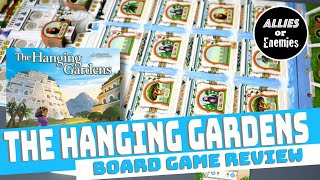
Allies or Enemies places the game in a lighter bracket. Its review calls the game a quick, light set collection title that shares "a bit of DNA" with Castle Combo and In the Footsteps of Darwin, though it is quicker and lighter than both. The reviewers praise its clarity but say the theme does not come through strongly.
Board Stupid previewed the game at UK Games Expo, describing it as a pyramid building game with open drafting and a cascading market. The channel highlights the production quality and the publisher's habit of releasing games that are playable within an hour. Watch It Played calls it "an underrated gem," while Watch It Played stresses that a strong theme is often what keeps a good game off the table, which makes the Hanging Gardens harder to sell to groups. Board Gaymes James mentions buying a copy at UK Games Expo, but offers little evaluative detail.
Core Mechanics That Define The Hanging Gardens
Card Drafting Under Scarce Worker Placement
Drafting is the engine of the game. On a turn, a player places one gardener on an empty space and then drafts a card from the column above it, paying a tool cost for cards above the first row. Reviewers stress that the number of worker spots is small. Rahdo Runs Through explains that each column has only two worker placement spots, so a column can close before a player reaches the card they want. Cards that sit unclaimed get cheaper over time, which gives players a reason to wait while also worrying that a rival will take the card first. Rahdo notes that "it is rare you see a game with such tight, tight, restrictive worker placement," and that the restriction is what makes the drafting challenging.
Tableau Building Into a Pyramid
Drafted cards are added to a personal garden in a pyramid. Each card can go next to a card in the same row, or on top of two cards in the row below, with row lengths narrowing from five to four to three. Allies or Enemies explains that each card tends to touch at least two of the six scoring paths, which include set collection of trees, flowers that want adjacency, animals that score by level, irrigation goals, royal objectives, and variable visitor goals. Reviewers agree that placement matters as much as selection. Rahdo Runs Through points out that many cards care about what sits above or below them, so the same card can be worth very different amounts depending on where it lands. Enhancements that can be added to blank cards later in the turn give players another way to adjust the tableau.
The Hanging Gardens Experience
Solitary and Puzzly
Reviewers consistently describe the game as a personal puzzle. Players draft from a shared market but spend most of their attention fitting cards into their own pyramid. Allies or Enemies notes that there is little direct interaction, so the game plays much like building your own structure while watching what others take. Rahdo Runs Through describes the experience as "crunchy" and "puzzly," with decisions that involve planning several turns ahead. Because each choice can open a second scoring path, players often find that the best move for their garden is also the move that denies a rival something they need.
Quick and Snappy
Speed is one of the game's most repeated strengths. Allies or Enemies reports that a two-player game takes about fifteen minutes, that the rules can be taught in roughly five minutes, and that even a five-player game should finish in around half an hour. Board Stupid also highlights how easy the game is to explain and how smoothly it moves. Reviewers see this speed as a reason to reset and play again immediately rather than as a sign of shallow play.
What Makes The Hanging Gardens Stand Out
Clarity and Ease of Teaching
Allies or Enemies praises the readability of the components. Every element on a card can be seen at a glance, and the enhancements fit neatly onto the cards. The clean layout is what allows a new group to start within minutes. Reviewers see the same clarity as the reason the game is accessible to families and casual players, even though the scoring paths interact in sophisticated ways.
Replayability From a Changing Puzzle
Each game uses one of five irrigation cards, only four of the ten royal objectives, and a different market of garden cards. Allies or Enemies argues that this variation means the puzzle changes from session to session, which keeps the game fresh despite its short length. Rahdo Runs Through echoes this, describing the mix of available objectives as the reason the game feels new each time.
Potential Drawbacks
A Plain Look and a Pasted-On Theme
The most consistent criticism is that the theme feels attached rather than woven into the play. Allies or Enemies observes that the cards look plain for a garden subject, and that the pyramid resembles a wall of Babylon more than a hanging garden. The reviewers accept that the clean visual style supports clarity, but they still find that the theme is less evocative than the subject deserves.
Limited Interaction and Unclear Edge Rules
Allies or Enemies notes that there is not much direct interaction, and that the number of players changes the game only modestly, with competition for royal objectives increasing at three and five players. Rahdo Runs Through, meanwhile, reports that the rules for collecting relics were vague and that the reviewer was still working out how that part of the game functioned. Players who want a confrontational experience may find the game too quiet, and groups should expect to resolve a few rules questions before a smooth game.
If You Enjoy The Hanging Gardens
Reviewers consistently point to Castle Combo as the closest relative. It comes from the same designer and shares the quick pace, tight drafting choices, and tableau scoring that define the Hanging Gardens. Allies or Enemies also links the game to In the Footsteps of Darwin, which shares its intertwined scoring paths and emphasis on indirect interaction. Rahdo Runs Through notes that the design team also created Federation, so players who enjoyed the restrained, elegant decision making of that title may find a similar temperament here. Players looking for a lighter entry point into tableau games may appreciate the Hanging Gardens for the same reasons reviewers praise it: it is simple to learn, fast to play, and difficult to play perfectly.
What Reviewers Are Saying
"It is rare you see a game with such tight, tight, restrictive worker placement and that's what creates the really challenging restrictions."
— Rahdo Runs Through
"The cards do look a little plain for the theme. It looks more like you're building the big wall of Babylon than a hanging garden, which leads to the theme feeling a bit pasted on."
— Allies or Enemies
"It's kind of a pyramid building game, an open drafting game with a cascading market and they're going to be putting things onto this pyramid uh to score points."
— Board Stupid