








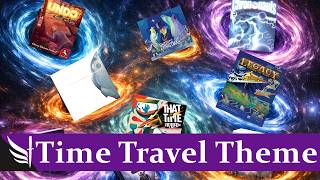






















The LOOP is a quirky co-operative game in which you battle the evil Dr. Faux. Play a Temporal Agent in four different game modes, full of new challenges and replay value. Gather powerful artifacts, defy the Doctor's duplicates, and sabotage his maniacal machine. Make the most of your cards and master the LOOP to use them multiple times in impressive chains — but the Doctor isn't going to make this easy on you!
The evil Dr. Faux has built a terrrrible time machine! With the help of the duplicates of himself that he is creating through the ages, he aims to carry out his Omniscience 2000 project to become master of the universe. But the rifts that he is opening in spacetime will probably destroy quantum space way sooner...
Join the Agency in the shoes of one of its most legendary agents, and co-operate to foil the fiendish schemes of Dr. Faux, using quirky but still powerful artifacts.
—description from the publisher
- unique board
- limited communication aspect
- cooperative trick-taking
- pirates trying to break the Captain's curse and escape a cave
- a cave
Mechanics (from transcript analysis)
- card drafting/exchange — At the beginning of each round, each player will select and exchange one card from their hand.
- card play with effects — Each of the cards has different symbols on it. After the trick winner is determined, various effects are going to be triggered by the combination of patterns on the two cards.
- Trick-taking — On your turn, you'll perform a trick. The lead player plays a card and the second player follows. Based on the colors and numbers of the two cards played, one of the players wins the trick.
Video topics + discussion points
Quotes (from this video)
- To break the Captain's curse, the Lion pirates continue their voyage and finally find the Devil's Whistle in Hamlin's cave.
- This is a two-player only cooperative trick-taking game where you are trying to get your ship to its destination out of the cave and back to safety.
- This ultimately is a limited communication game.
- Your aim is to try and navigate the ship out of the cave across this unique board. I love it.
References (from this video)
- Variety from modular encounter sets
- Thematic representation of criminal organization
- Worth getting for fans of street-level villains
- Can feel like being 'sandbagged' with held cards
- Frustrating 'top deck city' moments
- Leans analytical rather than thematic
- Can feel like a war of attrition
- Thematic inconsistencies
- Street-level villains don't differentiate much
- Considered the weakest scenario pack discussed so far
- villainous collaboration and ambition
- street-level
- Green Goblin
- Wrecking Crew
- The Once and Future King
- Sinister Six
Mechanics (from transcript analysis)
- Card draw/discard manipulation — The Hood's 'foul play' and 'unbridled ambition' cards can lead to a large number of face-down encounter cards being added or cards being discarded, impacting the encounter deck size.
- Minion swarm — The Hood can overwhelm players with high-health minions that require attention, even while the main threat advances.
- Modular Encounter Sets — The Hood uses a system where different modular encounter sets are randomly included in his deck for variety each game.
- Scheme acceleration — The main scheme advances, adding acceleration tokens, and reshuffling the encounter deck also adds acceleration tokens, creating a sense of urgency.
Video topics + discussion points
Quotes (from this video)
- It almost feels as if it's designed to have you basically always have two to three, four, maybe even four face down encounter cards, and I really don't like that as a system.
- It always feels bad whenever it's like top deck city when you could have when the game comes down to okay, I think we're going to win.
- So, it is the hood is kind of a it's it's a war of attrition and I feel like you're going to lose if you cannot deal enough damage to the hood quickly enough.
- And that's the first time you had to fight four different different villains all at once. Here, it's still just The Hood.
- I mean, so comparing this to Green Goblin, Wrecking Crew, I even like Wrecking Crew more just cuz at least there's four different They At least the four Wrecking Crew guys have a different gimmick about them.
- I don't think it's a bad scenario pack, but I can definitely tell you out of all the ones that have come out, I think it's the weakest that I've talked about so far.
References (from this video)
- The recommended set for the scenario is straightforward.
- Iceman's abilities are effective in controlling enemies.
- Venom has good potential for crowd control and damage output with upgrades.
- Iceman's opening hand is not ideal for the current situation.
- The scenario can become difficult quickly with multiple encounter cards being added.
- Some weapon upgrades for Venom are expensive.
- The 'Armored Guard' minion is a significant obstacle due to its toughness and guard ability.
- The Hood recruiting villains to unite them under one banner
- the city
Mechanics (from transcript analysis)
- Deck Searching — Players can search their decks for specific cards, such as attack events or weapon upgrades.
- hand management — Players discard cards from their hand to play other cards, a common element in the game's strategy.
- Modular encounters — The game uses multiple modular encounter sets that can be selected to adjust difficulty and gameplay.
- Status Effects — The 'Frostbite' status card is attached to enemies, reducing their stats and demonstrating a mechanic to hinder villains.
- threat management — Players work to remove threat from schemes, as seen when Iceman uses 'Chill Out' to remove threat.
- Villain activation — The villain, The Hood, has specific abilities like 'Foul Play' that trigger during the game, affecting players and the encounter deck.
Video topics + discussion points
Quotes (from this video)
- Viewer discretion is advised.
- I am doing a series called Marvel Mondays where I do something Marvel related every Monday until I run out of Marvel stuff, which is going to be a while.
- If The Hood is able to truly truly unite all of these criminals under one banner, he'll have a formidable empire that even the strongest of you will struggle against.
- So, Making Connections, The Hood is recruiting an army, convincing various villains that they are stronger together than they are apart.
- Seriously, dude, I'm all out of ice puns.
- Wow, he has a good opening hand. It's just not good right now.
- Damn. That's pretty solid to have.
- Damn. Has Iceman always been this strong in this game? Feels a little bit overpowered.
- I hate you. Armored Guard, he comes in. He has guard and he has toughness. That sucks.
- So, yeah, I think I have now won.
References (from this video)
- Significant value due to the inclusion of standard 2 and expert 2 encounter sets.
- Nine new modular encounter sets add immense variety and replayability.
- The 'foul play' mechanic and the way modular sets are integrated create a unique and challenging experience.
- The 'steady' keyword offers a new way to increase villain difficulty and counter specific player strategies.
- High value for money, providing a new scenario, many modular sets, and updated core encounter sets.
- The inclusion of the crucial standard 2 and expert 2 sets in a 'seemingly random' scenario pack might be a point of contention.
- Some players might have hoped for a more wildly unique scenario theme given the wait for new scenario packs.
- The Hood gathering super villains to create an empire, starting small and increasing in difficulty as he gathers more.
Mechanics (from transcript analysis)
- Environment Card — The 'Formidable Foe' card from the new standard set is an environment card that permanently grants villains the 'steady' ability.
- Foul Play — A unique ability where the Hood discards the top card of the encounter deck, and if it's not from his set, the player takes it as a face-down encounter card, triggering more often as more modular sets are added.
- Modular Encounter Sets — This scenario pack heavily utilizes modular encounter sets, allowing players to choose seven from their collection to be shuffled into the Hood's deck, and the pack includes nine new ones.
- Side Scheme — The 'Self-Experimentation' card is an interesting side scheme that prevents damage dealt to brute enemies from being applied, instead removing threat from the scheme.
- steady — A new keyword that requires two status cards of the same type (stun or confuse) to affect a character, making them harder to lock down.
- Treachery Cards — Cards like 'Field Recruitment' and 'Upper Hand' are treachery cards that contribute to shuffling more modular sets into the deck and triggering the 'foul play' ability.
Video topics + discussion points
Quotes (from this video)
- Fantasy Flight Games know that they are announcing these Marvel Champions pack packs too quickly. I can barely keep up.
- The biggest feature of this pack, in my opinion, is the fact that we are actually getting updated versions or advanced versions of the standard encounter set and the expert encounter set.
- I find it very interesting that we are getting those packs in a seemingly random scenario pack, The Hood.
- I honestly think that I'm sure there's going to be a little bit of discussion. Um I don't want to say controversy but there's going to be some discussion about, you know, the the need the fact that you have to buy seemingly a random scenario pack, the Hood, to get such a an important advancement in getting a standard two set and an an expert two set because both of those, you know, are going to change the way you play Marvel Champions a little bit.
- There's no better way to sort of refresh your Marvel Champions experience.
References (from this video)
Mechanics (from transcript analysis)
Video topics + discussion points
Quotes (from this video)
- Dark Tower is always fun to play. It's always enjoyable, it's a great group of people to play with.
- Dice Command is one of my all-time favorite two-player games.
- Weirdwood Manor is very very clever in how the day-based actions change the game.
- Tails from the Red Dragon Inn is great, light, quick, fast dungeon crawl.
References (from this video)
- deep combos and high interactivity
- stellar art and production
- one of the best integrations of drafting with base-building
- one of the more mechanically dense entries
- base-building via card drafting and power management
- moon base / space colonization
- sandbox with strong combo potential
Mechanics (from transcript analysis)
- card drafting — players draft cards and pass the remainder to opponents to build their moon base
- card drafting (pick and pass) — players draft cards and pass the remainder to opponents to build their moon base
- hand management — careful selection and timing of cards to maximize synergy
- Rondel — movement around action spaces yields different shop/board effects
- Rondell-like movement and action-taking — movement around action spaces yields different shop/board effects
Video topics + discussion points
Quotes (from this video)
- you live and die by your own strategy
- the more you learn, the more you want to play again
- it's one of the most sophisticated advanced games on this list
References (from this video)
- Thinky, tricky, and highly satisfying when you pull off a big combo
- One of the best cooperative experiences, with strong solo play potential
- Cube Tower mechanic adds tactile fun and tension
- Artwork/color scheme may deter some players who prefer different aesthetics
- Can be very punishing if you miss a critical sequence
- engine-building, cooperative puzzle with dynamic timing
- cooperative, thinky loop of actions with time-shifting effects
- clever, epic-turns oriented toward clever sequencing
- Sleeping Gods
- Welcome To The Moon
Mechanics (from transcript analysis)
- cooperative engine-building — players cooperate to trigger powerful, chainable effects.
- Cube tower — a unique mechanic often involving a tower of cubes to resolve effects; enhances tension and satisfaction.
- solo-play emphasis — the game is celebrated for its strong solo experience and clever design.
Video topics + discussion points
Quotes (from this video)
- There’s an entire campaign built in here with I think eight different maps that are very different.
- Cascadia is a very approachable, family-friendly tile-laying game that I really like.
- This is a game that just keeps popping up on my list.
- The Loop is one of my favorite cooperative games; it plays best solo and is incredibly underrated.
- Final Girl is a solo-only game that nails the atmosphere and does so with cinematic storytelling.
References (from this video)
- Brilliant puzzle-like design with clever time travel loops
- Cooperative and deeply strategic with real puzzle moments
- Time agents stopping Dr. Foe from cloning history
- Time-travel multi-era cooperation
- Cooperative, time-bending
Mechanics (from transcript analysis)
- Cube tower — Central tower reveals outcomes and drives tension
- cube tower gimmick — Central tower reveals outcomes and drives tension
- Deck building — Each agent has a unique deck with abilities used to complete missions
- deck-building — Each agent has a unique deck with abilities used to complete missions
Video topics + discussion points
Quotes (from this video)
- Bag building is an underused mechanism. It's just so tactile and fun.
- There's a freedom of design that comes from not being shackled to multiple players.
- This is one of the best cooperative games and one of the best deck building games ever made.
References (from this video)
- innovative cube tower mechanic
- satisfying card loop for big turns
- fun cooperative vibe
- limited solo play in some variants
- some players may prefer heavier euros
- time-bending cooperation and puzzle solving
- Futuristic cooperative setting with modular sectors
- light-hearted, silly
Mechanics (from transcript analysis)
- Cooperative Game — players coordinate to achieve a common objective
- cooperative play — players coordinate to achieve a common objective
- Cube tower — cube tower distributes cubes across three sectors; affects actions
- cube tower distribution — cube tower distributes cubes across three sectors; affects actions
- hand management — small hand where a type can be looped back into hand for reuse
- hand management / card looping — small hand where a type can be looped back into hand for reuse
Video topics + discussion points
Quotes (from this video)
- one of my absolute favorite cooperative games of all time
- this is another time travel themed game
- it's a ton of fun
- the solo mode is so quick and simple
- it's just a great worker placement Deck Builder
- the theme really works
References (from this video)
- one of the best solo-friendly coop experiences
- extremely satisfying looping mechanic when set up with teammates
- high degree of cooperative synergy and planning
- availability can be limited; it’s not always easy to acquire
- some players may find the loop mechanics repetitive over long sessions
- cooperative time travel mission completion with looping card mechanics.
- Time-travel crisis management with Dr. Foe as the antagonist across multiple ages.
- thematic, cinematic co-op with a strong loop mechanic and shared goals.
- Pandemic
- Time-looped co-ops
Mechanics (from transcript analysis)
- cooperative missions with multiple ages — Players coordinate across seven time periods to complete four missions before losses (vortexes).
- deck-building with looping — Each card shows a symbol; if you have multiple, you can loop and reuse cards using energy cubes.
- energy cubes as loop currency — Energy cubes let you 'buy back' cards with the same symbol to reuse effects.
- solo and multi-character play — Strong solo mode with good support for running multiple characters.
Video topics + discussion points
Quotes (from this video)
- After five years it's where you can really start to be like, 'Oh, is this game still around? Is this game still good?'
- The turns are slick and easy.
- It's sort of like a deck building game in slow motion where the cards that you're gaining and which ones are in front of you are going to be changing but not completely every single turn.
- You can actually play with all this stuff because it's a short, simple game.
- This looping mechanic is really, really cool and cooperative because you can set each other up.
References (from this video)
- Accessible, family-weight cooperative design
- Engaging looping mechanic that rewards planning and sequencing
- Strong thematic charm and charming artwork
- Multiple modes and mission variations boost replayability
- Two-player scaling lacks explicit rules for all mission types
- Can become chaotic and lengthy at higher player counts
- Luck in card draws significantly influences outcomes
- Time travel, stopping a mad scientist, cloning and era-based combat metaphors
- Across seven eras from the dawn of time to the end of time, where time agents attempt to stop Dr. Foe and his clones from destroying the universe
- Cooperative puzzle-brawler with light deck-building and time-hopping tableau
Mechanics (from transcript analysis)
- Asymmetric time agents — Each player has a unique Time Agent with a distinct power and starting deck that changes how they contribute.
- Cooperative Game — Players work together to complete missions before time/eras collapse due to rifts and vortexes.
- cooperative play — Players work together to complete missions before time/eras collapse due to rifts and vortexes.
- End conditions and vortex management — Lose by vortex formation or by exhausting cycles before completing four missions; critical to manage the board and timing.
- Looping and exhaustion system — Cards have symbols; looping can untap exhaust cards to reuse them, with costs that depend on symbols and card types.
- Mission tiles and artifacts — Rotating mission tiles around the board define objectives; artifact cards grant ongoing and situational effects that alter future turns.
- Resource management — Green energy cubes fuel movement and actions; red rift cubes are the primary threat to stop from mounting.
- Time machine and rift cubes — Dr. Foe moves through eras producing red rift cubes; if an era accumulates too many, a vortex forms and some missions become impossible.
Video topics + discussion points
Quotes (from this video)
- The Loop: Dr. Foe Strikes Back — a fully cooperative time-travel epic.
- Two-player mode is challenging but rewarding with asymmetric powers.
- Thematic, wacky, and family-friendly — a charming co-op experience.
References (from this video)
- Production choices (wooden monsters) add a cool tactile aesthetic
- Simple turn structure that remains crunchy via plan-ful play
- Interesting thematic premise and tension around conversions
- Unpredictability can be off-putting and board state is busy
- Rules are memory-intensive and can be hard to recall under pressure
- Overall complexity may overwhelm casual players
- religion, conversion, and territory control
- Border hex grid with priests, conversions, and temples in a cult/religious theme
- asymmetric influence and ritual conflict with modular chaos elements (monsters)
- Dominant Species
Mechanics (from transcript analysis)
- action draft with non-repeat rule — On your turn you activate one of four actions and cannot perform the same action back-to-back.
- action drafting — On your turn you activate one of four actions and cannot perform the same action back-to-back.
- conversion majority to score — Majority control on hexes determines who converts who; races to accumulate temples.
- monster summoning and rule perturbation — Monsters enter play and can disrupt or alter core rules, adding unpredictability.
- presence tokens and border triggering — Place presence on borders of hexes to trigger conversions and expand influence.
- Race — Players race to reach a temple-based threshold under varying conditions.
- temple race / end condition — Players race to reach a temple-based threshold under varying conditions.
Video topics + discussion points
Quotes (from this video)
- The unpredictability with this one maybe a bit too much for my comfort level.
- The board state is very busy and hard to remember what each piece can do.
- Not for me, hence why it's number 10.
- Breezy this game is extremely easy to play.
- I love the way that you have to manage your resources.
- Everything in this game feels good.
References (from this video)
- Engaging cooperative tension with a deep engine-building core
- Innovative time-loop mechanic that rewards planning and timing
- Beautiful presentation and thematic cohesion
- Thematic complexity may demand a longer initial learning curve
- Some may find the time-loop mechanic laborious in longer sessions
- Time loop mechanics and time-travel drama
- Time-travel agents battling Dr. Fu across zones
- Cinematic, narrative-driven co-op with time-based objectives
Mechanics (from transcript analysis)
- Cooperative Game — Players work together toward big goals while dealing with Dr. Fu’s timed disruptions
- Cooperative objective-driven play — Players work together toward big goals while dealing with Dr. Fu’s timed disruptions
- Deck building — Cards with symbols enable specific looped actions when drawn in a sequence
- Deck-building with icon matching — Cards with symbols enable specific looped actions when drawn in a sequence
- Time zone movement and time loops — Players move across zones in time and can trigger repeated hand effects via looping the same cards
Video topics + discussion points
Quotes (from this video)
- It's the castles of Burgundy. Oh my gosh, this is Euro perfection.
- Everything about Tiny Towns is fantastic. It's phenomenal.
- The Loop is a very pandemic inspired style game.
- This is the greatest cooperative fantasy deck building game of all time.
- The most powerful things we can do in this game is call a meeting between department heads.
- Earth is a masterpiece of positive player interaction. Really fun, tight, constrained tableau building and one of the best engine builders ever.
References (from this video)
Mechanics (from transcript analysis)
Video topics + discussion points
Quotes (from this video)
- The two by the way was Kingdoms for Lauren which is actually I think liked by others but I felt that you had to break your teeth on the rules to get to a game that was a whole lot of messiness.
- I really did not love Kingdoms for Lauren but I respect that it's a game that will work for others.
- The highest the highest individual score given out in 2022. So that's the 3.5 is the most common rating given.
References (from this video)
- innovative twist on deck-building
- tight cooperation
- fast resolution of combat
- can be solitary in 2-player mode
- cooperative deck-building with time-loop mechanism
- Space-time continuum; time-travel theme
- thematic, Sci-Fi
- Dimension
- Meadow
Mechanics (from transcript analysis)
- cooperative objective-based play — Work together to complete missions against Dr. Foe across time sectors.
- deck-building with loop — Draw, exhaust and reset actions using green cubes to loop actions.
- randomized infection-like events — Dr. Foe's agents insert cubes to threaten sectors; randomization via card/tower
Video topics + discussion points
Quotes (from this video)
- I think this may be my favorite of the three iron rail series games that we've played
- Meadow is designed by Clemens Kalicki
- the loop is basically being able to take the same actions again during your turn
- Dimension this game had a lot a lot more attention to it than what i was expecting
- not innovative in the sense of what you're doing of collecting sets and turning them in but i do think adding in the co-op aspect of it