/pic479124.jpg)
















The Lord of the Rings Deep Dive
What the Community Thinks About The Lord of the Rings
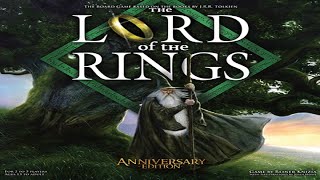
Reiner Knizia's 2000 cooperative adaptation of J.R.R. Tolkien's masterwork stands as a landmark in hobby gaming history. It arrived at a crucial moment as one of the first truly hobby-style cooperative board games, establishing tension and shared-jeopardy mechanics that would influence the genre for decades. Bower's Game Corner describes it as groundbreaking, the precursor to a whole lineage of cooperative designs. Yet, like all Lord of the Rings media, the game divides audiences. Board Gaymes James found it tense but more approachable than some alternatives, while The Dice Tower came away negative. The asymmetric powers, random encounter decks, and crushing difficulty create an experience that feels less like executing a plan and more like surviving against overwhelming odds, which, thematically, is precisely the point.
Core Mechanics That Define The Lord of the Rings
Quest Cards and the Conflict Boards
The heart of Knizia's design is playing quest cards across four thematic conflict boards: Moria, Helm's Deep, Shelob's Lair, and Mordor. Each board tests the Fellowship along multiple tracks representing fighting, hiding, traveling, and friendship. By playing cards with matching symbols, players advance along these tracks and push toward the next stage. Each Hobbit holds a unique special ability, and the cooperative nature means every decision ripples across the whole Fellowship. Published by Kosmos and Sophisticated Games, the design channels Knizia's gift for elegant, tense card play into a shared struggle.
The Corruption Track and the One Ring
Running parallel to physical progress is the corruption track, the game's signature pressure. Sauron's miniature advances toward the Ring-bearer as the Eye turns its gaze, and if Sauron ever reaches a Hobbit, that player is eliminated. The One Ring can be used to hide from danger, but repeated use draws Sauron's attention and corrupts the bearer. This dual-track threat model, balancing the Ring's corruption against the party's dwindling resources, creates constant psychological pressure. Reaching a stage destination stops the Ring-bearer while the rest of the Fellowship scrambles to keep up, producing harrowing moments where tactical superiority becomes impossible.
The Lord of the Rings Experience
A Desperate Survival Story
Playing this game feels less like controlling heroes and more like surviving an expedition. Reviewers note that the early stages are deceptively manageable, tempting players into optimism with sparse encounters and the chance to collect powerful cards. Yet as players push toward Mount Doom, the encounter cards grow vicious. Enemies layer, threats multiply, and corruption inches forward with every unlucky moment. Board Gaymes James captured the feeling of relentless pressure, noting how the related games make you feel like you are constantly dying. The tension is the experience, and it mirrors Tolkien's narrative, in which the odds of success were never good.
Memorable Thematic Moments
Despite the punishment, the game excels at creating memorable narrative beats. Slipping the Fellowship past a wall of foes at the last second, spending the Ring at a desperate moment, or watching a Hobbit succumb to corruption all land with thematic weight. These intersections of mechanics and story redeem moments of unfair difficulty. The core feeling endures: courage is finite, the road is dark, and only through collective sacrifice and precise timing can the Ring reach the fire. It is not a power fantasy; it is a survival story wrapped in cardboard.
What Makes The Lord of the Rings Stand Out
Deeply Embedded Asymmetry
Few cooperative games capture asymmetry as cleanly. Unlike Pandemic, where roles are modular, each Hobbit has an identity woven into the mechanics, and the Ring-bearer cannot deviate from the path. This restriction forces the Fellowship to work as a single unit, since you cannot save the Ring-bearer through individual heroism. You must synchronize and sacrifice. Reviewers point to this enforced cooperation as the design's enduring strength, a feature later co-op classics would echo.
Honest About Its Own Difficulty
The game also stands apart in how it handles failure: it punishes bad luck as hard as bad decisions. Board Gaymes James appreciated that the game embraces luck from the outset rather than pretending to offer a tidy strategy, calling it more friendly to parse than fiddly resource-trading alternatives. Some players find this liberating, while others find it frustrating, but the game's honesty about its desperate nature is precisely why it resonates decades after release. Boromir falls, Gandalf falls, and the Ring nearly corrupts them all, and the game makes those literary tragedies feel mechanically inevitable.
Potential Drawbacks
Limited Agency and Punishing Luck
The dice-and-card-driven nature that creates thematic tension also generates frustration. The Dice Tower's negative take reflects a real divide: if bad draws align with bad timing, the game becomes a slow march toward defeat with limited recourse. Unlike Descent: Journeys in the Dark or War of the Ring, where player decisions dominate outcomes, this game offers fewer levers. Powerful cards are rare and player abilities are limited, so less-skilled play does not meaningfully improve the odds, which can leave strategy-focused players cold.
Theme-and-Mechanics Tension
While thematically coherent in hindsight, the design can feel like a strong cooperative engine wearing Tolkien's IP. The presence of multiple Hobbits advancing across stages sits a little awkwardly against the singular nature of Frodo's quest and the Fellowship's unity. The rulebook itself acknowledges its complexity, especially in the final Mordor stage, instructing players to reread the rules when they arrive, a sign the design prioritized thematic flavor over clarity in places.
If You Enjoy The Lord of the Rings
Try Pandemic for cooperative tension with greater control, Descent: Journeys in the Dark for dice-driven fantasy adventure with asymmetric roles, or War of the Ring for a deeper, more strategic two-player take on Middle-earth. For a lighter, app-driven cooperative experience in the same world, The Lord of the Rings: Journeys in Middle-Earth blends narrative storytelling with card synergies, while The Lord of the Rings: Duel for Middle-earth offers an elegant two-player alternative.
What Reviewers Are Saying
"I like this better because it was the exact same feeling, but less stressful. I think I can conceive a win condition way easier than the other one. If we had played a little more conservatively and made a couple of different choices, it would have worked out okay for us."
— Board Gaymes James
"This game was hailed as being somewhat groundbreaking, as it was one of the first real hobby-style cooperative games, the precursor to the Fantasy Flight app-driven games that came later."
— Bower's Game Corner
"I also like that this is luck from the outset. We are rolling dice. There's no illusion of strategy. The other one had this awful system where you can trade resources, but not if you're in the same area, and only if they're the same type. This was way, way more friendly."
— Board Gaymes James