/pic3574541.jpg)










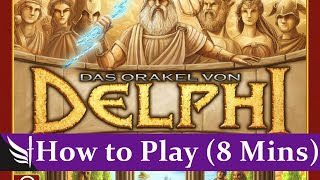


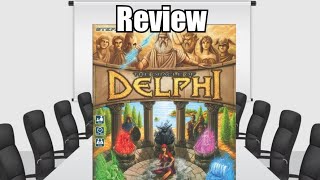




The Oracle of Delphi Deep Dive
What the Community Thinks About The Oracle of Delphi
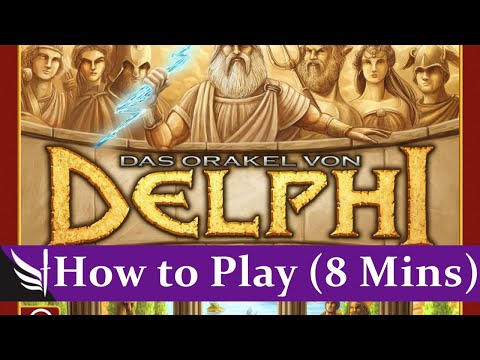
The Oracle of Delphi occupies a unique place in Stefan Feld's catalog as one of his most beloved yet underappreciated designs. Channels like Getting Games, Chairman of the Board, and Before You Play single it out as a favorite, noting that while it shares DNA with his famous Castles of Burgundy, the racing dynamic and logistics puzzle create an entirely different experience. It has won passionate advocates among competitive gamers and casual enthusiasts alike.
Core Mechanics That Define The Oracle of Delphi
Dice-Driven Action Selection
At the heart of The Oracle of Delphi sits a colored-dice system where each die's color and value determine available actions. Players roll their personal dice at the start of their turn, then spend them to move their boat across the modular Aegean map, pick up resources, fight monsters, or perform other tasks. The elegance lies in its flexibility: players can manipulate die values using favor tokens, creating a layer of mitigation against poor rolls. Designed by Stefan Feld and published by Hall Games, this transforms the game from pure luck into a puzzle of resource management and risk assessment, rewarding planning without eliminating the excitement of the dice.
Pick-Up-and-Deliver Race Mechanics
Players navigate a different island map each game, collecting statues, offerings, and monster trophies to complete a personal set of tasks assigned by Zeus. Because the board is modular and resources are scattered across discrete locations with limited capacity, players must constantly optimize their routes. The race structure creates meaningful tension: while you can see what others are attempting, the moment an opponent claims a resource or completes a task ahead of you forces dynamic replanning. No two turns feel identical, because opponents' actions perpetually reshape the landscape of available opportunities.
The The Oracle of Delphi Experience
Engine Building Through Divine Powers
As players complete tasks, they unlock god powers by advancing tokens on a shared track. These powers are genuinely game-changing: teleportation lets you jump across the map, while certain god abilities let you bypass the risky monster-fighting roll entirely. The brilliance is that players can also advance god powers during opponents' turns, creating passive investment even while waiting. This keeps everyone engaged throughout, watching for synergies to claim and evaluating when to activate their charged-up deities for maximum efficiency.
Wound Management and Push Your Luck
Each round, a black die is rolled, and if a player's shield strength is insufficient, they draw a wound card. Accumulate too many wounds and you must discard half your hand and skip a turn. This creates a secondary tension separate from the resource race: do you invest dice in shield strength to defend against wounds, or spend them on actual task completion? This balance between defense and offense gives players meaningful decisions beyond pure pathfinding.
What Makes The Oracle of Delphi Stand Out
A Feld Design That Feels Different
While The Castles of Burgundy popularized the colored-dice action system, The Oracle of Delphi proves the mechanic is far more versatile than it first appears. The race structure, combined with discrete island locations and a modular board, creates a logistics puzzle that feels nothing like other Feld designs. Players must think both strategically about long-term goal completion and tactically about immediate positioning, since opponents' moves constantly rewrite the optimal path forward.
Elegant Scaling Without Bloat
The game plays well across player counts without requiring multiple rule sets or complex adjustments. The modular board expands naturally with the count, and the shared god track keeps all players invested in each other's turns. There is little downtime, as players manage resources and consider positioning while others act. Games maintain their pace and engagement throughout, ending when a player completes all of their tasks rather than dragging to an arbitrary round limit.
Potential Drawbacks
Monster Combat as a Randomness Spike
The element that draws the most critique is fighting monsters. When attacking, players roll a die and must meet or exceed the monster's strength. While favor tokens provide mitigation and god powers can bypass the roll, this moment introduces variance that can feel disconnected from the otherwise elegant mitigation systems. Some players prefer designs where such pivotal decisions offer more control, though fans argue the uncertainty creates valuable choices about when to commit resources toward a guaranteed victory.
Availability and Out-of-Print Status
The Oracle of Delphi has been difficult to find in the secondary market, having been out of print in English for stretches. While this scarcity has perhaps contributed to its underrated status, it also means many curious gamers cannot easily experience what advocates consider one of Feld's finest works. Seeking a copy can represent a genuine commitment, as original printings command premium prices.
If You Enjoy The Oracle of Delphi
Fans of The Oracle of Delphi should explore other Stefan Feld designs, particularly The Castles of Burgundy for a kindred dice system applied to a tile-placement puzzle, and Trajan for a mancala-driven engine that emphasizes efficiency and forward planning. Bonfire shares the pick-up-and-deliver structure wrapped in a different mechanical package, offering that same satisfying logistics optimization. And for the race element combined with modular exploration, Explorers of the North Sea provides a lighter take with comparable replayability.
What Reviewers Are Saying
"My favorite tactical planning board game. In this game you are racing; you have a little boat in the middle of the Mediterranean with Greek god theming, and the idea is that Zeus has a set of different tasks that you need to do, and you just need to race and do all of those before your opponents do."
— Getting Games
"The dice mechanism with all those additional abilities, the engine building, and the race element are just such a cool combination of mechanisms and theme. I really do like it, and it just fits so well."
— Chairman of the Board
"I love every single element of this game. The one part of it, the fighting of the monsters, that can be a little bit challenging."
— Before You Play