










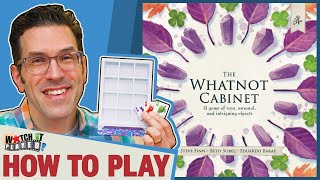






The Whatnot Cabinet Deep Dive
What the Community Thinks About The Whatnot Cabinet
Reviewers describe The Whatnot Cabinet, published by Pencil First Games, as a small and polished game that delivers a lot of decision-making in a short window of time. The praise is consistent. The Board Game Garden calls it a fantastic little puzzle that is easy to get to the table and easy to teach, and the same channel highlights its solo mode as a real draw. Dylan of All You Can Board describes it as a game that could be picked up by almost anyone and then returned to often, and places it alongside lighter strategy favorites rather than heavier euro titles.
Opinions diverge mainly on interaction and scoring clarity. Most commentators agree the game is quick, with the Good Time Society playthrough describing a session of roughly 20 to 30 minutes filled with choices on every turn. Some reviewers, however, point out that the game's interaction is fairly light. Even when players try to block one another, the overall tone tends to be relaxed rather than confrontational. The scoring system also took time to absorb during live play, which the Good Time Society playthrough documents in detail.
Core Mechanics That Define The Whatnot Cabinet
Tile Placement
The central activity in The Whatnot Cabinet is adding curio tiles to a personal cabinet. Watch It Played explains that the tiles come from a shared market arranged in action columns, and that each action lets a player draw, take, or sweep tiles before placing them in their own grid. Each placement is a decision about where an object fits, because the position of every tile determines which rows and columns will complete later. Designers Steve Finn and Eduardo Baroth built the game around this tension between grabbing the tile you need and leaving a tile for an opponent. The Good Time Society playthrough shows this clearly when one player takes a tile purely to deny a rival a completed row, a move the table promptly labels a hate draft.
Set Collection
Scoring in The Whatnot Cabinet rewards sets of matching curios, but the set is defined on two axes at once. Reviewers explain that rows score by object type, so three of the same object type or three different types can both earn points, while columns score by color. Dylan of All You Can Board describes the labeled set collection as one of the game's strongest features, and Watch It Played notes that the same tile can count toward a row and a column simultaneously. This dual scoring is what gives the game its puzzle character: a tile that completes a row may be a poor fit for the column it sits in. End-game crown icons on the tiles add a final point each, which can reward a player who has been quietly collecting them throughout the round.
The Whatnot Cabinet Experience
Gateway/Accessible
The first thing reviewers mention is how easy the game is to bring to a table. Dylan of All You Can Board says the game is going to be such an easy teach and such an easy learn, and the Board Game Garden makes the same point when it notes that the game is easy to get to the table. The rules are light enough that a first game rarely drags, and mistakes are forgiving because nothing in the setup or turn structure punishes a new player for missing a detail. Reviewers who introduce non-gamers to the hobby often list it as a good first pick, and the experience of playing it feels more like a warm welcome than an exam.
Solitary/Puzzly
Beneath the easy surface, the game feels like a personal puzzle. Players spend most of each turn studying their own cabinet, looking for the next tile that completes a row or a column. Jenna of The Board Game Garden describes the experience as calming, saying the game is very easy and very simple but still satisfying because of the drafting and arranging of small items. The feeling is less about outmaneuvering an opponent and more about arranging curiosities until the grid clicks into place. That quiet, focused satisfaction is why several reviewers describe the game as a comfort pick they return to often.
What Makes The Whatnot Cabinet Stand Out
A Solo Mode Reviewers Actually Play
Solo play is one of the features reviewers return to most often. The Board Game Garden praises the game's solo mode directly, noting that it is easy to set up and that the solo version is a real pleasure rather than an afterthought. Because the game is built around optimizing your own cabinet, the solo experience fits naturally. A solo session lets players focus on the puzzle without waiting for turns, and the reviewers who try it describe it as a relaxing way to spend a short evening.
Quick Play With Real Decisions
Reviewers consistently praise the balance between brief playtime and meaningful choices. The Good Time Society describes the game as only 20 to 30 minutes long while still packing a lot of decisions into each turn. Dylan and Carl of All You Can Board place the game in their Play It category, and they highlight its tile laying and set collection as a satisfying combination for the price and length. The game does not overstay its welcome, which is a recurring theme in how reviewers talk about its replay value.
Potential Drawbacks
Limited Player Interaction
Some reviewers note that the game offers less direct conflict than its tile market might suggest. The Board Game Garden acknowledges that players can hate draft when they choose, but observes that most of the time everyone is simply taking the tiles they need for themselves. Players who enjoy sharp, interactive competition may find the game too calm for their tastes. For groups that prefer parallel puzzle solving, this quiet style is a strength, but for others it can make the table feel less engaged.
Scoring Clarity During Play
The scoring rules are concise but easy to misapply in the moment. During the Good Time Society playthrough, the table paused for a score protest over whether rows score objects and columns score colors, and a player had initially scored a row with the wrong criteria. The reviewers agree that the explanation in the rulebook is clear once it is absorbed, but the mix of row and column rules for objects and colors means a first game may require a second look at the scoring summary before everyone is confident.
If You Enjoy The Whatnot Cabinet
Players who enjoy The Whatnot Cabinet's tile placement and light set collection will find similar satisfaction in Patchwork, which reviewers have repeatedly compared to the game for its compact puzzle feel. Dylan of All You Can Board also points to Lost Cities, Seven Wonders Duel, and Cafe as games that are not complicated to teach yet still offer enough strategy to make players return. For fans of its action-based turn order, where the choice of action determines what tiles become available, King Domino offers a related sense of building a tidy personal layout while managing what the table leaves behind.
What Reviewers Are Saying
"It is such a fantastic little puzzle. I love this game so so much. It's easy to get to the table, it's easy to teach and you can also play this one solo."
— The Board Game Garden
"...is a really simple game, honestly. It's going to be such an easy teach, such an easy learn."
— Dylan, All You Can Board
"I love putting things into nice orders and patterns. I just love to organize. Give me a game that organizes. And this is literally a game about organization."
— Good Time Society