





































The White Castle Duel Deep Dive
What the Community Thinks About The White Castle Duel
When The White Castle Duel was announced, skepticism was the natural first reaction. The original White Castle already plays beautifully at two players, and the board gaming community has watched a wave of two-player spin-offs arrive with mixed results. The Cardboard Herald put the central doubt plainly: "the big question when White Castle Duel was announced was why do we need this?" That question now has a satisfying answer, and reviewers who have spent time with the game have come away impressed that Devir and designers Isra and Shei have delivered something that justifies its own existence rather than simply repackaging the original in a smaller box.
The consensus from reviewers who have played it is that The White Castle Duel is not a lesser version of its parent game. It is a condensed, tightly sculpted alternative that trades expansiveness for intensity. Rahdo describes it as "absolutely fantastic" and declares it "does not disappoint." The Cardboard Herald calls the game "just as crunchy, just as maddening, just as puzzling as the original, but in a much, much tighter shell." Before You Play, who ranked it fourth among their most anticipated games at Essen 2025, capture the broader feeling: a duo who "almost exclusively play the White Castle at two players" were genuinely curious what a purpose-built two-player redesign could offer, and the answer turns out to be quite a lot.
Core Mechanics That Define The White Castle Duel
The Lantern Token Placement System
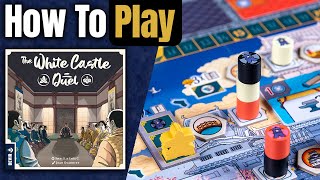
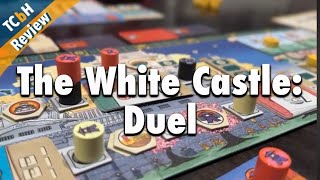
The most commented-on design innovation in The White Castle Duel is its colored worker placement system, which replaces the dice-rolling of the original game with lantern tokens in three colors: black, orange, and white. On each turn a player places one of their colored tokens onto a location on the main board, but placement is governed by a strict constraint: the token you place must be a color not already present at that location. No location can hold more than three tokens, and all three must be different colors. This creates a constantly shifting puzzle where the availability of any given spot depends on what you and your opponent have already placed.
Rahdo captures why this feels so alive: "the actual space that I can send my workers is constantly shifting based on what I and my opponent do, what we end up covering up on the board." The color you cover also determines which personal lantern area activates, triggering accumulated bonus rewards. Every placement is therefore two decisions at once: which action to access, and which lantern to fire. The game is played over two rounds: in the outgoing round, players place tokens onto the board; in the return round, they retrieve the top token from any stack and activate the lantern of that color. The Cardboard Herald calls this "a brilliant twist of organic game state development," noting that the board state built in the first half becomes the resource the second half consumes.
Resource Tracks, Influence Cards, and the Scoring Web
Beneath the placement system lies an interconnected scoring puzzle. Each player manages three resource tracks on their personal domain board: food, iron, and mother of pearl. Spending food places clan seals in the garden; iron places them in the training yards; mother of pearl advances the courtier along the social climbing path. The two actions available on any given turn are those adjacent to wherever the token was just placed or retrieved, so the positioning of every move determines which part of the engine gets fed.
Influence cards, purchased from three castle decks, sit at the heart of the scoring web. Each card has two faces: a purchase face with an immediate effect, and a back face carrying scoring icons such as flags, katanas, kabutos, and origami cranes. Cards only contribute to end-game scoring after being flipped through an "improve" action, and since the whole game unfolds over twelve turns, finding time to both buy and improve cards is a persistent tension. The Cardboard Herald describes feeling "pressured to take flip actions before the game runs out," and that pressure is what gives the experience its relentless focus. Flags multiply against the courtier's height on the social climbing path, katanas and kabutos multiply against clan seals in the training yards, and blue and white origami cranes multiply each other. Recognizing which combination to pursue, and which multipliers to build, is the strategic core.
The The White Castle Duel Experience
Dense Decisions in a Short Game
The Cardboard Herald describes the experience as "a tighter knot of blissfully agonizing opportunity cost, condensed and compacted." This is not a casual filler. With six turns per round and twelve in total, every action carries real consequences. There is no recovery round to regroup: each turn demands a decision on which colored token to place and where, which lantern area fires, and which two adjacent actions to take. Rahdo calls the puzzle "awesome," pointing to the constraint that forces creative routing: you want to land on a color your lanterns are invested in, but you cannot place a worker on a spot already showing that color, so the board constantly reframes what is possible. The multipliers compound only when several systems are developed together, which means passive play is almost always losing play.
Direct Confrontation and a Shared Board State
Unlike the original White Castle, which The Cardboard Herald describes as sometimes feeling like parallel solitaire when played at two, the Duel version builds direct confrontation into its structure. Every token placed is potentially blocking a spot the opponent needed. Every token retrieved in the return round is one fewer option for your opponent. The Cardboard Herald observes that "there's a distinct sense that everything you do impacts the board state for your opponent in ways present, if not fully prevalent, in the OG." This creates a qualitatively different emotional texture: rather than optimizing against a static puzzle, players are optimizing against a living opponent who is actively reshaping the available choices.
The Cardboard Herald notes that a close gaming partner found The White Castle Duel more compelling than the original because "there feels like just as many ramifications, but fewer sandbox choices and more direct consequences of individual actions." The Before You Play hosts anticipated as much before playing, expecting "a little bit more interactive and more restrictive" experience because "you're kind of going head-to-head," and post-release reviews confirm that instinct was correct.
What Makes The White Castle Duel Stand Out
A Companion to Its Parent Game, Not a Replacement
The question reviewers wrestle with is not whether the game is good, but when to reach for it over the original. The Cardboard Herald frames the answer as tonal: the original rewards leisurely strategic development across a broader action space, while the Duel rewards surgical precision in a compressed window. Neither obsoletes the other. Rahdo agrees, noting that while the Duel is "much simpler" and "a much more straightforward game," the simplification does not mean triviality. The game still demands engagement with multiple interlocking systems, and the compressed turn count means a few well-placed decisions can swing the outcome dramatically.
Variable Setup and Replayability
The rules walkthroughs from the Dice Tower and kovray both reveal a meaningful level of modularity. Activation tiles, location tiles, garden tiles, training yard tiles, and social climbing tiles are all placed randomly or drawn from shuffled stacks, and even the starting resources are drafted between players. This variability means the spatial configuration of available actions shifts with every setup, so players who know the scoring systems well still face a fresh routing puzzle each game. No two sessions play out the same.
Potential Drawbacks
No Solo Mode and a Narrow Player Count
The White Castle Duel is strictly a two-player game with no solo mode. Rahdo flags this plainly: "two-player only, no solo mode, sadly." The original White Castle accommodates one to four players with a solo variant, making it far more flexible on the shelf. The Duel is purpose-built for exactly one scenario: a head-to-head session for two players. Before You Play acknowledged the constraint but saw the brief runtime as a bonus given their circumstances, noting "20 to 40 minutes sounds great to us, especially with a baby coming."
The "Why Do We Need This" Question
Even among reviewers who enjoy the game, the question of shelf justification lingers. The Cardboard Herald states directly: "Is it better than the original White Castle? No, I don't think so. The original is more flexible. It's more robust. And in some ways it's less pressure." The compression that makes the Duel feel intense also strips away the breathing room that longer strategic games reward. Players who fall behind on a key multiplier track early may find the remaining turns do not provide enough runway to recover. For anyone who already owns and plays the original regularly at two, the tonal difference is real but may not be sufficient to justify adding a second box.
If You Enjoy The White Castle Duel
If the focused two-player intensity of The White Castle Duel resonates with you, the natural next conversation is the original The White Castle, which expands the same thematic world into a more sprawling, dice-driven engine builder that accommodates up to four players. Reviewers who love the Duel often describe the original as the richer, more leisurely sibling, worth exploring if you want more runway for long-term planning and a broader action space.
The other comparison that comes up organically in discussion is Splendor Duel, the two-player-only adaptation of Splendor. Like The White Castle Duel, Splendor Duel takes a game that already worked at two and redesigns it from the ground up for that player count, introducing mechanics specifically tailored to head-to-head play that change the feel substantially from the original. Players who enjoyed what Splendor Duel did for its source material are likely to appreciate the similar philosophy at work in The White Castle Duel.
What Reviewers Are Saying
"It is just as crunchy, just as maddening, just as puzzling as the original, but in a much much tighter shell. If you like high octane euros and you don't want them to always take a bunch of time and you like things that are sculpted to precision, especially that are going to accommodate two players, then the White Castle Duel really does something that is different than the original and justifies its own existence."
— The Cardboard Herald
"The puzzle of this game is awesome. I'm just here to say right now, folks, this does not disappoint. There is so much to recommend here. It's absolutely fantastic."
— Rahdo Runs Through
"The question I keep coming back to is when am I going to choose this versus the original? The obvious answer is when I want a dense, nuanced Euro I could still tackle in 30 minutes. There's something really distilled about Duel. And like the best Duel adaptations before it, it encourages directly confrontational, if not fully combative, player interaction."
— The Cardboard Herald