





The Witcher Adventure Game Deep Dive
What the Community Thinks About The Witcher Adventure Game
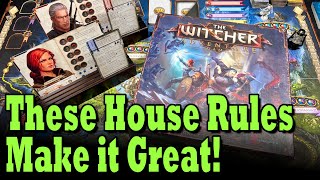
Opinion on this Fantasy Flight release splits along the lines of how each reviewer came to it. A community reviewer who bought the game after looking for a solo or co-operative option came away enthusiastic, and most of that enthusiasm is directed at fan-made co-operative rules rather than the printed game. The Getting Games channel covered the game as one of several convention impressions. It spent a session with three players and enjoyed the experience, though it did not sound eager to rush out and buy a copy. The Dice Tower, reviewing the game in a roundup of older mid-weight titles, reached a clearly cooler verdict and said the game had not aged well. What all three agree on is that the box is attractive and the game is full of content. They disagree on whether that content adds up to satisfying turns.
Core Mechanics That Define The Witcher Adventure Game
Character development decks
Each of the four characters has a personal deck of abilities. On a turn a player can spend one of their two actions to develop, which means drawing two cards from that deck and keeping one. The community reviewer explained that Triss's spells are powered up with tokens and then spent for their effects, while Geralt's potions and Witcher signs follow the same pattern. Getting Games stressed that development is available from the first turn, so a player does not need to win fights before gaining a new skill. That early access is what makes the game feel like building a character rather than only collecting points.
Dice-based combat against creatures
When a player faces a creature, they roll a set of battle dice plus their character's own dice, then count swords and shields against the creature's attack and defense values. Failures cost damage, and damage limits which actions a character can take until they rest. The community reviewer called this approach simple and effective, because it conveys conflict without the bookkeeping of hit points. Creatures come in bronze, silver, and gold tiers, which signal how much risk each fight carries. The combat is central to the game, and reviewers judged it by how quickly it resolves.
The Witcher Adventure Game Experience
Brisk, snappy turns
Because each turn has only two actions, the game moves quickly, and Getting Games noticed that a player comes back around soon after their turn ends. The same channel pointed out the flip side: a turn can end with a move and a rest, which leaves a player feeling they achieved little. The community reviewer found the combat especially snappy and said it never overstays its welcome. Together these comments describe a tempo that feels light and quick, sometimes to the point of thinness.
Mounting pressure in co-operative play
The fan-made co-operative rules change the feel of the game more than the printed rules do. Players share one pool of victory points that starts at 20, and each turn spends points from that pool. As the war track advances, every turn gets more expensive, and running out of points means the group loses. The community reviewer described the result as a constant need to balance monsters, quests, and time, and said the change keeps all of the base game's activities in place. The pressure comes from the costs rising over time, not from an external timer.
What Makes The Witcher Adventure Game Stand Out
Characters that play differently
Each character converts gathered leads into proof at a different rate, so a character that is strong in one area is weaker in another. Each also draws from a quest deck tied to a particular color of lead. Geralt focuses on combat quests, Triss on magic, and Dandelion on diplomacy, while Yarpen can choose between two decks. The community reviewer said these differences give every character a distinct way to approach the same map. This asymmetry is the feature reviewers returned to most often when they described why the game feels personal.
Support quests that pull rivals together
Every character has a main quest, side quests, and a support quest. A support quest can be advanced by a rival who shares the character's space and spends the required currency, so players sometimes help each other inside a competitive game. The community reviewer said this "does kind of simulate that cooperative nature that these characters would have even though this is a competitive game." Getting Games observed that a helper can also gain points from the favor, so the cooperation is not purely selfless.
Potential Drawbacks
Thin rewards for much of the fighting
Getting Games found that combat often gives little in return, especially against the lowest-tier creatures, and that the meaningful rewards come mostly from the higher tiers. The same reviewer felt that a turn could pass with nothing gained, which undercuts the sense of progress that the development decks create. Players who enjoy steady rewards may find the early fights unsatisfying. The concern is less about difficulty and more about how little some fights appear to pay back.
Parallel play and a fading first impression
Getting Games described the competitive game as relatively close to multiplayer solitaire, because players mostly run their own quests on the board and only occasionally interact. The Dice Tower reported that its initial, high ratings did not survive a closer look and said the game does not hold up well. Those two points suggest that the game can feel like a set of separate journeys that converge at the end, and that the appeal may fade once the novelty of the characters wears off. Groups looking for constant player interaction may be disappointed.
If You Enjoy The Witcher Adventure Game
- Runebound Second Edition: The community reviewer plays this competitive adventure game solo and treats it as a comparable experience, so it is a natural next step for anyone who wants travel, encounters, and quests in a similar framework.
- Talisman: Also named by the community reviewer as a competitive adventure game that works well alone. It suits players who want a classic adventure-board feel with a competitive finish.
- The Witcher: Old World: The community reviewer compared the two directly and found this game's brighter art more faithful to the look of the video games. Old World is the choice for players who want the same universe with a different design approach.
What Reviewers Are Saying
"It doesn't take away anything. It barely changes anything. It just adds to the experience."
— a community reviewer
"...often times it feels like you don't really get much for those monsters especially the lowlevel ones but you get victory points for the higher ones in general."
— Getting Games
"Our initial ratings of this game were high, but it just did not stand up very well. This is when Fantasy Flight was huge."
— The Dice Tower