/pic8037086.jpg)





























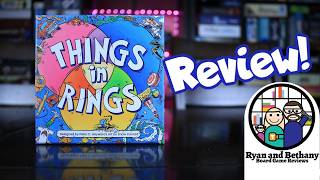
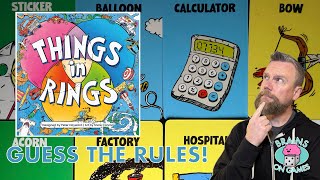

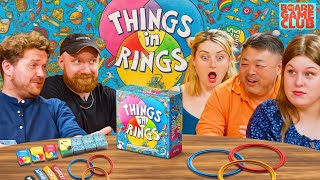




Things in Rings Deep Dive
What the Community Thinks About Things in Rings
Things in Rings stands as a truly polarizing experience among board gamers, a game that reviewers either embrace as a creative marvel or find entirely confounding. The design's uniqueness clearly resonates with players seeking something genuinely different from standard deduction games, yet this very uniqueness creates a clear divide in audience reception. Across multiple gameplay contexts and reviewer groups, a consistent pattern emerges: players either discover an engaging puzzle that keeps their minds active throughout, or they feel completely lost trying to decipher hidden rules. The game succeeds brilliantly at what it sets out to do, but reaching that success requires the right combination of player mindset, group dynamic, and initial difficulty selection.
Core Mechanics That Define Things in Rings
The Venn Diagram Deduction System
At its heart, Things in Rings revolves around a deceptively simple structure: one player serves as the Knower, holding the secret rules for how cards should be placed into three overlapping rings. The other players must deduce these rules through trial and error, attempting to empty their hands of cards by placing them in the correct positions within the Venn diagram. The three rule categories remain consistent across games, the word rule (relating to spelling, sound, or letter patterns), the attribute rule (relating to physical properties like size or material), and the context rule (relating to where something is found or how it's used). However, the specific rules chosen within each category vary tremendously, creating endless combinations that keep players engaged across repeated plays. When a player places a card incorrectly, the Knower moves it to its proper location, providing valuable information that gradually narrows the possible rules.
The Difficulty Scaling Through Rule Selection
The game provides three difficulty levels, easy, medium, and hard, through the selection of rules from corresponding decks. Easy rules might be straightforward patterns like "has a double letter" or "made of wood." Hard rules venture into subjective territory that tests not just deductive reasoning but also judgment calls about what constitutes a valid fit. This scaling mechanism allows groups to find their exact challenge level, though even experienced players report that hard mode rules can blur into genuinely ambiguous territory that challenges the Knower's ability to adjudicate fairly. The beauty of this system lies in its flexibility: the game remains engaging whether played competitively or cooperatively, and even within the competitive mode, players find themselves genuinely rooting for others to solve the puzzle rather than adopting an adversarial stance.
The Things in Rings Experience
The Gradual "Aha" Moment That Defines Success
For players who connect with the game, the experience culminates in a deeply satisfying moment of recognition. The first portion of any round typically feels chaotic, cards are placed seemingly at random, and the rules remain utterly opaque. But somewhere in the middle game, something shifts. A player notices a pattern emerging, sees multiple cards of a certain type clustered together, and suddenly begins to form hypotheses about what those clusters mean. This isn't a moment of complete certainty; it's more a collection of intuitive hunches based on accumulated information. Players describe feeling confident enough to place cards without necessarily being able to articulate exactly why those placements feel right. The game rewards pattern recognition and probabilistic thinking more than explicit logical deduction.
Social Dynamics and the Role of the Knower
A fascinating social dimension emerges when examining how players experience the Knower role. Rather than encouraging antagonistic play where the Knower deliberately obscures information or tries to trick other players, the game's structure naturally creates a collaborative dynamic. The Knower becomes an informant and referee simultaneously, confirming correct placements and providing corrective information when players go astray. This creates an unusual party game atmosphere where the person "in power" actively wants others to succeed. Even in competitive modes, players report feeling invested in whether other players finally crack the code. The game also invites considerable flexibility in how seriously groups treat the subjective elements of hard-mode rules, some groups embrace debate and discussion, while others allow the Knower's judgment to stand unquestioned, creating very different social experiences from the same base rules.
What Makes Things in Rings Stand Out
Visual and Thematic Cohesion Through Dr. Seuss Inspiration
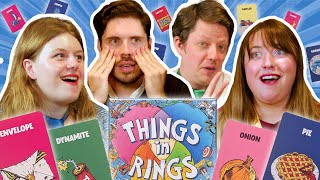
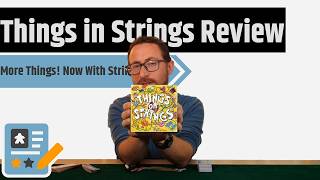
The game's visual presentation serves as one of its strongest selling points, creating an immediate sense of charm and invitation. The Dr. Seuss-inspired artwork isn't merely aesthetic window dressing; it creates a cohesive, whimsical atmosphere that makes the game feel approachable and fun despite its mental demands. The card illustrations are distinctive, colorful, and thematically varied, drawing from a wide range of objects and concepts. This visual distinctiveness actually aids gameplay, as players can more easily remember what specific cards looked like and recall where they were placed in previous turns. The string-based physical component of creating the Venn diagram adds tactile satisfaction and visual clarity that transcends typical card game presentation. Reviewers consistently highlight how simply seeing this game set up on a table draws curiosity from onlookers, making it an excellent conversation starter at game events or casual gatherings.
The Party Game That Actually Engages Analytical Minds
Things in Rings occupies a rare niche in the party game landscape, it's genuinely simple enough to teach in minutes, yet strategically deep enough to sustain interest across multiple plays. Unlike games built primarily around humor, luck, or random outcomes, Things in Rings offers consistent intellectual engagement throughout. This creates an unusual dynamic where the game appeals simultaneously to serious gamers seeking analytical challenges and casual players looking for something fun and not overly complex. The game doesn't punish players for uncertainty the way purely logic-based deduction games might; players can make educated guesses and still progress meaningfully. The removal of explicit time pressure, beyond what's imposed by turn structure, allows players to think through their decisions without stress, making the experience less about reflex and more about genuine deduction.
Potential Drawbacks
The Experience Can Depend Too Heavily on Knower Competence
The game's success relies fundamentally on the Knower's ability to maintain consistent, fair rule application throughout the round. If the Knower misunderstands their own rules, changes interpretations mid-game, or struggles with edge cases, the entire experience can collapse into frustration for other players. Harder difficulty rules, in particular, invite genuine ambiguity, is something "found in a house" if you might theoretically keep it there? Does a rule about being "flammable" apply when nearly everything could technically catch fire under extreme conditions? These edge cases emerge frequently enough that they demand careful Knower judgment. Groups that play multiple times with the same Knower eventually build understanding about how that particular person interprets fuzzy rules, but new Knowers can create unpredictable results. This makes the game somewhat dependent on group dynamics and willingness to collaboratively navigate ambiguity rather than treating adjudication as purely objective.
The Learning Curve Can Exclude Players Who Lack Inductive Reasoning Confidence
For players who don't naturally gravitate toward pattern recognition and inductive reasoning, Things in Rings can feel genuinely frustrating. Some reviewers report that the game makes them feel inadequate during play, despite trying their best, they struggle to form meaningful hypotheses about the hidden rules and spend the entire game feeling lost. The first few rounds, where information is genuinely sparse, can feel discouraging to players accustomed to games with clearer feedback mechanisms. Unlike deduction games where players might logically eliminate possibilities, Things in Rings requires a more intuitive comfort with uncertainty and pattern recognition. Additionally, if a group moves too quickly into medium or hard difficulty without spending sufficient time on easy mode, newer players can be overwhelmed before they develop the confidence and skill to engage with the game's core appeal. The game clearly isn't for everyone, and forcing it on players who actively dislike the experience rarely converts them into fans.
If You Enjoy Things in Rings
Players drawn to Things in Rings typically appreciate Code Names for its collaborative deduction elements, though they'll note that Code Names involves less uncertainty about correctness. The party game appeal also intersects with Detective Club, which similarly creates a deduction atmosphere through hidden information, though from a different mechanical foundation. For those who loved the Venn diagram structure specifically, Cascadia and other spatial arrangement games offer similarly satisfying puzzle-solving through completely different mechanics. The general appetite for "thinking party games" might lead to Wavelength for group guessing, Harmonies for pattern-based collaborative play, or even light deduction games like Love Letter that reward reading other players. Players who specifically valued the quirkiness and uniqueness of the concept might explore the wider catalog of small box games from All Play Games, including Gingham and Gazebo, which offer similarly innovative experiences in compact formats.
What Reviewers Are Saying
"I really really really enjoyed it... this is a very one of the more creative party games especially that I played in a long time and I'm not typically a huge fan of word games but just the entire package of this it's so small the artwork is really really cute."
— Before You Play
"I love this game. It's so fun. I think it's a hoot. I think it's a really good party game and I love the Dr. Seuss art style to it... they just nailed the art style like everything feels so cohesive and just funny and silly."
— The Cardboard Herald
"This is such a good party game. Easy to play game. Affordability, accessibility, all those things. It is very different than other games... I have so much fun with this game."
— BoardGameCo