/pic6349029.png)









































Three Sisters Deep Dive
What the Community Thinks About Three Sisters
Reaction to Three Sisters leans strongly positive, with reviewers circling back to its tight rules and quick setup as the biggest draws. Board Game Critique called it an elegant roll-and-write that flies under the radar compared to bigger releases, praising how a session opens with two pads of sheets, some dice, and a pumpkin token, done in a few minutes with zero friction. Bethany of Ryan Board Game Reviews has kept the game in regular rotation since naming it one of her top ten titles the year it came out, and found the solo mode delivered everything she wanted from the multiplayer version, calling it good enough to bring along on a lunch break instead of a book. Ilia and Tyler, who cover the wider family of roll-and-write games from the same design team, rank Three Sisters as their favorite of that group and single out its garden theme as the most convincing of the bunch.
Not every voice is uncritical. Tabletop Tokki placed Three Sisters on a list of games that did not fully deliver on expectations, arguing that for the investment of time the combos did not unlock with the satisfaction the genre usually offers, and pointed viewers toward French Quarter and Loron instead. Ilia and Tyler, despite ranking the game highly, flagged that its interconnected tracks can become overwhelming to keep straight without deliberate note-taking. The split mostly concerns how much long-term depth the design offers once its combo paths are learned, rather than whether the core loop is enjoyable in the first place.
Core Mechanics That Define Three Sisters
Dice Drafting Around a Garden Rondel
A shared pool of dice is rolled based on player count, and players take turns picking individual dice from that pool. Board Game Critique described the loop plainly: players roll dice based on player count, take turns picking dice groups, and perform a garden action alongside a rondel action each turn. Taking a die you want denies it to whoever drafts next, which Board Game Critique framed as the game's most direct form of player interaction, calling it competitive without being mean or personal, since grabbing a die is felt by the table but never targets an opponent's board state specifically.
Farmer Edith and Interconnected Tracks
Ilia and Tyler noted that the dice drafted each round follow a board where Farmer Edith leads the way, and Bethany described how Farmer Edith drafts from the same pool in solo play, scratching off sections of a player's garden and interfering with their plans, while the rulebook frames her as kind-hearted rather than adversarial. Board Game Critique tied the mechanic to the game's combo engine, explaining that garden choices directly affect what a player can access on the shed track, which in turn opens perennial tracks that multiply future harvests, so a slow start in the early rounds can cascade into a run of bonuses later in the game.
The Three Sisters Experience
A Fast, Low-Friction Sit-Down
Board Game Critique measured the whole experience against heavier competitors and landed on speed and simplicity as the defining feeling: open the box, grab two pads, some dice, and a pumpkin token, and be playing within minutes, with no scratch-off card areas or component sorting to manage first. That same reviewer found the game easiest to teach to new gamers of the titles they compared it against, and said friends who do not play regularly enjoyed it immediately and wanted to play again. Bethany echoed that accessibility from a different angle, noting that once she already knew the rules she could jump straight into the solo variant without relearning anything, keeping the reference page open only for the automated opponent's behavior.
The Pull of the Garden Theme
Ilia and Tyler ranked Three Sisters ahead of the rest of its family specifically for theme integration, pointing to how planting, seeding, and watering all make sense together in the garden, and how contributing to the apiary and planting fruit trees feels like nurturing something that grows across the game rather than an abstract point engine. The Board Game Garden's livestream sessions carried that same enthusiasm into the Harvest Edition's campaign chapters, working through modules like Groundhog Trouble and a giant pumpkin scenario, with the streamer describing a renewed love for the game after a break, calling the design one of her top ten roll-and-writes overall.
What Makes Three Sisters Stand Out
Exceptional Value and Accessibility
Board Game Critique repeatedly returned to price as a selling point, noting the game runs in the twenty-two to thirty dollar range against far pricier competitors while still delivering comparable enjoyment for a handful of plays, and calling it the slam dunk choice for a group that plays casual games rather than an optimization-focused table. That reviewer summarized the pitch directly: buy Three Sisters if you want exceptional value and elegant design in thirty to sixty minutes, especially at two players or as a gateway before a heavier box.
The Harvest Edition's Modular Campaign
Jamie of Tabletoptiktok called the Harvest Edition fantastic, explaining that it spreads new content across twelve chapters that are not tied together as a legacy game, so modules can be mixed, matched, or skipped once introduced, and every chapter is compatible with solo play. Grant Lyon framed the release as a standalone replacement for the original game rather than a simple add-on, noting the base chapter is unchanged while later chapters can be folded back into any regular game once unlocked. The Board Game Garden's stream backed that up in practice, working through specific chapters like Groundhog Trouble and finding each one added a genuinely new focus without changing what already worked about the base game.
Potential Drawbacks
Overwhelming Combo Tracking
Ilia and Tyler were candid that their biggest issue with an otherwise favorite game is how overwhelming it gets to follow the combos and keep track of everything happening across the interconnected tracks, unless a player is actively jotting notes in the game's journal section or circling and crossing out stars as they go.
Small Components and a Ceiling for Optimizers
Board Game Critique flagged that the pads are dense and small, and that players with vision concerns genuinely struggled to read the grid. The same review cautioned that the design caps out after a couple of plays for an optimization-focused gamer, since the eight rounds are tight and the combo paths become visible once a player has solved the puzzle once. Tabletop Tokki raised a related concern from the base game, arguing that for the amount of investment the game asks for, the combos did not unlock with the same satisfaction as similarly weighted alternatives.
If You Enjoy Three Sisters
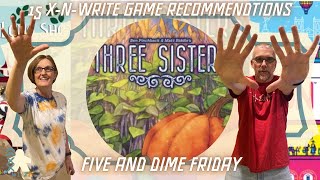
Board Game Critique placed Three Sisters directly alongside Tend and Stardew Valley in a head-to-head comparison, recommending it as the pick for casual game nights while pointing devoted optimizers toward the heavier Tend. Ilia and Tyler, who cover Three Sisters as part of the same designers' broader catalog, rank it alongside Fleet the Dice Game and Motor City as favorites within that family of roll-and-write games. Tabletop Tokki, less satisfied with how the combos in Three Sisters land, suggested French Quarter and Loron as alternatives that scratch a similar itch with more combo payoff per action.
What Reviewers Are Saying
"Three Sisters, though, that's a game that understands elegant complexity. Eight rounds, super simple turn structure. You roll dice based on player count. You take turns picking dice groups and performing a garden action in a rondelle action."
— Board Game Critique
"Three Sisters I really really like. The only issue I have with it, it gets very overwhelming following the combos, following anything that you're actually doing, maintaining and not missing things is something that can happen in Three Sisters."
— Ilia and Tyler
"Three Sisters, for the amount of investment and time that you spend with the game, didn't feel like it was as satisfying with unlocking those combos. So, if you're looking for a game that's similar weight, similar production, it uses cards instead of dice, but French Quarter is one that I did really enjoy."
— Tabletop Tokki