/pic8586892.png)















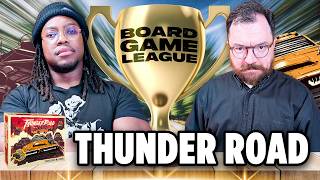











Thunder Road: Vendetta Deep Dive
What the Community Thinks About Thunder Road: Vendetta
Thunder Road: Vendetta has become one of those rare games that generates genuine enthusiasm across wildly different types of players. Banter and Boards describes it as a game that "brings families together and turns game night into the highlight of the week," while Board Game Animal placed it among their all-time favorite games and even sang a song in its honor. Rolls in the Family's Ryan called it "the MadMax Fury Road, the board game," praising its pure fun experience and solid game system working together to create consistently exciting moments. No Rolls Barred captures the spirit well: once the rules click, this is a game where players become genuinely invested in every collision, every dice roll, and every cascading slam.
Not everyone falls head over heels immediately. The Board Gaming Doctor offers a measured perspective: a pleasant experience, but one that felt better as an occasional pull-off-the-shelf game rather than a weekly staple. His main reservations center on the high luck factor and the potential for player elimination to leave someone watching from the sidelines. These are real concerns, and honest reviewers name them. But even those with reservations tend to close with some version of "I'd play it again with the right group," which says something important about the game's fundamental appeal.
What makes the community conversation around Thunder Road: Vendetta so interesting is how it crosses category lines. Self-described Euro gamers enjoy it. People who love heavy strategic games enjoy it. Parents play it with young children. Groups that never heard of the 1986 Milton Bradley original find themselves charmed by a revival they did not know they needed. Restoration Games, the publisher behind Unmatched and Return to Dark Tower, has earned a reputation for taking older games and giving them thoughtful modern design upgrades, and Thunder Road: Vendetta is widely seen as one of their best examples.
Core Mechanics That Define Thunder Road: Vendetta
The Dice Assignment System
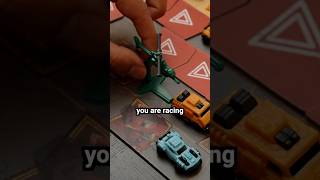
At the heart of every round is a deceptively elegant decision engine. Each player rolls four dice at the start of a round and then spends those dice across three turns, assigning one die per turn to one of their three cars (a small, medium, and large vehicle). The value on the die becomes that car's movement for the turn. A fourth die can be spent once per round to activate a command: Nitro for bonus movement, Drift to ghost through another car, Repair to remove damage, or an Air Strike to deploy a helicopter.
What reviewers praise about this system is how much texture it packs into a simple rule. Because the dice are fixed at the start of the round (no re-rolling between turns), players are constantly weighing which car gets which die value and when. No Rolls Barred's Adam describes the strategic texture with genuine enthusiasm: there is something meaningful about keeping the balance of your three cars, deciding whether to send the large car out front as a battering ram while sneaking the small car down a side lane where choppers and opponents tend to ignore it. Rolls in the Family's Ryan zeroes in on the same appeal: the game has "the toy factor of just playing with fun little toys and seeing what happens, but it's got a very solid game system behind it that increases the odds of having interesting situations."
Slams, Hazards, and Chain Reactions
Movement on the modular road board is only part of the picture. When one car drives into a space occupied by another, a slam occurs: two dice determine which car gets displaced and in which direction. The larger vehicle can demand a re-roll, giving big cars a meaningful advantage in collisions. Hazard tokens placed face-down across the road hide oil slicks, mud patches, mines, and wreck debris, revealing their effects only when a car drives over them.
This is where the game's chaos earns its reputation. Banter and Boards notes that the slam mechanic can set off spectacular chain reactions: one car drives into another, which slams into a third, which lands on a helicopter space and gets instantly eliminated. It creates a chaotic mess that feels different from the last game you played. Rolls in the Family's Ryan describes the same quality: "I love the slam mechanism and how when you slam people it's more likely it's going to slam the bottom car, but it might slam you, and whoever has the bigger car could ask for a re-roll because that's the advantage of being the larger vehicle." The damage token system adds another layer of surprise: when a car takes damage, the player flips a token that might cause a skid, send shrapnel into nearby vehicles, or even blast the car airborne to land on a random space far away.
The Thunder Road: Vendetta Experience
Controlled Chaos
Thunder Road: Vendetta occupies an unusual space: it is a roll-and-move game that earns genuine respect from people who normally dismiss roll-and-move games. The key is what Rolls in the Family's Caitlin articulates clearly: "it does feel a little bit controlled. It's not quite like Galaxy Trucker where you build your ship and then you just go fly and get obliterated. There is a little bit of sense of controlled chaos where you can choose to run into someone and cause chaos, or you could choose to try to play it a little safer and go off on your own." The meaningful decisions (which car gets which die, when to activate a command, whether to use the road bonus, when to deploy a chopper) keep players engaged even as the dice churn out surprises.
Board Game Animal describes the experiential appeal directly: "you don't take it too seriously, you aim the chaos, and you have a blast. Ultimately a roll-and-move game shouldn't be this fun, but it is." The post-apocalyptic Mad Max theme, the battered miniature vehicles, the dramatic moment when a chopper descends onto the highway, all of it encourages players to lean into the spectacle rather than fighting against it. The Board Gaming Doctor notes that reviewers praised how people get really invested in what is going on with the board, comparing the roleplay investment to something approaching a Dungeons and Dragons session.
Table Energy and Accessibility
One of the most consistent observations across reviewers is how quickly new players get on board. Banter and Boards highlights what makes this work as a gateway game: the objective is clear, everyone understands where they start and where they need to end, the fastest one to get there wins, but you can create havoc along the way. The rules teach quickly, the turns resolve fast, and the shared spectacle of crashes and chain reactions pulls everyone into the moment even when it is not their turn.
Rolls in the Family's Ryan makes a point that comes up in several reviews: setting expectations correctly is important, especially for newcomers. It is not uncommon for a car to get eliminated on the very first turn, and players who are not prepared for that level of early volatility can feel the rug pulled out from under them. With the right framing, that same early chaos becomes the game's biggest selling point: every turn is a potential disaster or a spectacular triumph, and no one knows which until the dice land.
What Makes Thunder Road: Vendetta Stand Out
Nostalgic Design with Modern Sensibilities
Thunder Road: Vendetta is a reimagining of the 1986 Milton Bradley game Thunder Road, and Restoration Games has built their reputation on exactly this kind of thoughtful revival. Board Game Animal describes what Restoration does in general terms: they are the board game publisher making your childhood dreams come true, delivering games that feel like the ultimate toy box experience but with actual in-depth strategy and tactics. Rolls in the Family's Ryan adds that the appeal of Thunder Road specifically is how it hearkens back to an older style of board games while incorporating modern design sensibilities that make it genuinely better. The Board Gaming Doctor notes that for players with nostalgia for that era, the game brings back the thematic spirit while feeling fresh rather than dated.
The modular board system means every session runs on a different stretch of post-apocalyptic highway, with hazard tokens distributed randomly at the start of each new road tile. No two games build the same geography of disasters. Add to that the expansions and modules available (particularly in the Maximum Chrome deluxe edition), and the replay potential grows substantially. Board Game Animal's enthusiasm for the full version is unrestrained: "you really don't often see a game that has this many modular expansions and add-ons where everything isn't just good, it's magnificent." The Chop Shop expansion, which introduces asymmetric driver abilities and car upgrades via card drafting, draws special praise for how it personalizes each team of vehicles without significantly increasing play time or complexity.
The Three-Car Convoy Dynamic
Having three cars of different sizes is not just a cosmetic feature. It creates an ongoing strategic conversation throughout every game. The small car is the hardest to shoot (the shooting die needs to match the target's size, making smaller vehicles harder to hit), and it can slip through gaps in the traffic. The large car excels at initiating slams and can demand re-rolls of the slam dice, giving it bully-on-the-road advantages. The medium car sits between those extremes. No Rolls Barred's Adam articulates the convoy strategy that develops naturally: the big car goes out front with reckless abandon, slamming opponents and drawing attention, while the small car slips up a side lane where nobody bothers to target it. Managing all three cars simultaneously, with only one die to spend per turn per vehicle, is the game's central tension and the source of its depth.
Potential Drawbacks
High Luck and Limited Control
The dice are both the game's greatest strength and its most common complaint. Everything in Thunder Road: Vendetta runs through dice: movement values, slam outcomes, shooting results, hazard effects, and damage tokens. For players who prefer feeling in control of their destiny, the constant randomness can feel oppressive. The Board Gaming Doctor places it in the same category as Dice Throne: games where you feel like you are reacting to what the dice give you rather than executing a premeditated strategy. He also notes that some community reviewers felt this version is actually more luck-driven than the 1986 original, despite the added modules and customization options.
Banter and Boards is honest that for groups accustomed to games where rules comprehension is a barrier, Thunder Road: Vendetta can be a welcome breath of fresh air. But for groups that come to gaming seeking meaningful strategic expression, the dice luck ceiling may feel low. The game's design is clearly intentional in embracing this quality: it is not trying to be a tight Euro. Players who come in expecting that type of experience will likely be disappointed.
Player Elimination and Pacing Concerns
Thunder Road: Vendetta includes player elimination, and at higher player counts this can leave eliminated players watching while the remaining cars race to the finish. The Board Gaming Doctor names this explicitly as a personal concern: as someone who frequently hosts game nights and feels responsible for everyone having a good time, the prospect of a player being knocked out early due to dice luck and then sitting idle would not feel good to anyone at the table. The rules mitigate this somewhat by triggering the finish line only after the first player is fully eliminated, but the gap between elimination and game end can still stretch uncomfortably in a four-player game.
Pacing is a related concern. The Board Gaming Doctor also found the game slightly longer than its weight justifies, noting that for a chaotic dice-chucker he personally wanted the experience to wrap up closer to thirty minutes than an hour. With four players and the full ruleset active, that sixty-minute estimate is realistic. These are not fatal flaws for most groups, but they are worth knowing before sitting down with players who have a low tolerance for downtime or bad luck.
If You Enjoy Thunder Road: Vendetta
Players who love the chaotic racing and confrontational energy of Thunder Road: Vendetta may want to explore a few other directions. The Board Gaming Doctor draws a comparison to Dice Throne, which similarly delivers dice-driven combat with asymmetric player powers and a reactive play style. Reviewers also mention Ready Set Bet as a thematic neighbor: another party-weight game built around dice rolling, communal spectacle, and chaotic momentum where nobody is quite in full control. Rolls in the Family points to Magical Athlete as sharing some of the same DNA, a lighter racing game with a similarly playful and unpredictable character. For players drawn to the racing format but wanting something that feels a bit more like controlled Galaxy Trucker mayhem, the comparison to Galaxy Trucker comes up as another game where you build something and then watch chaos claim it. The Carnival of Chaos expansion for Thunder Road itself is also worth highlighting: it converts the game into a victory-point arena mode that Board Game Animal describes as dialing the base game's wildness "past 11," feeling like a completely different game built on the same beloved engine.
What Reviewers Are Saying
"Ultimately a roll-and-move game shouldn't be this fun, but it is. Even just the base game of Thunder Road is fantastic and a guaranteed good time. It's got the toy factor of just playing with fun little toys and seeing what happens, but it's got a very solid game system behind it that increases the odds of having interesting situations."
— Board Game Animal
"There's so much deep strategy in it. I know it's a luck game, it's rolling dice, but there's something about keeping the balance of your cars that I love. You've got a small car, really hard to shoot. Your large car, really good at smashing. Which car do you put out in front? If you've got a large car leading the way, who's gonna risk ramming into you to try and knock you into the wall?"
— No Rolls Barred
"It's controlled chaos. You can choose to run into someone and cause chaos, or you could choose to try to play it a little safer. The game does the best chain reaction type experience that I think I've seen in a game. There are so many moments where it's like, oh my gosh, because that hit that and that caused this and that resulted in this. That's super fun."
— Rolls in the Family