/pic2374467.jpg)





Thunderbirds Deep Dive
What the Community Thinks About Thunderbirds
Thunderbirds stands as a remarkable achievement in cooperative board gaming, earning recognition from multiple reviewer communities as both a thematic success and a mechanical triumph. The game has cultivated devoted players who cite its elegant integration of theme and gameplay as the foundation of its appeal. Reviewers consistently praise how the game respects its source material while delivering engaging, puzzle-like decision spaces that reward careful planning and collaboration.
Core Mechanics That Define Thunderbirds
Pick-Up and Deliver with Vehicle Management
The central mechanic that distinguishes Thunderbirds from other cooperative designs is its vehicle-based pickup and delivery system. Players must position specialized Thunderbird vehicles across a world map to respond to disasters. Each vehicle type carries distinct movement rules and bonuses that make the logistics puzzle engaging. Rather than simply treating a disease or containing a crisis, players must first navigate the correct vehicle to the disaster site, then use that vehicle's specific advantages to resolve the problem. This layer of spatial planning transforms the experience into something more tactile and grounded than abstract resource management. The coordination required when team members occupy the wrong vehicles in the wrong locations creates meaningful moments where players must orchestrate multi-turn sequences to position themselves for success.
Cooperative Problem Selection and Triage
At its core, Thunderbirds presents players with a card-driven system of cascading crises. The game exposes multiple devastations simultaneously, and the team must choose which problems to address immediately and which to permit to escalate temporarily. This creates a firefighting dynamic where perfect solutions are impossible; players instead balance risk and reward, deciding whether to rescue stranded victims now or invest resources in prevention. The weight of prioritization lands on the entire group rather than individual players, fostering genuine discussion and compromise around strategy.
The Thunderbirds Experience
Adventure and High-Octane Rescue
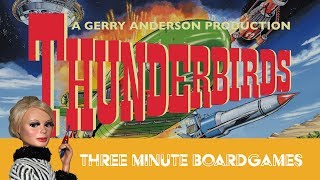
The theme of international rescue across an expansive world creates a genuine sense of adventure. Players navigate from continent to continent, venture into space, dock at orbital stations, and even establish lunar operations. The scope of the setting matches the mechanical breadth of the game. Disasters vary wildly, giant alligators in Florida, sabotaged equipment in industrial zones, stranded colonists in space, lending each scenario distinct flavor. The card artwork, featuring the iconic puppet characters rendered with surprisingly charming goofiness, reinforces the playfulness without undermining the stakes. This tonal balance allows experienced players to remain engaged by the puzzle while newcomers absorb themselves in the spectacle.
Planning and Puzzle-Solving Depth
Thunderbirds demands that players think several turns ahead, layering their actions into sequences of strategic positioning. A vehicle might need to travel across continents in anticipation of a future crisis. Team members coordinate their movement patterns like pieces on a chess board, accounting for travel times and vehicle capabilities. This forward-planning requirement transforms casual playthroughs into engaging logistical puzzles, especially in solo and two-player sessions where the cognitive weight falls heavily on individual decision-makers. The game rewards patience and systematic thinking, punishing hasty moves with cascading failures.
What Makes Thunderbirds Stand Out
Evolution Beyond the Pandemic Formula
Designer Matt Leacock is recognized as a master of cooperative mechanics, yet Thunderbirds represents a meaningful step beyond his celebrated Pandemic. While Pandemic established the firefighting cooperative genre, Thunderbirds adds dimensional complexity through its vehicle system and spatial logistics. The games share philosophical roots but diverge significantly in execution. Reviewers emphasize that despite mechanical similarities, Thunderbirds builds a much larger decision space. The addition of vehicle types, movement constraints, and the necessity of coordinating multiple team members across a sprawling world map make Thunderbirds feel like a natural evolution of cooperative design rather than a direct copy with a theme coat of paint.
Exceptional Solo and Multi-Player Flexibility
Thunderbirds functions brilliantly across player counts. In solo play, the game becomes a personal logic puzzle where single players manage multiple characters and coordinate elaborate rescue sequences turns in advance. The expansion content adds a competitive element, allowing one player to control The Hood, the series' antagonist, pitted against the cooperative team. This flexibility means the game serves different needs throughout a gaming collection. Whether someone wants a meditative puzzle experience, a family cooperative adventure, or a competitive hidden-movement variant, Thunderbirds adapts. Reviewers specifically call out how well the core mechanics scale without becoming unwieldy.
Potential Drawbacks
The Puppet Aesthetic as Barrier
Thunderbirds derives from the 1960s television series featuring puppet characters, a fact that creates an unusual friction point. While some players find this visual quirk charming and immersive, others experience genuine discomfort with the aesthetic. The card artwork renders these puppets with an intentionally humorous exaggeration, emphasizing their "goofball" qualities, but this does not universally overcome initial hesitation. Potential players raised outside the show's cultural moment may require reassurance that the aesthetic choice reflects thematic authenticity rather than production limitation.
Relative Scarcity and Limited Availability
Despite its critical reception among reviewers, Thunderbirds has not achieved mainstream commercial success. This means the game does not receive frequent reprints, making physical copies harder to locate than other popular cooperative titles. Collectors and curious players may struggle to find copies at reasonable prices, and the game's relative obscurity means fewer opportunities to demo before purchasing. For some, the barrier to entry exists not in the rules or theme but simply in the challenge of acquiring the product itself. Secondhand markets remain the primary avenue for many interested parties.
If You Enjoy Thunderbirds
Players who find Thunderbirds compelling should explore Pandemic and its variants to understand Leacock's foundational work in cooperative design. Nemo's War offers similar solo-focused cooperative satisfaction with narrative depth and variable player motivations. For those drawn specifically to the rescue-and-logistics aspects, Ticket to Ride Legacy provides a campaign structure with persistent consequences, while Dawn of the Zeds delivers intense resource scarcity and desperate decision-making in a cooperative package. Finally, Pandemic: Legacy and its sequel extend the legacy campaign concept further, though they sacrifice the repeatable puzzle-like structure that makes Thunderbirds perpetually accessible.
What Reviewers Are Saying
"I think it's better than pandemic and that's because there's an added element to this... all of these different vehicles... the game takes into account those things... you have to use a vehicle to get them there so some people might be in the wrong vehicle in the wrong location you have to swing by and pick them up and take them to Florida while dealing with all the different problems around the world."
— The Secret Cabal Gaming Podcast
"The theme is just beautifully executed and I am a thunderbirds fan from from childhood but I think it's a game that even if you don't know the theme the core gameplay and mechanics are just really fun... your turns are layers and have to be planned out in advance... it represents an evolution of mat leacock's ideas from pandemic."
— 3 Minute Board Games
"Thunderbirds is different enough... the map is not as straightforward as simply a glob because you've got like going off into space and that there's a lot more logistical stuff... the vehicles are really cool like when you add like that little mechanical wrinkle that just kind of makes the game it a little bit different."
— The Broken Meeple