/pic5854968.png)














































Tichu Deep Dive
What the Community Thinks About Tichu
Every reviewer who talks about Tichu talks about how much they play it, not just how good it looks on paper. Rolls in the Family calls it a deeply strategic game and says a group that loves it can play it endlessly without getting tired of it. Board Game Hangover rates it a nine or a ten specifically because of the team versus team aspect and how much a hand of cards ends up telling a partner without a word being spoken. Getting Games goes further, treating Tichu as essentially a favorite older game, with somewhere around two to three hundred lifetime plays and years when it got played at nearly every game night the channel attended.
The disagreement, such as it is, comes down to how approachable that depth turns out to be. Rolls in the Family frames the tension around when to call Tichu and when to just play as one of the biggest draws of the game. Getting Games frames that same depth as a real teaching obstacle, warning that the game only works if at least two new players learn it together, never just one. Board Game Hangover leans into the lighter side of that same complexity, describing the swings of the calling mechanic as a game that plays like a roller coaster.
Core Mechanics That Define Tichu
Calling Tichu
Getting Games lays out the calling mechanic as the reason the game holds up over hundreds of plays: before anyone plays a card in a hand, a player can call Tichu, a hundred point bet that they will get rid of all of their cards before anyone else, including their own partner across the table. Get it right and the team gains a hundred points; get it wrong and the team loses a hundred points instead. The channel adds that once a player has seen half of their cards, a Grand Tichu call raises the same bet to two hundred points before the rest of the hand is even looked at, usually attempted as a comeback when a team is falling behind.
Rolls in the Family frames that same call from the player's seat: the biggest tension in the game is knowing when to call Tichu and when to just play, since beating the card on the table right now might leave a hand of low singles that can never go out first. Deciding whether a hand is strong enough to call, out of every card dealt that round, is what the channel points to as the source of the game's real strategy.
Climbing and Partnership Play
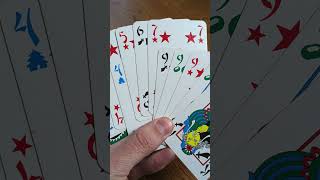
Board Game Hangover explains the climbing structure directly: when someone plays a combination, the next player has to beat it with a higher combination, and once nobody else can top it, whoever played the highest combination collects those cards as points. Getting Games adds the specifics: the deck is a standard fifty two cards plus four special cards with their own rules, combinations can be singles, doubles, or a full house, and the last player to place cards takes them and leads the next round.
Both channels tie that structure to the game's team play. Board Game Hangover describes using a played combination to signal a partner without talking, so the partner has to figure out what is being asked of them on their own turn. Rolls in the Family describes the same idea as working with a partner without talking, calling the two versus two element a ton of fun on its own.
The Tichu Experience
Strategic Tension in Every Hand
Rolls in the Family describes Tichu as a deeply strategic game where every decision feeds back into the next one: beating a card now might feel good, but if it leaves a hand of low singles, going out first is no longer possible. That constant recalculation, weighing whether to hold back or clear the table, is what the channel says makes the game endlessly replayable with the right group.
A Game That Builds Community
Getting Games ties Tichu to years of regular game nights, describing a group that played it essentially every Tuesday and Thursday until, by eleven at night, seven or eight games of Tichu were running at once among twenty to thirty people who called it "Tichu o'clock." That history of shared play, more than any single session, is what the channel points to when explaining why the game tops a personal list of favorite older titles.
What Makes Tichu Stand Out
Deep Replayability
Rolls in the Family says a group that loves Tichu can play it endlessly without getting tired of it. Getting Games backs that up with volume: somewhere around two to three hundred games played over more than a decade, enough on its own, in the channel's words, to put it at the top of a list of favorite older games.
Stakes That Reward Mastery
The calling mechanic gives Tichu stakes most climbing games do not have. Getting Games describes calling Tichu as creating incredible depths of knowledge and strategy, since a player has to judge whether their hand is the best one dealt that round before making a bet that can swing a team a hundred or two hundred points in either direction.
Potential Drawbacks
A Steep Learning Curve
Board Game Hangover flags the rules as complex for newcomers even while praising the game, and Rolls in the Family points to the calling mechanic and hand management as the parts that take real time to learn. Both channels connect that complexity to the same source: reading a full hand of cards well enough to know when to call, hold, or pass.
Teaching Is Tricky
Getting Games is the most direct about the game's biggest catch: the ideal way to teach Tichu is to have one or two people who do not know it at the table, and the channel says teaching it to just one new person does not work, no matter how many times it has been tried. That makes the game harder to introduce to a group than its depth might suggest.
If You Enjoy Tichu
Getting Games describes Tichu as a mishmash of a few other games, naming Deuces as one of the games it draws from, while adding that what Tichu becomes once those pieces come together is its own experience.
What Reviewers Are Saying
"It really is a deeply strategic game. And the 2v2 element in it is a ton of fun. We've got we've had games of tremendous comebacks."
— Rolls in the Family
"It's nine or 10 probably. It is because I really love simple card games and I love the team versus team aspect because there are ways I can pass cards to you."
— Board Game Hangover
"So likely I've played two to three hundred games of Tichu, and I think that alone is going to probably be enough to put it at the top of the list. I would not keep playing this game if I didn't love it so much."
— Getting Games