














Tinners' Trail Deep Dive
What the Community Thinks About Tinners' Trail
Reviewers describe Tinners' Trail as a Martin Wallace economic game set in nineteenth century Cornwall, where players buy mines, extract copper and tin, and sell the ore at prices that shift from round to round. Praise is consistent: the game is seen as underrated relative to its reputation. The Board Gaming Doctor placed it ninth on an underrated list, valuing its economic core and the social bluffing that emerges when players prospect land. Games by Tay ranked it 18th among its top games of 2025 and called it a hidden gem with a strong feel and real historical background. Chairman of the Board and its ranking videos have returned to the game repeatedly, with one monthly review naming it the best game of that month.
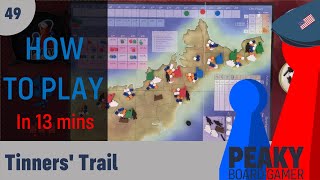
Agreement centers on the auctions, the market, and the theme. Disagreement centers on rules complexity and replayability. Picky Board Gamer presents the rules as fairly simple for a game with a serious theme and walks through seven phases per round. Board Gaming Ramblings had a rougher first session, describing many rule mistakes and parts of the game that made no sense to them, although they enjoyed some of it and wanted another attempt. The Board Gaming Doctor adds that replayability is less varied than in Brass, which is the main reason it ranks lower for that reviewer.
The Getting Games channel discussed the updated edition from its rulebook and box rather than a recent table session. Their summary is that the reimplementation replaces die-rolled board resources with tiles, adds dual-use cards that provide information before an auction, and includes an arsenic expansion.
Core Mechanics That Define Tinners' Trail
Auction-Based Mine Acquisition
The build mine action drives the opening of the game. The active player proposes an area for auction, and bidding moves clockwise with each player either raising or passing. A player who passes cannot rejoin, and the last remaining bidder wins the area, pays the price, and places one of their mines there. Picky Board Gamer notes that the winner alone pays the time cost of the action, not the player who proposed the auction. If the proposed area is empty, dice are rolled to populate it after the win. Games by Tay adds that the tiles are face down, so a bidder may win a mine whose contents are unknown until the tile is turned over.
Time Track Turn Order
Turn order is not fixed. Each action costs time points that move a player's marker along a track, and the next player to act is the one furthest back. Picky Board Gamer explains that after moving, a marker goes to the topmost empty space in its column, so a player who spends little time can keep acting until others pass them. Chairman of the Board describes the same rule from the other side: a player leading the track does not get another turn until the others overtake them. Chairman of the Board's 2023 list adds that a player behind on that order can keep taking turns. Each action therefore trades speed against control of the next move, and the mechanism sets the game's pacing.
The Tinners' Trail Experience
Speculative Tension
Reviewers describe the game as a speculative exercise. Chairman of the Board says that when bidding on a mineshaft, the player knows little about it and cannot tell whether it will be rich or a dud, which makes the bidding feel very exciting. Mines also fill with water as they are worked, so each extraction becomes more expensive. Chairman of the Board notes that players must buy pumps and boats to manage this, which means cash is always under pressure. The market adds to the tension because tin and copper values change each round. Games by Tay summarizes the choice as one between copper and tin when prices move in their favor.
Social Brinkmanship
The Board Gaming Doctor describes the feel of prospecting as a bluff. A player presents an area as promising, other players invest in it, and the tile may reveal far less than they expected. This makes the game feel social as well as economic. The reviewer says this interaction keeps the game economic while still rewarding table talk, and expects it to work especially well around a live table rather than on Board Game Arena.
What Makes Tinners' Trail Stand Out
Hidden Tiles and Bluffing
The face-down land is the feature most often singled out. Games by Tay describes the moment of choosing whether to bid on a tile that is unknown, followed by the reveal of its resources. That risk is what makes the auction feel like brinkmanship. The Board Gaming Doctor identifies the same hidden information as the source of its bluffing, noting that other players' purchases can make a bluff pay off or fail.
Historical Cornwall Setting
Games by Tay praises the rulebook's historical notes on Cornish mining and the game's account of how Cornwall's mining technology spread to mining regions around the world. The reviewer shares an anecdote in which a co-worker's ancestors were Cornish miners who emigrated to Australia, and the game's history helped explain that connection. The reviewer also notes that the theme gives the game a grounded feel rather than a purely abstract one.
Potential Drawbacks
Rules Density and Learning Curve
The rules are the most frequently raised concern. Picky Board Gamer lays out auctions, time costs, production, water removal, selling ore, and tie-breakers, and the game's phase structure has many interlocking parts. Board Gaming Ramblings found the first play difficult to follow and described many mistakes. Their reaction suggests that the game rewards a second session after the rules are internalized, and that a first session can feel confusing.
Limited Variety and the Shadow of Brass
The Board Gaming Doctor finds the replayability less varied than in Brass, and that difference is the main reason it sits lower on that reviewer's list. Games by Tay expects the game to labor in the shadow of Brass, which the reviewer calls its older sibling. Both reviewers treat Brass as the benchmark for Wallace's economic designs, and both suggest Tinners' Trail is the more modest of the two.
If You Enjoy Tinners' Trail
Players who enjoy Tinners' Trail's auction-driven economy will find a related experience in Brass, which reviewers use as the reference point for Martin Wallace's economic design. The Board Gaming Doctor names Brass and Via Nebula as Wallace games it enjoys, and it ranks Tinners' Trail below Brass for replay variety. Players who want a Wallace economic game with a wider sense of replay might start with Brass, then return to Tinners' Trail for its tighter, more speculative mine-buying. Chairman of the Board grouped Brass and Anno 1800 with Tinners' Trail among recent Wallace titles it was getting to the table, which makes Anno 1800 a reasonable next step for players who enjoy long-term economic planning.
What Reviewers Are Saying
"When it's your turn, you can you can look at a tile and then you can start an auction for that tile. So, there's a lot of brinkmanship going on."
Matt Jay, Games by Tay
"I love the scoring system here as the earlier in the game you can trade your money in for more points or you can try and keep hold of your money for future rounds but not get as many points in return for that money."
Chairman of the Board
"We have played it once but we played it horribly wrong and it was not that fun yeah we did some rules mistakes like a lot of them yes so we have to play it again to get a feel of the game."
Board Gaming Ramblings